Asset Forfeiture and Crypto Seizures by Country: Global Trends in 2025-2026
 Jul, 29 2026
Imagine waking up to find your entire life savings-stored as Bitcoin or Ethereum-gone. Not hacked by a stranger on the dark web, but seized by a government agency because of a regulatory technicality or a suspected crime. This isn't science fiction anymore. It is the new reality of asset forfeiture in the digital age. In 2025, the landscape shifted dramatically. Governments stopped just freezing accounts; they started hoarding digital gold.
The United States made headlines in March 2025 by establishing a Strategic Bitcoin Reserve, which centralizes over 207,000 BTC worth roughly $17 billion in forfeited cryptocurrencies. This was not a minor policy tweak. It was a fundamental change in how sovereign nations view seized digital property. No longer are these assets immediately liquidated to fund police budgets. Instead, they are held as strategic reserves, hedging against inflation and funding future enforcement actions. If you hold crypto, understanding where your assets might end up-and why-is no longer optional. It is essential for risk management.
The New Era of Government Crypto Holdings
For years, the standard procedure for law enforcement was simple: seize the crypto, sell it off, and put the cash into the general fund. That model broke down when the value of Bitcoin skyrocketed. Selling billions of dollars worth of BTC at once would flood the market, crashing prices and potentially causing losses for the very governments holding them. The solution? Hold.
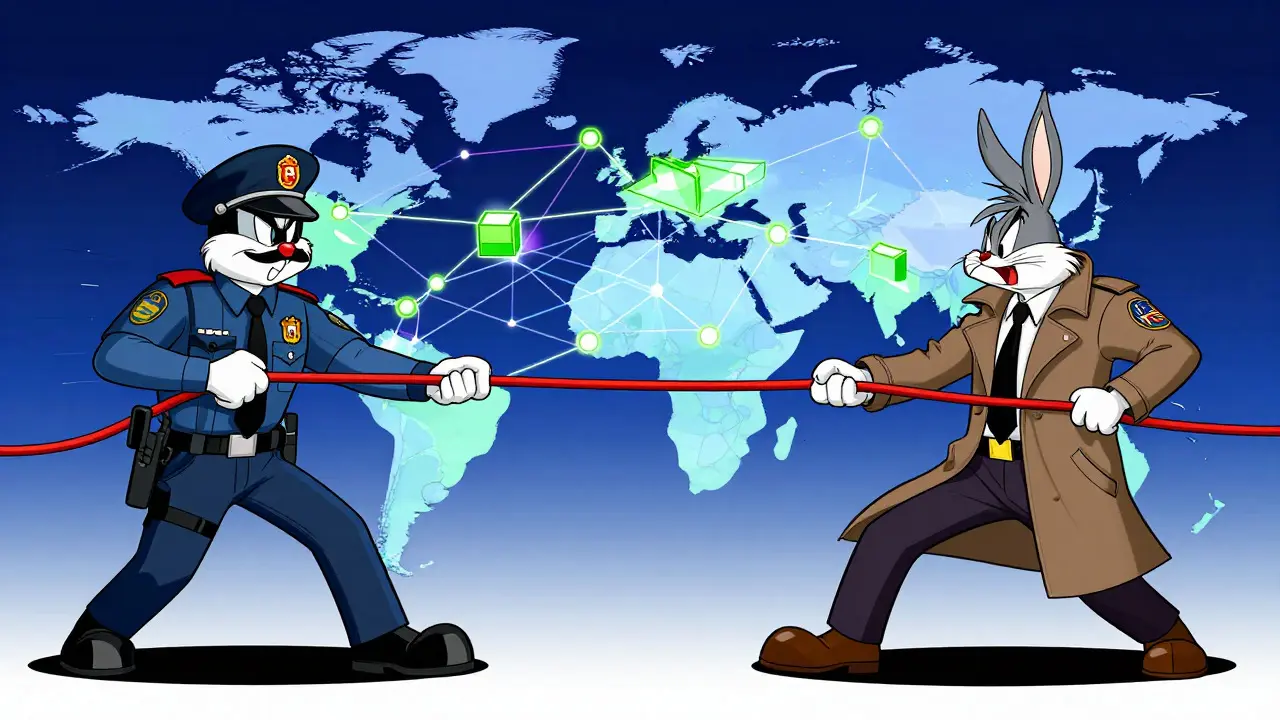
This shift turned the U.S. Treasury into one of the largest holders of Bitcoin globally. The Strategic Bitcoin Reserve acts as a hedge against inflation and a tool for national security. But this is not an American phenomenon alone. Other jurisdictions are watching closely. The Spanish Guardia Civil conducted a landmark seizure operation in 2025 with direct support from U.S. law enforcement. This highlights a growing trend: international cooperation in digital asset recovery. When you move money across borders digitally, you are now navigating a web of coordinated enforcement agencies.
Why does this matter to you? Because the definition of "forfeitable" is expanding. Courts are increasingly recognizing that forfeiture laws apply to non-fungible tokens (NFTs) and decentralized finance (DeFi) tokens. If your DeFi yield farming strategy touches a sanctioned entity, or if your NFT wallet is linked to a mixer used by criminals, your assets could be flagged. The net is widening.
Global Crime Patterns: Who Is Getting Hit?
To understand seizures, you have to look at theft. You cannot seize what has not been stolen. The first half of 2025 saw over $2.17 billion stolen from cryptocurrency services. That figure alone is more devastating than the entirety of 2024. The geographic patterns of this theft reveal where enforcement agencies are focusing their efforts.
| Metric | Leading Regions/Countries |
|---|---|
| Highest Victim Counts | United States, Germany, Russia, Canada, Japan, Indonesia, South Korea |
| Highest Value Stolen Per Victim | UAE, Chile, India, Lithuania, Iran, Israel, Norway |
| Fastest Growth in Victimization | Eastern Europe, MENA (Middle East & North Africa), CSAO (Central/Southern Asia & Oceania) |
| Dominant Asset Type Stolen | North America: Bitcoin & Altcoins; Europe: Ethereum & Stablecoins |
Notice the distinction. North America dominates in total Bitcoin and altcoin theft. Europe leads in Ethereum and stablecoin theft. This suggests different criminal behaviors. Attackers in Europe may prefer stablecoins because they are easier to launder through traditional banking channels or DeFi protocols without the volatility of Bitcoin. Meanwhile, high-value targets in the UAE and India suggest sophisticated phishing or insider attacks targeting wealthy individuals rather than mass-scale exchange hacks.
Enforcement follows the money. If Eastern Europe and MENA regions experienced rapid growth in victim totals, expect increased scrutiny and potential seizure operations in those areas in 2026. Agencies are building specialized units, like the U.S. Cyber and Emerging Technologies Unit, to track these cross-border flows. They are getting better at tracing transactions on the blockchain. Your anonymity is eroding.
Regulatory Shifts: From Punishment to Compliance
In early 2025, the United States climbed to sixth place globally for digital asset regulation. This wasn't due to stricter bans, but rather clearer rules. President Trump's executive order, "Strengthening American Leadership in Digital Financial Technology," created the President's Working Group on Digital Asset Markets. The goal? To mandate that all federal agencies account for their crypto holdings and to establish structured compliance frameworks.
The Securities and Exchange Commission (SEC) and the Commodity Futures Trading Commission (CFTC) shifted from an "enforcement-first" approach to one focused on structured compliance. They relaunched the Crypto Task Force and clarified token classifications. For businesses, this means less ambiguity. For criminals, it means fewer loopholes. The introduction of stricter KYC (Know Your Customer) and AML (Anti-Money Laundering) requirements, along with stablecoin reserve mandates, makes it harder to hide illicit funds.
Consider Circle, the issuer of USDC. Their IPO in April 2025, alongside Coinbase listing on Nasdaq, signals institutional maturity. Publicly traded companies face intense scrutiny. They will comply with every subpoena and freeze request. If your funds are in a centralized exchange, you are subject to these corporate compliance pressures. Decentralized wallets offer more privacy, but they also lack the legal protections of insured bank accounts. When a seizure happens, there is no customer service line to call.
Legal Status Across Borders: A Patchwork Quilt
If you think regulations are uniform, think again. The legal status of cryptocurrency varies wildly from country to country. This patchwork creates arbitrage opportunities for criminals but headaches for users trying to stay compliant.
- Mauritius: Treats cryptocurrencies as regulated Digital Assets under the Financial Services Act 2007. Full legality, but investors get no statutory compensation if things go wrong.
- South Africa: The Reserve Bank declared virtual currencies have "no legal status" back in 2014. However, the tax office treats Bitcoin as an intangible asset. You can own it, but you must pay taxes on it.
- Angola: Fully legal, despite government officials advising against its use. No specific legislation prohibits it.
- Namibia: More restrictive. The Bank of Namibia stated in 2017 that exchanges are not allowed and crypto cannot be used for payments.
Then look at adoption leaders. Ukraine topped the 2025 Global Crypto Adoption Index, followed by Moldova, Georgia, Jordan, and Hong Kong SAR. High adoption doesn't always mean high regulation. In fact, countries with weak traditional banking systems often see higher crypto usage. Enforcement agencies in these regions are playing catch-up. They may rely more heavily on international cooperation, asking partners like the U.S. or EU to help trace and seize assets.

Risks for Investors and Users
What does this mean for your portfolio? First, diversification is not just about asset classes; it is about jurisdiction. Holding all your crypto on an exchange based in a single country exposes you to that nation's legal risks. If that country decides to freeze assets or enforce strict capital controls, you are locked out.
Second, understand the concept of "commingling." If you mix clean crypto with funds from a dubious source, or if you send funds to a wallet that later receives dirty money, your entire balance could be tainted. Law enforcement often seizes the whole wallet, not just the specific coins involved in the crime. Proving ownership and innocence requires meticulous record-keeping.
Third, watch for procedural safeguards. Proposed reforms in the U.S. and elsewhere aim to introduce more transparency in forfeiture cases. Currently, civil asset forfeiture allows the government to seize property without necessarily charging the owner with a crime. This "guilty until proven innocent" dynamic is particularly harsh in the crypto world, where proving control over a private key can be technically complex.
Future Outlook: What to Expect in 2026
The trend is clear: retention over liquidation. Governments realize that holding Bitcoin is a smarter financial play than selling it during a bear market. Expect more countries to announce similar strategic reserves. We may see a global network of government-held crypto vaults, monitored by AI-driven analytics teams.
International cooperation will deepen. The Spanish-U.S. joint operation is a preview. Imagine a scenario where a hacker in Brazil steals from a user in Japan, moves funds through a mixer in Estonia, and tries to cash out in Dubai. By 2026, real-time data sharing between these jurisdictions could lead to near-instantaneous freezes. Speed is the new weapon in asset forfeiture.
For the average user, the advice remains consistent but urgent. Use hardware wallets. Keep detailed records of your transaction history. Understand the tax implications in your country. And remember: in the eyes of the law, crypto is property. And property can be taken.
Can the government seize my crypto without a conviction?
Yes. Under civil asset forfeiture laws in many jurisdictions, including the U.S., the government can seize property suspected of being involved in criminal activity without charging the owner with a crime. The burden of proof often shifts to the owner to prove their assets are legitimate.
What is the Strategic Bitcoin Reserve?
Established in March 2025, the Strategic Bitcoin Reserve is a U.S. government initiative to retain forfeited cryptocurrencies rather than liquidating them. It currently holds over 207,000 BTC, serving as a hedge against inflation and a source of funding for law enforcement.
Which countries have the highest crypto theft rates?
In H1 2025, the U.S., Germany, Russia, Canada, Japan, Indonesia, and South Korea had the highest number of victims. However, the UAE, Chile, India, and Lithuania saw the highest value stolen per victim, indicating targeted attacks on wealthier individuals.
Is crypto legal in Namibia?
Crypto is largely restricted in Namibia. The Bank of Namibia has stated that cryptocurrency exchanges are not allowed and that crypto cannot be accepted as payment for goods and services, though personal ownership is not explicitly criminalized in all contexts.
How does international cooperation affect crypto seizures?
Agencies are increasingly working together across borders. For example, the Spanish Guardia Civil collaborated with U.S. law enforcement in a major 2025 seizure. This trend means that moving funds internationally does not guarantee safety, as data sharing and joint operations are becoming more common.