Bear Market Survival Strategies for Crypto Investors: How to Stay Strong When Prices Crash
 Jan, 14 2026
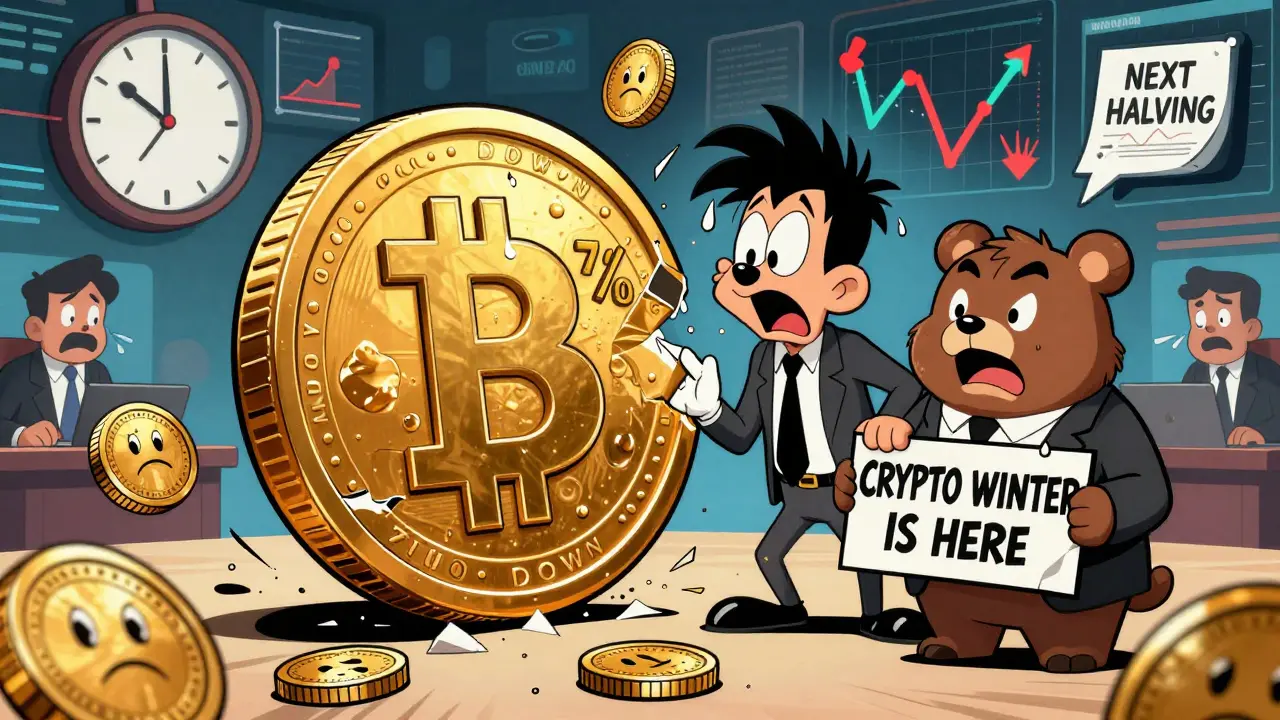
When Bitcoin drops 77% in less than a year, and your portfolio loses half its value overnight, it’s not just a market correction-it’s a test of your discipline. The crypto bear market isn’t a glitch. It’s a feature. And if you’re still holding onto hope that prices will bounce back tomorrow, you’re already behind. The truth? Bear markets don’t end because someone says they’re over. They end when the last person panics and sells. Your job isn’t to predict the bottom. It’s to survive until the next cycle starts.
Understand What a Crypto Bear Market Really Is
A bear market in crypto isn’t just a price drop. It’s a sustained collapse-typically 20% or more over three months, but often much worse. Historical data shows Bitcoin has lost 80-88% of its value in past bear markets. The last one, from November 2021 to December 2022, saw Bitcoin fall from $68,789 to $15,590. That’s not a bad day. That’s a 77% crash. And it wasn’t unusual. Crypto markets are smaller and more volatile than stocks. That means drops are sharper, and recoveries take longer. On average, crypto bear markets last about 10 months. Some stretch beyond a year. The term “crypto winter” isn’t just a catchy phrase-it’s a reality. During this time, exchanges collapse, tokens die, and hype turns to silence. But here’s the key: these crashes aren’t random. They follow cycles, often tied to Bitcoin’s halving events. After each halving, prices surge for 6-12 months, then enter a long, grinding decline. Knowing this pattern removes the fear of the unknown.Stop Trying to Time the Bottom
Everyone wants to buy at the bottom. But the bottom isn’t a price. It’s a feeling. It’s when the news is awful, your friends are quitting, and your portfolio feels like a graveyard. That’s when the smart money starts buying-not because they know the exact number, but because they know fear creates opportunity. Trying to catch the bottom is like trying to catch a falling knife. You’ll get cut. In 2022, Bitcoin dropped from $30,000 to $16,000, then bounced to $19,000, then back to $15,000. People who bought at $19,000 thought they got the bottom. They didn’t. They bought too early. The real bottom came months later. And if you waited for “proof” that the market had turned, you missed it entirely. Instead of timing, focus on accumulation. Buy small. Buy often. Don’t wait for the perfect moment. Wait for the perfect mindset.Dollar-Cost Averaging (DCA) Is Your Best Friend
DCA isn’t sexy. It doesn’t make headlines. But it’s the most reliable strategy in a bear market. Here’s how it works: you invest a fixed amount-say, $100-every week, no matter what the price is. When Bitcoin is at $20,000, you get 0.005 BTC. When it drops to $16,000, you get 0.00625 BTC. When it hits $12,000, you get 0.0083 BTC. Over time, your average cost per coin drops. And when the market turns, you’re already positioned. Swan Bitcoin’s 2022 case study showed investors who DCA’d $100 weekly into Bitcoin during the 2018-2019 bear market made 223% returns by 2021. Why? Because they bought more when prices were low. They didn’t try to guess. They just showed up. Set up automatic purchases. Use a platform that lets you buy weekly or biweekly. Don’t check your balance every day. Let compounding do the work.Keep Cash Ready-But Not in Cash
Having cash on the sidelines isn’t just smart. It’s essential. But “cash” in crypto doesn’t mean sitting in USD. It means holding stablecoins-USDC, USDT, DAI. These are digital dollars pegged 1:1 to the U.S. dollar. They don’t gain value, but they don’t lose it either. During the FTX collapse in November 2022, panic hit hard. Prices plunged. But those who had 20-30% of their portfolio in stablecoins didn’t get wiped out. They had fuel to buy when others were frozen. Fidelity’s data shows investors who held 25% in USDC during that crash ended up with 37% higher returns during the recovery. Don’t wait until the panic to buy stablecoins. Start now. Keep them in a non-custodial wallet-never on an exchange. You need control, not promises.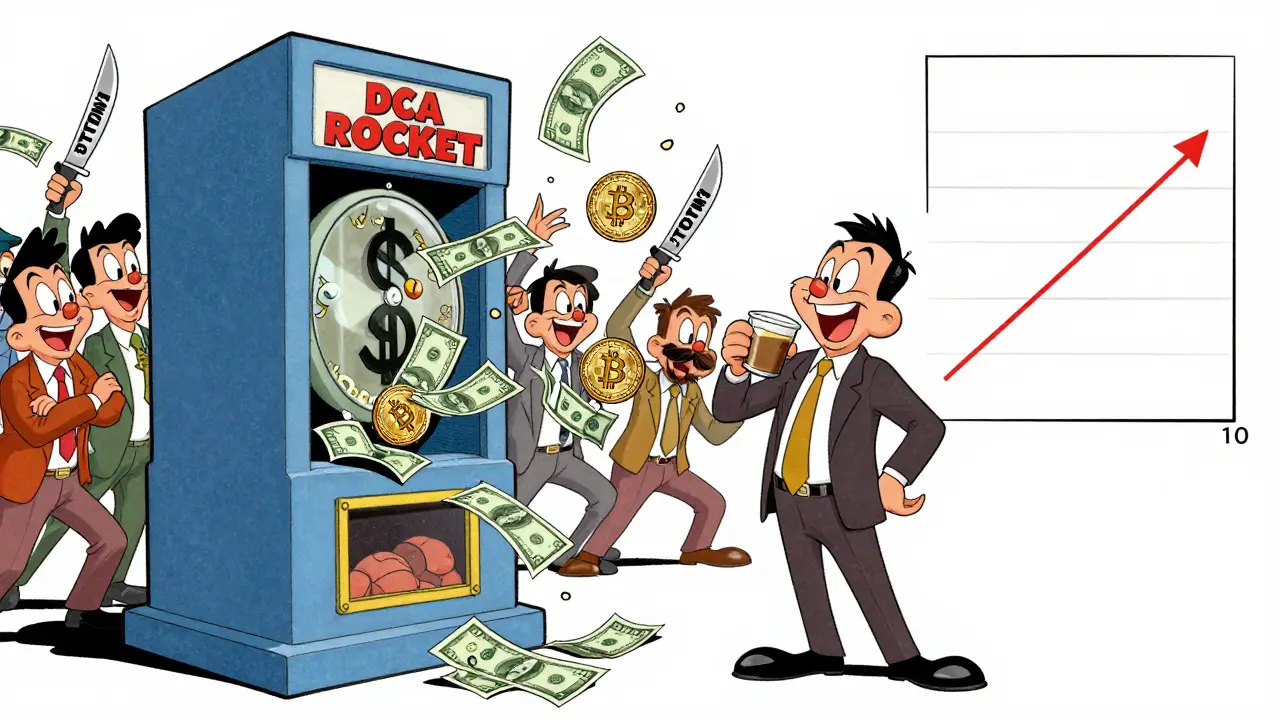
Use the Fear & Greed Index-But Don’t Trust It Blindly
The Fear & Greed Index is a simple tool that measures market sentiment on a scale of 0-100. Below 30? Fear. Above 70? Greed. During the 2022 bear market, it dropped below 20 multiple times. And every single time, it signaled a local bottom. Glassnode research found that every dip below 30 aligned with a market low. Coinbase Institutional found that buying Bitcoin when the index fell below 25 generated 147% annualized returns over the next year across three market cycles. But here’s the catch: the index doesn’t tell you when to sell. It tells you when to buy. When it hits 20, that’s not a signal to panic. It’s a signal to act. Keep a spreadsheet. Track the index weekly. When it drops below 30, make a small purchase. When it drops below 20, make a bigger one.Focus on Cost Basis, Not Current Price
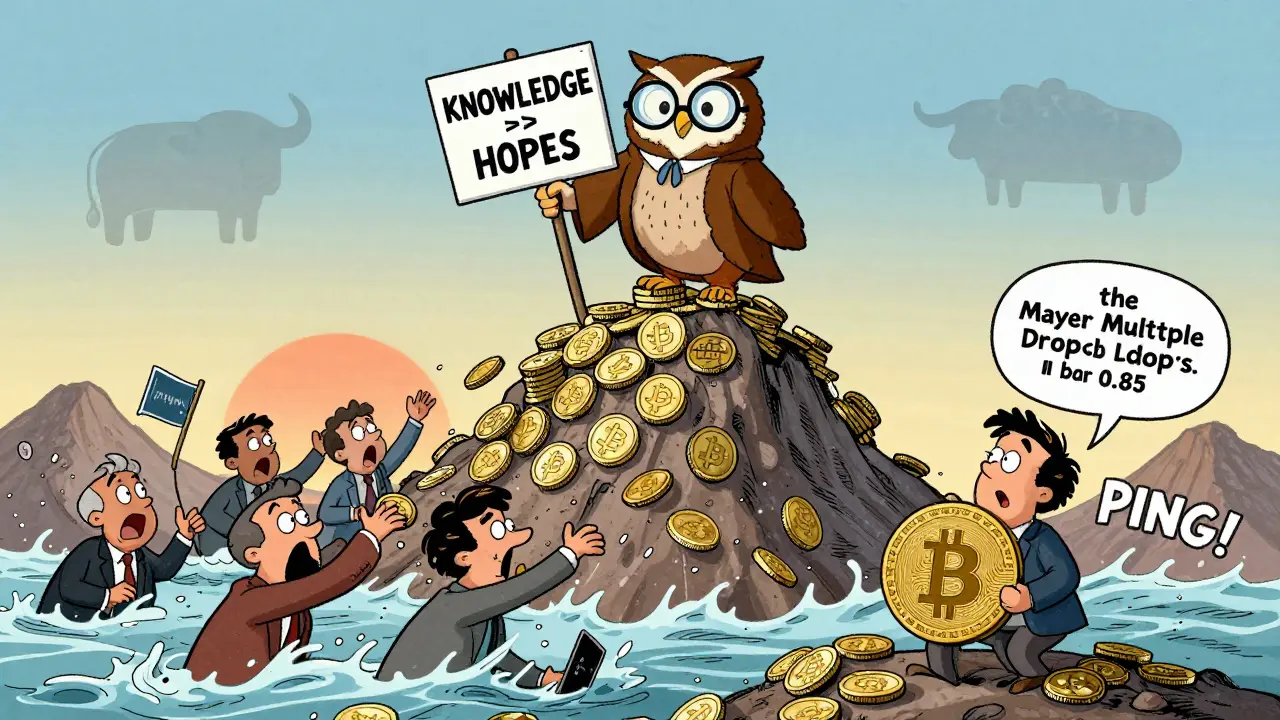
Your portfolio’s current value is irrelevant. What matters is your average cost per coin. If you bought Bitcoin at $40,000 and it’s now at $18,000, you’re not broke-you’re just waiting. The market hasn’t changed your cost. Only your emotions have. The Mayer Multiple is a powerful tool for this. It’s Bitcoin’s price divided by its 200-day moving average. When it drops below 0.85, it’s historically been a strong buy signal. In 2015, 2019, and 2023, every major bottom happened when the Mayer Multiple was under 0.85. Track this number. When it drops below 0.85, it’s not a reason to panic. It’s a reason to buy. This isn’t magic. It’s math.Diversify-But Not the Way You Think
Most people think diversification means buying 20 altcoins. That’s not diversification. That’s gambling. True diversification means spreading your risk across asset classes. A smart portfolio in a bear market might look like this:- 30% Bitcoin
- 20% Ethereum
- 20% high-quality altcoins (like Solana, Cardano, or Polkadot with strong fundamentals)
- 20% stablecoins
- 10% traditional assets (gold, S&P 500 ETFs, or bonds)
Shaun Beckford
January 14, 2026 AT 17:04Let’s be real-this whole ‘DCA through the bear’ thing is just retail investor fanfiction. The whales aren’t buying $100 chunks-they’re front-running your moves while you’re setting up auto-buy schedules. You think you’re accumulating? You’re just feeding the liquidity pool for the VCs who dumped at $60K.
Anna Gringhuis
January 15, 2026 AT 00:57Wow. So you’re telling me the solution to losing half my life savings is to keep throwing money into a black hole while reading Binance Academy articles? I appreciate the optimism, but I’d rather be wrong than broke. This reads like a crypto influencer’s LinkedIn post written by someone who’s never actually held Bitcoin through a real crash.
Deb Svanefelt
January 15, 2026 AT 16:40There’s a quiet poetry in the bear market-it strips away the performative, the performative, the performative. What remains is not wealth, but wisdom. The coins you hold aren’t assets; they’re artifacts of your conviction. The Mayer Multiple isn’t a tool-it’s a mirror. And when it dips below 0.85, it doesn’t whisper ‘buy.’ It asks: ‘Do you still believe in time?’
Most people mistake volatility for meaning. But the market doesn’t care about your spreadsheets. It only cares whether you’ve outlasted your fear.
Chris Evans
January 16, 2026 AT 09:51Let me reframe this: You’re not investing in Bitcoin-you’re participating in a decentralized monetary experiment that’s currently undergoing a Darwinian purge. The 2022 crash wasn’t a correction-it was a systemic pruning. The projects that survived? They’re the ones with real node distribution, non-custodial wallets, and tokenomics that don’t rely on yield farming pump-and-dumps.
And let’s not pretend DCA is ‘safe.’ It’s just slower suicide. The real play is stacking sats in non-KYC wallets while the CEXs melt down. The next bull run won’t be driven by ETFs-it’ll be driven by self-custody evangelists who never trusted a centralized exchange.
Bryan Muñoz
January 17, 2026 AT 00:32They're lying to you. The halving is a scam. The ETFs are a front. The whole thing is being manipulated by the Fed and BlackRock to lure in the sheeple. You think you're buying Bitcoin? You're buying a ticket to the next flash crash. They'll crash it again at $10K and call it 'correction.' Stay out. Buy gold. Real gold. Not crypto gold.
Christina Shrader
January 18, 2026 AT 13:46I’ve been holding since 2017. I didn’t sell at $15K. I didn’t panic at $18K. I didn’t even check my portfolio for six months. And now? I’m up 300%. This isn’t about timing. It’s about showing up. Keep going.
Anthony Ventresque
January 19, 2026 AT 20:29Just wanted to say thank you for writing this. I’ve been stuck in analysis paralysis since last year, and this actually gave me a roadmap-not just hope, but a plan. I started DCAing $50/week last week. Feels weird to be buying when everything looks like a dumpster fire, but… maybe that’s the point.
Lauren Bontje
January 21, 2026 AT 11:29Of course you’re telling Americans to DCA. Meanwhile, inflation’s eating your paycheck and your rent doubled. You think your $100/week Bitcoin buys are gonna save you? Go buy a house. Or a farm. Or a gun. Anything but this digital fantasy.
Chidimma Okafor
January 22, 2026 AT 11:26This is one of the most thoughtful breakdowns I’ve read in years. The emphasis on knowledge over speculation is exactly what’s missing in crypto discourse. I’ve shared this with my study group in Lagos-we’re all starting DCA with our mobile airtime credits converted to USDC. It’s not about wealth. It’s about sovereignty.
Patricia Chakeres
January 23, 2026 AT 12:47Oh please. The ‘Mayer Multiple’ is just a lagging indicator dressed up as prophecy. And the Fear & Greed Index? That’s just a sentiment bot trained on Twitter rage. You’re not investing-you’re following algorithmic noise dressed as wisdom. The real players aren’t reading blog posts. They’re in private Telegram groups with zero public trace.
nathan yeung
January 24, 2026 AT 19:46bro i just bought 0.002 btc every friday for 6 months. i dont check it. i dont care. i just keep doing it. now its 2x what i paid. i dont know what mayer multiple is. i just kept going.
Katherine Melgarejo
January 25, 2026 AT 12:39So let me get this straight: the secret to surviving crypto is… to keep buying when everything sucks? Wow. Groundbreaking. Next you’ll tell me the sun rises in the east. I’m just here wondering how many people actually followed this advice and still lost everything.
Ashlea Zirk
January 27, 2026 AT 04:52While the advice here is generally sound, one critical omission: the tax implications of DCA and rebalancing. In the U.S., each purchase and sale triggers a taxable event-even if you’re not withdrawing. Many investors fail to account for capital gains reporting across multiple wallets and exchanges. Consult a crypto-savvy CPA before automating anything.
Liza Tait-Bailey
January 28, 2026 AT 07:36im so done with crypto. i lost my rent money on shiba. now im trying to buy stablecoins but my exchange is down. why is everything so hard?? 😭
Stephanie BASILIEN
January 28, 2026 AT 15:59It is worth noting that the historical data cited here is inherently biased by survivorship-Bitcoin’s resilience does not imply that all cryptocurrencies will recover. Indeed, over 90% of altcoins launched since 2017 have been abandoned, their contracts rendered inert. To conflate Bitcoin’s trajectory with the broader ecosystem is a logical fallacy of the highest order.
Moreover, the assertion that institutional adoption mitigates volatility is empirically unsupported. The ETF approvals were accompanied by increased correlation to equities, thereby introducing systemic risk previously absent. One must question whether the crypto market is becoming more resilient-or merely more entangled with the very system it purported to disrupt.
Vinod Dalavai
January 29, 2026 AT 09:39bro i been holding since 2021. i bought at 40k. now its 18k. i dont stress. i just keep working. crypto is just a side thing. i got my job, my family, my bike. if it goes to zero? i lost a side hustle. if it goes to 100k? cool. i just chill.
Bharat Kunduri
January 31, 2026 AT 05:44lol this whole thing is a joke. dca? stablecoins? you think this is a game of chess? its a casino with a blockchain theme. the only thing you should be doing is buying moon tickets and praying to satoshi
Chris O'Carroll
January 31, 2026 AT 07:16Everyone’s acting like this is some deep spiritual journey. Nah. It’s just a financial rollercoaster with bad UI. I’m not ‘accumulating wisdom’-I’m just trying not to cry when I see my balance. And yes, I still check it every hour. Don’t judge me.
Michael Jones
February 1, 2026 AT 18:34Anna, you’re right to be skeptical. But this isn’t about blind faith-it’s about systems. DCA works because it removes emotion from decision-making. That’s not magic. That’s behavioral economics. And if you’re not ready to treat this like a long-term business, then maybe crypto isn’t for you. Not because it’s risky-but because you’re not ready to be disciplined.
Kelly Post
February 2, 2026 AT 04:40Michael, thank you for saying that. I’ve been trying to explain this to my friends who think ‘just hold’ is naive. But discipline isn’t passive. It’s active restraint. It’s choosing to buy when your stomach is in knots. It’s not about hoping-it’s about showing up, again and again, even when you’re terrified.
I started DCAing in January. I cried the first week. I still check my wallet. But now? I feel like I’m building something real. Not a get-rich-quick scheme. A foundation.
Jason Zhang
February 2, 2026 AT 07:49Most of this is just recycled advice from 2018. The only thing new is the jargon. And let’s be honest-half the people following this advice are just trying to feel better about their losses. Real wealth isn’t built by buying BTC every Tuesday. It’s built by building things people actually use.
Nishakar Rath
February 3, 2026 AT 10:16Stop promoting this cult. Bitcoin is a Ponzi. The halving is a marketing gimmick. The ETFs are a trap. The only people winning are the ones who sold at the top. Everyone else is just paying the fees to keep the system running. Wake up.
Telleen Anderson-Lozano
February 4, 2026 AT 12:22There’s a difference between patience and passivity. DCA isn’t about ignoring the market-it’s about respecting its rhythm. I’ve watched people buy $10,000 worth of BTC at $25K, then panic-sell at $18K because they didn’t ‘time it right.’ Meanwhile, the person who bought $100/week for a year? They’re laughing. Not because they’re smart. But because they didn’t let fear write their story.
And the stablecoins? They’re not ‘cash.’ They’re ammunition. You don’t carry ammo because you expect to shoot tomorrow. You carry it because you know, someday, you’ll need to.
This isn’t about getting rich. It’s about staying free. Free from the need to panic. Free from the illusion of control. Free from the belief that someone else’s timeline matters more than your own.
And if you’re still reading this? You’re already ahead of 90% of the people who started this journey.
Rod Petrik
February 5, 2026 AT 22:10they're watching you. every time you buy btc they track it. the fed has a crypto surveillance program. they're waiting for you to accumulate so they can freeze your wallet. dont trust any of this. buy silver. hide it. burn the receipts.