TVL Distribution Across Blockchain Networks in 2025
 Dec, 4 2025
TVL Distribution Calculator
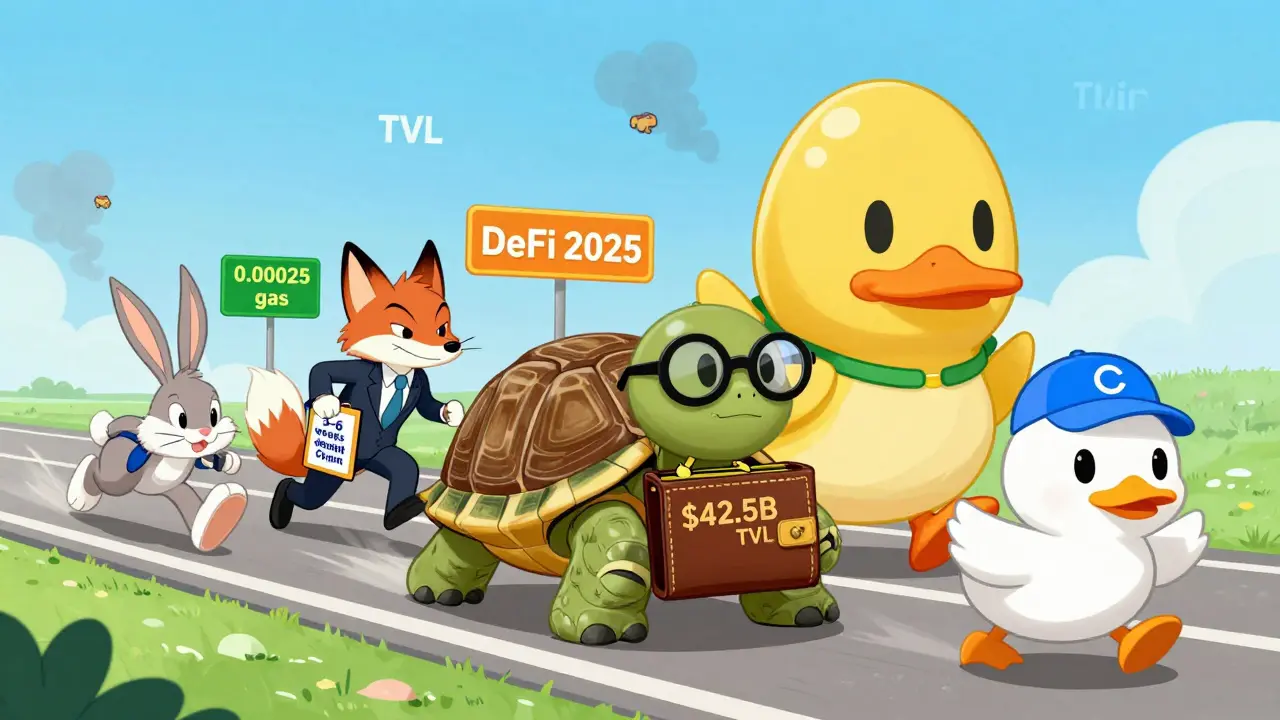
By early 2025, the total value locked (TVL) in decentralized finance had crossed $100 billion for the first time. That number isn’t just a headline-it’s the heartbeat of the entire DeFi ecosystem. TVL tells you where real money is sitting, which protocols people trust, and which blockchains are winning the race for adoption. But here’s the thing: TVL isn’t evenly spread. It’s concentrated. And that concentration is shifting.
Ethereum Still Leads, But It’s Not the Whole Story
Ethereum holds about $42.5 billion in TVL, which is just over 41% of the entire DeFi market. That’s massive. But it’s also the lowest share it’s had since 2021. For years, Ethereum was the only game in town. If you wanted to lend, borrow, or trade crypto without a middleman, you went to Ethereum. Now, users have choices-and many are leaving.
Why does Ethereum still hold on? Security. Developers. Liquidity depth. Institutions like JPMorgan and Fidelity use TVL as a proxy for safety. The higher the TVL, the harder it is for a protocol to get hacked or collapse. Ethereum’s network has survived multiple bear markets, hacks, and price crashes. Its smart contracts are audited, battle-tested, and trusted. That’s why, even with gas fees averaging $1.85 during peak times, 63% of DeFi users still choose it because they know it won’t vanish overnight.
Solana’s Rise: Speed Over Security
Solana’s TVL hit $18.7 billion in early 2025, making it the second-largest chain by a wide margin. It didn’t get there by being safer than Ethereum. It got there by being faster and cheaper. Transactions on Solana cost $0.00025 on average. Settlements happen in under a second. That’s why traders, yield farmers, and NFT collectors flocked to it.
But there’s a trade-off. Solana has had six major network outages since 2022. Each one wiped out millions in locked value temporarily. Users didn’t lose their funds, but they couldn’t access them for hours. Still, the growth kept coming. Twitter sentiment analysis from Nansen shows that 81% of positive mentions about Solana included words like “fast,” “cheap,” or “no waiting.” For many, that’s enough. Especially when you’re trading $500,000 in a day and every second of delay costs you money.
BNB Smart Chain: The Easy Switch
BNB Smart Chain sits at $12.3 billion in TVL. It’s not flashy. It doesn’t have the security reputation of Ethereum or the speed of Solana. But it’s the easiest place for Ethereum developers to move. The tooling is nearly identical. Solidity works here too. Deployment time drops from 8-12 weeks on Ethereum to just 3-6 weeks on BSC. That’s why so many DeFi projects launched here first-especially those targeting Asia.
It’s also the chain with the fewest validator nodes-only 41. That makes it more centralized than Ethereum or Solana. But for users who don’t care about decentralization as long as their trades go through, it’s a sweet spot. And with Binance’s marketing muscle behind it, BSC keeps pulling in new capital.
TRON: The Stablecoin Powerhouse
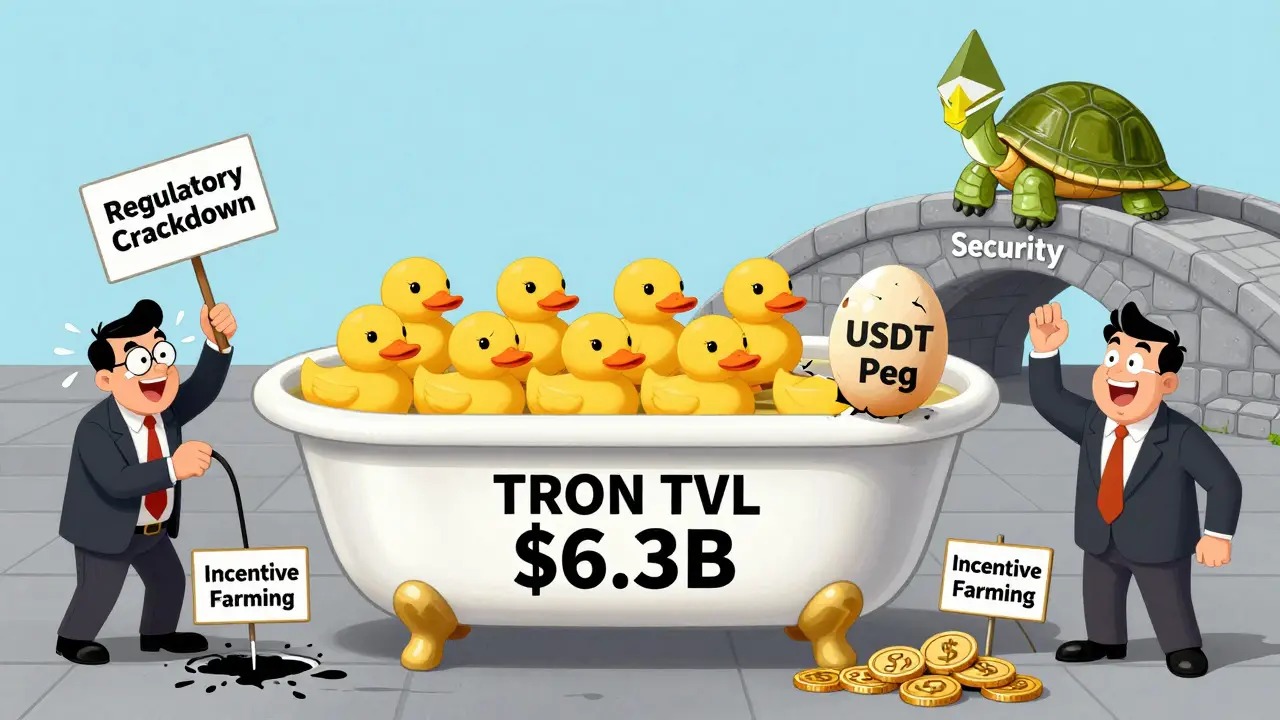
TRON’s TVL is $6.3 billion, and 98% of it is in USDT. That’s not a coincidence. TRON became the dominant chain for stablecoin transfers because it’s cheap, fast, and has no real regulatory hurdles in key markets like China and Southeast Asia. It processes 58% of all USDT transactions globally. That’s more than Ethereum, Bitcoin, and all other chains combined.
But here’s the risk: if USDT ever depegs, TRON’s TVL collapses. It did exactly that in August 2024, dropping 15.7% in 48 hours. Users who didn’t understand the connection between USDT and TRON got blindsided. That’s why experts warn: TRON’s TVL isn’t a sign of DeFi innovation-it’s a sign of stablecoin concentration. It’s a liquidity pool built on a single asset. That’s fragile.
Layer-2s Are Eating Ethereum’s Lunch
Here’s the most important shift nobody talks about enough: Layer-2 solutions now account for 22.7% of Ethereum’s total TVL. That’s $9.6 billion locked on Arbitrum, Optimism, Base, and others-not on Ethereum mainnet.
Base, Coinbase’s Layer-2, hit $5.45 billion in TVL by February 2025. Why? Because Coinbase made it stupid simple. If you already have a Coinbase account, you can deposit USDC directly into Base with one click. No bridge. No wallet setup. No gas fees. Over $2.3 billion in USDC moves through Base every month. And it’s not just retail users-developers are building here too. Base hosts 1,800 DeFi protocols, up from just 300 a year ago.
Arbitrum and Optimism are growing too, but they’re still complex. You need a wallet, you need to bridge, you need to understand gas tokens. Base doesn’t require any of that. That’s why it’s growing at 12.2% per quarter-faster than any major chain.
The Dark Side of TVL: Inflated Numbers and Illusory Liquidity
Not all TVL is real. Chainalysis found in late 2024 that up to 37% of reported TVL across 15 major protocols was artificially inflated. How? Double-counting. Fake liquidity pools. Reward farming that doesn’t last.
Some protocols offer 100% APY for a week to attract deposits. They call it “liquidity mining.” But when the rewards stop, the money leaves. Delphi Digital calls this “incentive-driven growth”-it spikes fast and crashes harder. You see it on newer chains like Provenance or Etherlink, where TVL jumped 45% in a week, then dropped 30% the next.
Even big names aren’t immune. Some protocols list the same tokens twice-once as collateral, once as borrowed. That inflates the number. Nic Carter of Castle Island Ventures says TVL is becoming “increasingly misleading.” But not all experts agree. Paradigm’s Georgios Konstantopoulos argues that if you filter out incentivized liquidity, TVL is still the best indicator of real demand. And 82% of institutional investors say they do exactly that before making decisions.
Emerging Chains and the Long Tail
There are dozens of smaller chains trying to break through. Mantle grew 287% in Q4 2025 by integrating with EigenLayer and offering $150 million in incentives. Provenance hit $179 million. XDC Network saw Curve Finance grow 1,130% in one quarter.
But here’s the catch: only 14.2% of the total DeFi TVL sits on chains with $100 million to $1 billion in locked value. The rest is dominated by the top five: Ethereum, Solana, BSC, TRON, and Base. The market is getting more concentrated, not less. The winners keep winning. The rest fight for scraps.
What’s Driving TVL Growth? Real Users, Not Just Rewards
Behind every TVL number is a person. And what they care about isn’t the protocol’s code-it’s the experience.
On Reddit, a user named u/DeFi_Degens said he moved $50,000 from Ethereum to Base because “onboarding my parents was 10x easier.” That’s not about yield. That’s about usability. A survey of 1,247 users found that 63.4% chose a chain based on familiarity, not APY. They stick with what they know.
TRON users complain they can’t easily move assets to Ethereum. Base users say they have fewer protocols to choose from. Solana users worry about outages. Ethereum users hate the gas fees. There’s no perfect chain. Only trade-offs.
The Future: Fragmentation, Not Dominance
By 2027, Bernstein analysts predict Ethereum will hold only 35-40% of TVL. Not because it’s dying-but because other chains are carving out niches. Real-world asset (RWA) protocols added $18.3 billion to TVL in 2025. MakerDAO alone has $8.7 billion in RWA collateral. That’s not on Ethereum mainnet-it’s on its own ecosystem. Gaming chains, identity protocols, and privacy networks are starting to lock in billions too.
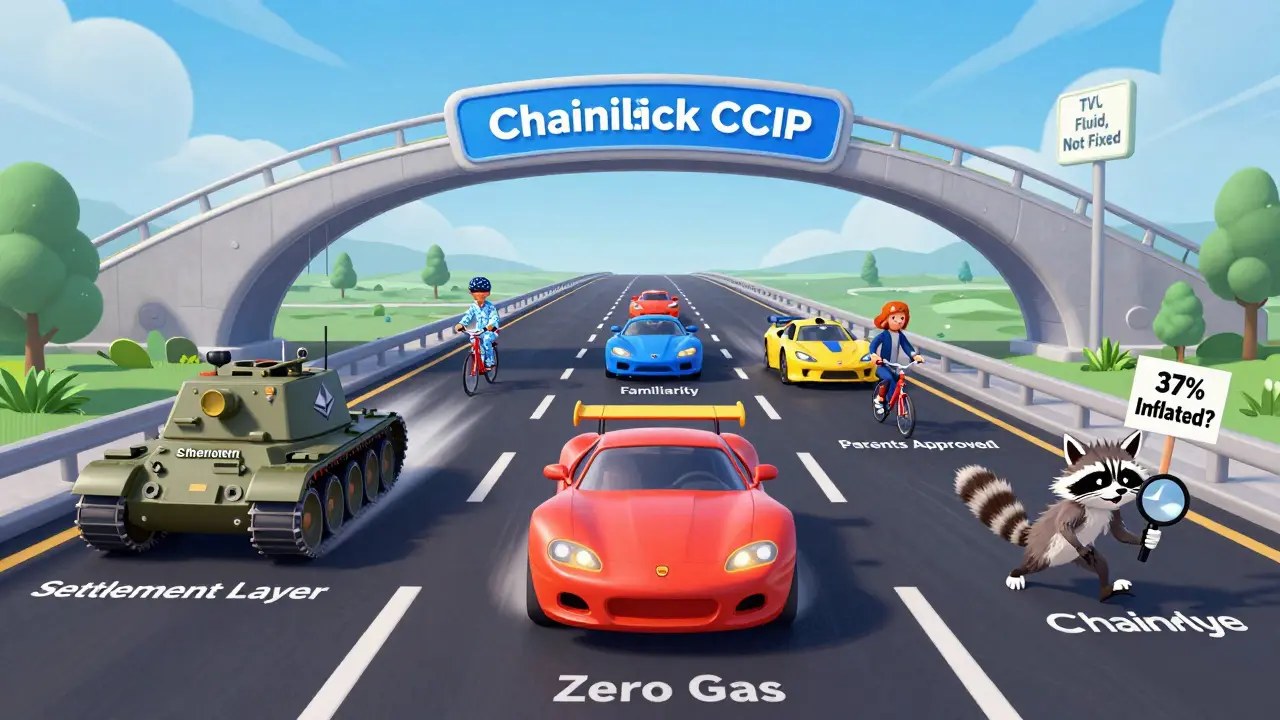
And cross-chain tech is changing the game. Chainlink’s CCIP enabled $4.2 billion in cross-chain positions by November 2025. You can now lock assets on one chain and use them on another. That means TVL won’t be tied to one blockchain anymore. It’ll be distributed, fluid, and dynamic.
The era of one chain to rule them all is over. The future belongs to users who understand where their money sits, why it’s there, and what happens if things go wrong.
What does TVL mean in DeFi?
TVL stands for Total Value Locked. It’s the total amount of cryptocurrency deposited into DeFi protocols-like lending platforms, exchanges, and yield farms-on a specific blockchain. It’s measured in USD and used to gauge how much trust and liquidity a network has. Higher TVL usually means more users and deeper liquidity, but it doesn’t always mean safety.
Why is Ethereum still the top chain for TVL?
Ethereum leads because of its security, developer ecosystem, and first-mover advantage. Most major DeFi protocols were built on Ethereum first. Institutions trust it more because it’s been tested through multiple market cycles. Even with high gas fees, users stay because they know their funds are less likely to vanish due to a hack or protocol failure.
Is Solana’s TVL growth sustainable?
Solana’s growth is driven by speed and low cost, not security. It’s gained traction because traders and NFT users want fast, cheap transactions. But its history of network outages makes some wary. Growth is sustainable only if users prioritize performance over reliability. If a major outage happens during a market rally, TVL could drop sharply. Long-term sustainability depends on fixing its infrastructure, not just attracting users with low fees.
Are Layer-2s taking over Ethereum?
Yes, but not by replacing Ethereum-they’re extending it. Layer-2s like Arbitrum, Optimism, and Base handle most new DeFi activity while relying on Ethereum for security. As of early 2025, Layer-2s hold over $9.6 billion in TVL, which is nearly a quarter of Ethereum’s total. Base is growing fastest because of Coinbase’s user base and seamless onboarding. Ethereum mainnet is becoming more of a settlement layer than a user-facing platform.
Can TVL be manipulated?
Absolutely. Some protocols inflate TVL by offering huge rewards to lure liquidity that disappears after a few days. Others double-count assets-like listing the same token as both collateral and borrowed funds. Chainalysis found up to 37% of TVL across major protocols was misleading in 2024. Smart investors filter out incentivized or artificial liquidity before making decisions. TVL is useful, but only if you know what’s behind the number.
What’s the biggest risk to TVL in 2025?
The biggest risk is over-reliance on stablecoins, especially USDT on TRON. If USDT depegs again, TRON’s TVL could drop by billions overnight. Another risk is regulatory crackdowns-MiCA in Europe caused a 12.4% TVL drop in Q2 2025 as protocols scrambled to comply. And finally, artificial TVL growth can collapse fast, leaving users with illiquid assets. TVL tells you where money is, but not always if it’s safe or real.
Noriko Robinson
December 5, 2025 AT 13:13TVL is such a flawed metric but we keep using it like it’s gospel. It doesn’t tell you who’s actually using the protocol, just who’s farming the most rewards. I’ve seen people deposit $50 into a pool just to get a 200% APY for three days and then vanish. That’s not adoption, that’s gambling with a spreadsheet.
Scott Sơn
December 5, 2025 AT 13:32Ethereum’s TVL is like a 70-year-old grandpa who still runs marathons - no one else can keep up, but everyone knows he’s gonna collapse if you push him too hard. Meanwhile Solana’s the 22-year-old sprinter who breaks his ankle every other race but still wins the 100m. We’re not choosing between them - we’re just betting on which one we want to watch next.
Mairead Stiùbhart
December 6, 2025 AT 16:01Oh sweet merciful heavens, another post pretending TVL is a measure of innovation. Let me guess - next you’ll tell me the number of Instagram followers proves someone’s a good artist? TRON’s TVL is just USDT doing a slow-mo belly flop into a vat of low-fee liquidity. It’s not DeFi. It’s a stablecoin highway with no exits.
Martin Hansen
December 7, 2025 AT 16:20Base is the only chain that actually gets it. No wallet? No bridge? No gas? Just log into Coinbase and go. Why are we still pretending Ethereum mainnet is relevant? It’s like trying to stream Netflix on a dial-up modem while your cousin’s on 5G. The rest of us moved on years ago. Stop romanticizing gas fees.
Josh Rivera
December 8, 2025 AT 21:05Let’s be real - Ethereum’s dominance is just institutional inertia. JPMorgan doesn’t care about decentralization. They care about audit reports and lawyers who’ve read the code. If you think TVL means safety, you’ve never seen a 300% APY farm with a 3-line smart contract and a Discord admin who ghosted after the airdrop.
ronald dayrit
December 10, 2025 AT 16:42There’s a deeper philosophical question here - if value is locked in a system that can be arbitrarily paused, is it really locked at all? Solana’s outages don’t destroy value - they reveal its fragility. And if the only reason you’re holding a position is because the interface is smooth and the gas is cheap, then what you’ve locked isn’t capital - it’s convenience. Capital endures. Convenience evaporates when the Wi-Fi goes down.
Brooke Schmalbach
December 11, 2025 AT 20:25TVL is a lie dressed in blockchain jargon. You think $100B is real? Half of it is just bots rotating tokens between pools to make the dashboard look pretty. And don’t get me started on the ‘incentive-driven growth’ crowd - they’re the same people who sold you NFTs of apes last year. This isn’t finance. It’s a casino with a whitepaper.
Jonathan Sundqvist
December 13, 2025 AT 12:01Base is winning because it doesn’t ask you to be a crypto nerd. My mom used it. My aunt used it. They didn’t care about L2s or rollups. They just wanted to send USDC without losing $10 in fees. That’s the future. Not some Ethereum maximalist ranting about decentralization while his wallet sits empty.
miriam gionfriddo
December 15, 2025 AT 03:10TRON’s TVL is a ticking time bomb. 98% USDT? That’s not a protocol - that’s a single point of failure wrapped in a blockchain costume. One regulatory move, one Tether crisis, and boom - $6B vanishes overnight. And everyone who thought they were ‘earning yield’ will be left holding a digital napkin.
Manish Yadav
December 16, 2025 AT 17:50Why do people still talk about Ethereum like it’s the only real chain? It’s slow, expensive, and full of people who think they’re smarter than everyone else. Solana’s fast. BSC’s easy. Base’s simple. TRON’s cheap. Pick one and stop acting like you’re defending democracy by holding ETH.
Yzak victor
December 17, 2025 AT 04:28I used to think TVL meant something. Now I just look at how many people are actually transacting. On Base, I see real people sending money to their cousins in Mexico. On TRON, I see bots moving USDT between exchanges. One’s real. One’s a ghost. TVL doesn’t show you that. You have to dig deeper.
Madison Agado
December 17, 2025 AT 15:01TVL is a mirror. It doesn’t show you the truth - it shows you what people want to believe is true. We’ve turned a liquidity metric into a status symbol. We’re not measuring adoption. We’re measuring ego. The chain with the biggest TVL isn’t the best - it’s just the one that convinced the most people to lock their money there, even if they didn’t understand why.
Jerry Perisho
December 18, 2025 AT 03:35Layer-2s aren’t stealing from Ethereum - they’re extending it. Think of Ethereum as the foundation and L2s as the rooms you build on top. Base is the kitchen. Arbitrum is the study. Optimism is the patio. You don’t need to live in the basement to benefit from the house. The real innovation is in the architecture, not the bricks.
Stanley Wong
December 18, 2025 AT 17:12People forget that TVL is a snapshot. It doesn’t show you the flow. A chain can have $20B locked and lose $15B in a week because the rewards stopped. That’s not a failure of the chain - it’s a failure of the incentive model. Real adoption is when people stay even when the rewards are gone. That’s the test no one’s measuring.
Tom Van bergen
December 19, 2025 AT 07:25Why are we still talking about chains like they’re nations? They’re software. They’re code. They’re servers. You don’t love a server. You use it until it breaks. Then you switch. The idea that anyone should be loyal to a blockchain is absurd. The only thing that matters is what it does for you right now.
Billye Nipper
December 21, 2025 AT 02:41My dad just asked me why he can’t send money to his friend in India without paying $15 in fees. I showed him Base. He sent $200. Took 3 seconds. No wallet. No seed phrase. No panic. That’s the future. Not some Ethereum fanboy preaching about ‘decentralization’ while his wallet sits empty because he can’t figure out MetaMask.
Doreen Ochodo
December 21, 2025 AT 03:58Real talk: If your DeFi strategy relies on TVL numbers, you’re already behind. Look at who’s building. Look at who’s using. Look at how many people can onramp without a tutorial. Base isn’t winning because it’s ‘better’ - it’s winning because it’s the first chain that didn’t treat users like hackers.
Thomas Downey
December 21, 2025 AT 19:46It’s deeply concerning that the entire DeFi ecosystem is being judged by a metric that can be so easily gamed. The notion that TVL correlates with security is not only naive - it’s dangerous. Institutions are allocating billions based on this number, as if it were a bond rating. But a 300% APY farm with a 100-line contract and a Discord admin who vanished after a week is not a safe asset. It’s a trap. And we’re letting it become the new standard.
Roseline Stephen
December 23, 2025 AT 10:03TRON’s TVL is like a house built on sand. It looks solid until the tide comes in. USDT is the tide. And when it pulls back, everyone will scramble to find where their money went. No one talks about this because no one wants to admit they were just riding a stablecoin wave, not building DeFi.
Holly Cute
December 23, 2025 AT 17:10TVL is the new follower count. Everyone’s obsessed with the number, but nobody asks who’s actually behind it. Are these real people? Or just bots farming rewards? Or whales dumping into their own pools? I’ve seen protocols with $1B TVL where 90% of the deposits came from three wallets. That’s not a market. That’s a puppet show.
Neal Schechter
December 24, 2025 AT 18:07People forget that TRON’s dominance isn’t about DeFi - it’s about payments. It’s the SWIFT of crypto. If you need to move USDT fast and cheap across borders, TRON is the tool. Calling it ‘fragile’ ignores the fact that it’s doing exactly what it was designed for. Maybe the problem isn’t TRON - maybe it’s that we keep trying to force every chain to be everything.
Ben VanDyk
December 26, 2025 AT 13:50Why do people act like Solana’s outages are a dealbreaker? It’s a blockchain. It’s not a bank. If you need guaranteed uptime, use a credit card. If you want permissionless, high-speed, low-cost transactions, you accept the trade-offs. The fact that people still treat blockchains like traditional financial systems is the real problem.
Lore Vanvliet
December 26, 2025 AT 18:36Base is the future. And if you’re still clinging to Ethereum mainnet because you think it’s ‘more secure,’ you’re just scared of change. I’ve lost more money to bank freezes and FDIC limits than I ever have to a Solana outage. The system you trust is broken - you just don’t realize it yet.
sonia sifflet
December 26, 2025 AT 19:30TVL is a joke. The only thing that matters is who’s using it daily. On Base, I see real people sending money to family. On Ethereum, I see bots. On TRON, I see USDT moving between exchanges. Pick your metric. But don’t pretend TVL tells you anything real.
Vincent Cameron
December 28, 2025 AT 17:33Maybe the real story isn’t which chain has the most TVL - but which one lets you sleep at night. Ethereum gives you security. Solana gives you speed. Base gives you simplicity. TRON gives you liquidity. But none of them give you peace of mind. Because in DeFi, peace of mind is the one thing you can’t lock.