What Are Privacy Protocols in Cryptocurrency? A Clear Breakdown
 Mar, 18 2026
When you send Bitcoin or Ethereum, everyone on the network can see exactly how much you sent, when you sent it, and which wallet it went to. Your transaction is permanently recorded on a public ledger. It’s not anonymous-it’s pseudonymous. That means if someone links your real identity to your wallet address, they can track every move you make with your money. For many, that’s a problem. That’s where privacy protocols come in.
Why Privacy Matters in Cryptocurrency
Not everyone wants their financial history公开. Think about it: if you’re a small business owner paying suppliers, you don’t want competitors knowing how much inventory you’re buying. If you live in a country with strict capital controls, you might need to move money without government oversight. Or maybe you just don’t want your bank or employer knowing every purchase you make. Privacy protocols exist to give people real control over who sees their financial activity-without giving up the benefits of decentralized networks.
Unlike Bitcoin, where every transaction is visible, privacy protocols are built to hide three things: who sent the money, who received it, and how much was sent. This isn’t about hiding illegal activity-it’s about protecting financial freedom. The same way cash lets you pay someone without a paper trail, privacy coins aim to do the same digitally.
How Privacy Protocols Work: The Core Technologies
Privacy protocols don’t rely on one trick. They combine multiple advanced cryptographic tools to make transactions untraceable. Here are the main ones:
- Stealth Addresses: Instead of using the same wallet address every time, a stealth address generates a new, one-time address for each incoming transaction. Even if someone watches your public address, they can’t tell what you received or from whom.
- Ring Signatures: This groups your transaction with several others, making it impossible to tell which signature belongs to the real sender. Imagine being in a crowd where everyone signs a document, but only one person actually made the payment. The system proves one of them did-but doesn’t say which.
- Zero-Knowledge Proofs (zk-SNARKs): This is the most powerful tool. It lets the network verify that a transaction is valid-without revealing any details. Think of it like proving you know a secret password without saying the password. Zcash uses this to let users choose between public and shielded transactions.
- Ring Confidential Transactions (RingCT): An upgrade to ring signatures that hides the transaction amount. Without this, even if you hide who sent the money, someone could still guess how much was transferred based on known balances.
- Transaction Mixing: Services like Dash’s PrivateSend pool funds from multiple users, shuffle them, and send them out in different amounts and times. It breaks the chain of linked transactions, but it’s not as strong as the other methods because it depends on centralized nodes.
Each of these tools has trade-offs. Some are faster. Some are more private. Some are easier to use. But together, they form the backbone of true financial anonymity on blockchain networks.
The Top Privacy Coins Compared
| Coin | Privacy Method | Privacy by Default? | Transaction Speed | Exchange Support |
|---|---|---|---|---|
| Monero | Ring signatures, stealth addresses, RingCT | Yes | Slow (2-3 minutes) | Limited (delisted on many exchanges) |
| Zcash | zk-SNARKs (optional shielded transactions) | No | Fast (2.5 minutes) | High (supported on major exchanges) |
| Dash | PrivateSend (mixing via masternodes) | No | Fast (1-2 minutes) | Moderate (available on most exchanges) |
| Bytecoin | Ring signatures (early version) | Yes | Slow | Very Low |
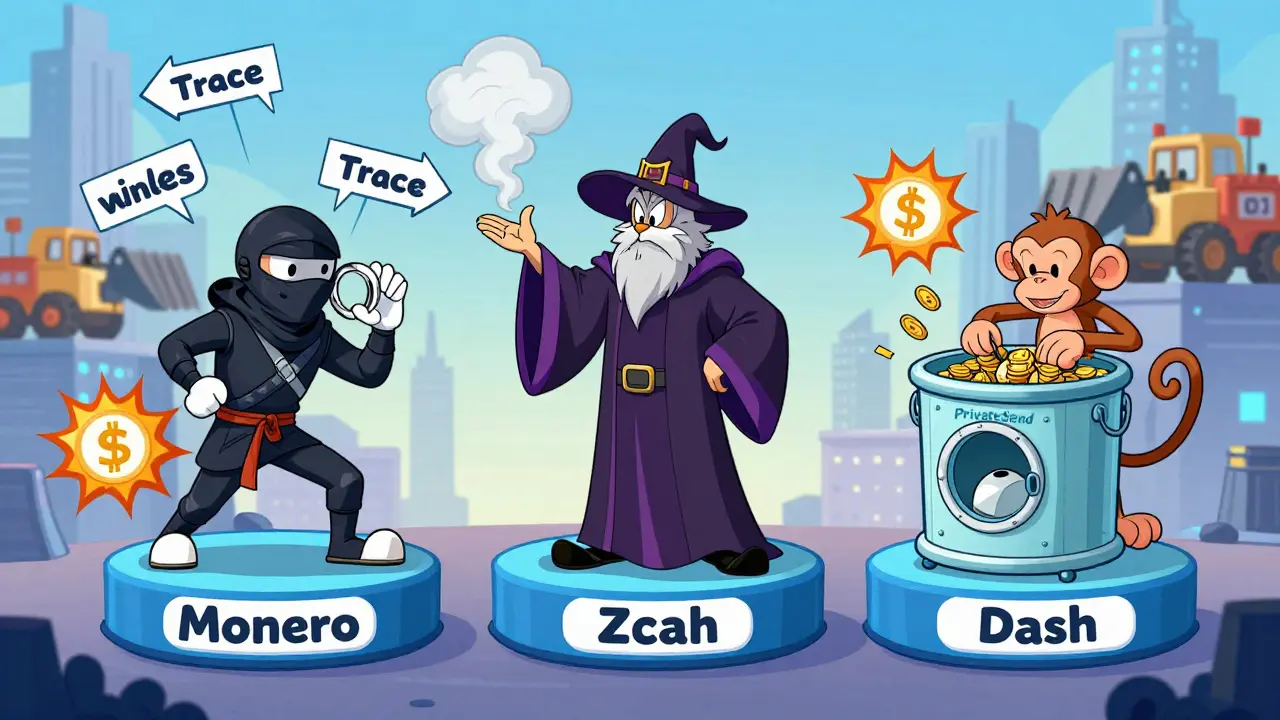
Monero is the gold standard. Every transaction is private by default. There’s no option to make it public. That’s why it’s the favorite among users who need real anonymity. But it’s also why exchanges like Coinbase and Binance have removed it. Regulators see it as too risky.
Zcash lets you choose. You can send transparent transactions like Bitcoin-or shielded ones that hide everything. The problem? Most people use the transparent option. So even though Zcash has the strongest tech, its network anonymity is weak because few use it properly.
Dash’s PrivateSend is easier to use but less secure. It mixes funds through masternodes, which are operated by a small group of users. That means if those nodes are compromised-or if regulators pressure them-it could break the privacy chain.
What Users Really Experience
People who use privacy coins say the same things over and over:
- Slower transactions: Monero takes longer to confirm because the system has to process complex cryptographic data. If you’re paying for coffee, that’s a problem.
- Bigger file sizes: Privacy data adds weight to each transaction. That means higher fees on networks with limited space.
- Hard to find wallets: Many mobile apps don’t support full privacy features. You often need a desktop wallet or a specialized app like Monero GUI or Cake Wallet.
- Exchange delistings: If you own Monero, you might find it harder to trade. Some exchanges won’t list it. Others restrict withdrawals.
- Confusing setup: Turning on shielded transactions in Zcash requires extra steps. Most users skip it because they don’t understand how.
Reddit and Bitcoin Forum threads are full of users who switched from Bitcoin to Monero after realizing how traceable their spending was. But they also complain about the learning curve. Privacy isn’t plug-and-play. It demands effort.
Regulation and the Future
Governments don’t like privacy coins. The Financial Action Task Force (FATF) has called them a “high-risk” asset class. Countries like South Korea, Japan, and the Netherlands have banned or restricted trading. The U.S. Treasury has flagged Monero as a top money laundering risk.
But here’s the twist: the same technologies that hide transactions are being used by banks and enterprises to improve compliance. Zero-knowledge proofs are now part of private blockchain networks used by JPMorgan and IBM. Why? Because they let companies verify transactions without exposing sensitive data to each other.
So the future isn’t about killing privacy-it’s about controlling it. Central banks are building digital currencies with built-in surveillance. That’s pushing more people toward privacy coins-not because they want to break the law, but because they want to protect their rights.
Looking ahead, we’ll see more integration of privacy tech into Layer 2 solutions. Projects like the Lightning Network are experimenting with confidential channels. Ethereum’s future upgrades may include optional privacy layers. The goal isn’t to replace Bitcoin-it’s to give users choice.
Should You Use Privacy Protocols?
Here’s a simple way to decide:
- If you care about maximum anonymity and don’t mind slower transactions and fewer exchange options → go with Monero.
- If you want flexibility and better exchange access, but are okay with manually enabling privacy → try Zcash.
- If you just want occasional mixing and don’t need full anonymity → Dash might work.
- If you’re unsure, start with a small amount. Test the wallet. See how long sync takes. Try sending a shielded transaction.
There’s no perfect system. Even Monero isn’t 100% untraceable. Experts have shown that with enough data and time, patterns can be found. But for most people, it’s enough. Enough to protect your spending habits, your business deals, your personal freedom.
Privacy isn’t about hiding from the law. It’s about not being watched by everyone.
Are privacy coins illegal?
No, privacy coins themselves are not illegal anywhere. But many countries restrict or ban trading them on exchanges. For example, Monero is delisted on major exchanges in the U.S., Japan, and South Korea due to regulatory pressure. Owning or using them privately is still legal in most places, but exchanging them for fiat currency may trigger reporting requirements.
Can you trace Monero transactions?
Not with standard tools. Monero’s ring signatures, stealth addresses, and RingCT make it extremely difficult to trace sender, receiver, or amount. Even blockchain analysts with advanced tools have only succeeded in rare cases-usually by exploiting user mistakes, like reusing addresses or combining Monero with non-private coins. For all practical purposes, Monero transactions are untraceable.
Why is Zcash less private than Monero?
Because most users don’t use its shielded feature. Zcash lets you choose between transparent (public) and shielded (private) transactions. Over 90% of Zcash transactions are transparent, meaning they look just like Bitcoin. That means the network’s overall anonymity is low. Monero, by contrast, makes privacy mandatory for every transaction.
Do privacy coins have higher fees?
Yes, often. Privacy protocols add extra data to each transaction, making them larger in size. Since blockchain space is limited, larger transactions cost more in fees. Monero transactions are typically 2-3 times larger than Bitcoin, leading to higher fees during peak network use. Zcash shielded transactions also cost more than transparent ones.
Can I use privacy coins on my phone?
Yes, but with limits. Mobile wallets like Cake Wallet (for Monero) and ZecWallet Lite (for Zcash) support basic privacy features. However, full functionality-like generating stealth addresses or verifying ring signatures-is often only available on desktop apps. Mobile apps may also lack advanced security settings, making them less ideal for high-stakes privacy use.
What’s Next?
If you’re curious about privacy protocols, start small. Buy a fraction of a Monero or Zcash. Try sending a shielded transaction. Read the documentation. Join a privacy-focused community. You don’t need to be a cryptographer to use these tools-you just need to care enough to learn.
The future of money isn’t just about speed or scalability. It’s about control. And privacy protocols are the only way to keep that control in a world where every transaction is recorded.
Henrique Lyma
March 18, 2026 AT 23:01Steph Andrews
March 19, 2026 AT 11:10Zachary N
March 19, 2026 AT 18:50Anastasia Thyroff
March 20, 2026 AT 05:20Ann Liu
March 21, 2026 AT 00:11Ross McLeod
March 21, 2026 AT 22:43rajan gupta
March 23, 2026 AT 21:15Billy Karna
March 25, 2026 AT 17:08Cheri Farnsworth
March 26, 2026 AT 20:25Gene Inoue
March 27, 2026 AT 00:44Ricky Fairlamb
March 28, 2026 AT 10:05Tony Weaver
March 29, 2026 AT 08:26sai nikhil
March 30, 2026 AT 01:02