Why Cryptocurrency Has Value: Supply, Demand & Technology
 Aug, 16 2026
Hold a $20 bill in your hand. It has no inherent worth as paper and ink; its value exists only because the government says it does. Now look at a Bitcoin. There is no president signing it, no central bank vault backing it up, and no law forcing you to accept it. So why do people pay thousands of dollars for a string of code? The answer lies in a shift from authority to consensus. Cryptocurrency is a digital asset that uses cryptography to secure transactions and control the creation of new units, operating independently of any central authority. Its value isn't given; it's built by millions of users agreeing that this specific digital ledger is useful, scarce, and secure.
The Core Driver: Scarcity Meets Demand
If you strip away the hype, the price tag on any crypto comes down to one simple equation: how much of it exists versus how many people want it. This is the same logic that makes gold valuable, but with a twist. Gold is scarce because it’s hard to dig up. Bitcoin is scarce because the code limits it.
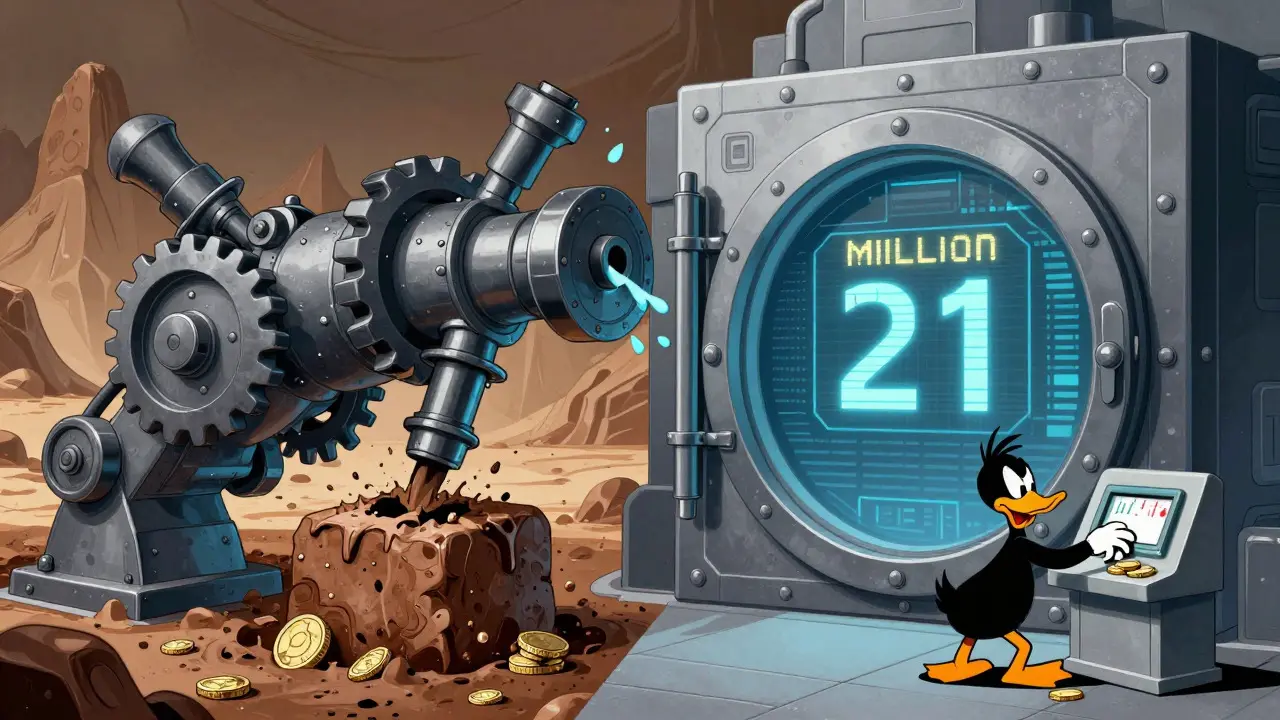
Bitcoin is the first decentralized cryptocurrency with a fixed maximum supply of 21 million coins. You can never have more than 21 million. Every four years or so, the amount of new Bitcoin created slows down-a process called the halving. As the supply tightens, if demand stays the same or grows, the price naturally rises. It’s basic economics, but applied to a digital world where scarcity is programmed, not geological.
Demand, however, is trickier. It’s not just about hoarding. People buy crypto because they believe it will be useful in the future. They see it as a hedge against inflation, a way to send money across borders without paying high fees, or simply a speculative asset that might go up. When more institutions and individuals join the party, the pool of buyers gets bigger, pushing the value up.
Technology That Actually Does Something
You might ask, "But why not just use regular money?" Because traditional banking has friction. Sending money from New Zealand to Europe can take days and cost significant fees due to currency exchanges and intermediary banks. Blockchain is a distributed ledger technology that records transactions across multiple computers, ensuring data integrity without a central administrator. By removing the middlemen, crypto enables peer-to-peer transfers that are often faster and cheaper, especially for international remittances.
This isn't just theoretical. The technology behind these assets provides three key values:
- Security: Transactions are protected by complex mathematical algorithms. Once recorded, changing them requires controlling most of the network, which is practically impossible for large networks like Bitcoin.
- Transparency: Every transaction is visible on the public ledger. You don't need to trust a bank's audit; you can verify the history yourself.
- Accessibility: If you have an internet connection, you can participate. No credit score, no bank account, no permission needed.
For many users, this utility is the real value. It’s not about the number going up; it’s about having a financial tool that works globally, 24/7, without asking for ID or approval.
Beyond Payments: The Utility Economy
Not all cryptocurrencies are just digital cash. Some are designed to run software. Take Ethereum, which introduced smart contracts, allowing developers to build decentralized applications (dApps) on its blockchain. Think of Ethereum less as a currency and more as a global computer. Developers pay fees in Ether (ETH) to run their programs. The more apps are built on Ethereum, the more demand there is for ETH to pay for those services. This creates a direct link between technological adoption and token value.
This leads to the concept of DeFi, or Decentralized Finance. In DeFi, you can lend, borrow, and trade assets without a bank. The tokens used in these protocols often derive their value from the actual financial activity happening on the platform. If a lending protocol earns interest, its native token might share in that revenue. Here, value is tied to cash flow, similar to how a stock represents ownership in a company.
Network Effects and Community Consensus
There is a psychological component to crypto value that often gets overlooked: the network effect. A phone is useless if nobody else has one. Similarly, a cryptocurrency is less useful if few people accept it. As more merchants, investors, and developers adopt a specific coin, its liquidity increases. Higher liquidity means you can buy or sell quickly without crashing the price. This stability attracts more serious players, creating a virtuous cycle.
Community sentiment plays a huge role here. Unlike stocks, which trade during set hours, crypto markets never close. This constant trading allows for immediate price discovery based on news, social media trends, and developer updates. While this can lead to volatility, it also means the market reacts instantly to changes in utility or adoption. If a project launches a major upgrade, the community votes with its wallet, often boosting the value immediately.
How Crypto Value Differs from Fiat Money
To understand why crypto holds value, it helps to compare it directly with the dollar or euro. Fiat money is backed by the full faith and credit of a government. If the government collapses, the money might lose value. Crypto is backed by code and consensus. If the code breaks, the value drops. But if the code holds and the community stays, the value persists regardless of political shifts.
| Feature | Fiat Currency (e.g., USD) | Cryptocurrency (e.g., Bitcoin) |
|---|---|---|
| Source of Value | Government Authority & Legal Tender Status | Market Consensus, Scarcity & Utility |
| Supply Control | Central Bank can print unlimited amounts | Fixed by Code (e.g., 21M Bitcoin max) |
| Transaction Speed | Days for international transfers | Minutes to Hours globally |
| Intermediaries | Banks, SWIFT, Clearinghouses | None (Peer-to-Peer) |
| Risk Factor | Inflation, Political Instability | Volatility, Regulatory Uncertainty, Hacking |
Notice the risk profile. With fiat, you trust the institution. With crypto, you trust the math. Both have risks, but they are different kinds. For someone living in a country with hyperinflation, the "risk" of holding volatile crypto might be far lower than the certainty of losing purchasing power every month in local currency. This is why value is subjective-it depends on what problem you are trying to solve.

Speculation vs. Fundamental Value
Let’s be honest: a lot of crypto trading is speculation. Traders buy in hoping to sell higher later. This doesn't mean the value is fake, but it does mean the price can decouple from the underlying technology for short periods. However, over time, fundamentals tend to win. Projects with strong development teams, real-world usage, and clear roadmaps tend to retain value better than those that are purely memes or pump-and-dump schemes.
Investors now use two main methods to assess this:
- Fundamental Analysis: Looking at the team, the code quality, user numbers, and partnerships. Is the project solving a real problem?
- Technical Analysis: Studying price charts and volume to predict short-term movements based on historical patterns.
The best approach combines both. You identify a project with solid fundamentals (long-term value) and use technical analysis to time your entry (short-term efficiency).
The Future of Digital Value
As we move further into the 2020s, the line between crypto and traditional finance is blurring. Banks are launching their own digital currencies. Corporations are holding Bitcoin on their balance sheets. This institutional adoption adds a layer of legitimacy that wasn't there a decade ago. It signals that crypto is no longer just a niche experiment but a recognized asset class.
Value will continue to evolve as technology improves. We’re seeing better scaling solutions that make transactions faster and cheaper. We’re seeing interoperability, where different blockchains can talk to each other. These improvements reduce friction, making crypto more accessible to the average person. The more usable it becomes, the more people will use it, and the stronger the value proposition becomes.
So, why does cryptocurrency have value? Because it offers something unique: a decentralized, transparent, and scarce store of value and medium of exchange that operates on global scale. It’s not magic. It’s a combination of sound economic principles, robust technology, and collective human agreement. Whether you view it as digital gold, a payment rail, or a speculative bet, the value is real to those who use it-and that’s enough to keep the lights on.
Does cryptocurrency have intrinsic value?
Most economists argue that cryptocurrency has no "intrinsic" value like gold or silver, which have industrial uses. Instead, its value is derived from extrinsic factors: scarcity, utility, and social consensus. It is worth what people are willing to pay for its features, such as borderless payments or programmable money.
What determines the price of Bitcoin specifically?
Bitcoin's price is primarily driven by its fixed supply of 21 million coins and global demand. Key factors include institutional adoption, macroeconomic conditions (like inflation rates), regulatory news, and the halving events that reduce new supply issuance. Its reputation as a "store of value" also influences long-term pricing.
Is cryptocurrency safer than holding cash or bank deposits?
It depends on the threat model. Cash can be stolen physically. Bank deposits are insured up to a limit but subject to bank failure or government policy. Crypto is secured by cryptography but requires self-custody (managing your own keys). If you lose your private key, you lose access permanently. However, the network itself is highly resistant to censorship and single-point failures.
How does blockchain technology add value to money?
Blockchain removes the need for trusted intermediaries like banks. This reduces costs, speeds up settlement times, and increases transparency. By enabling smart contracts, it also allows money to be "programmable," meaning you can automate payments, loans, and other financial agreements without manual intervention.
Why do some cryptocurrencies lose value while others gain it?
Value retention depends on utility and adoption. Coins with active development, real-world use cases, and strong communities tend to hold value better. Coins that are purely speculative, have poor security, or lack a clear purpose often lose value as investor interest wanes. Network effects play a critical role: the more people using a coin, the more valuable it generally becomes.
Sarah Campbell
August 16, 2026 AT 12:23Finally someone writes about this without the usual tech-bro nonsense. The $20 bill analogy is spot on, we are all just playing a game of make-believe but at least crypto doesn't need a president to sign it off! 🇺🇸📉💸
Alexander Scheel
August 17, 2026 AT 06:37One must appreciate the rhetorical flourish here; comparing fiat currency to a mere piece of paper is a bold move for those who have never experienced hyperinflation firsthand. It is a charmingly naive perspective that ignores the legal tender status which actually provides a floor for value in most stable economies.
Sarah Campbell
August 17, 2026 AT 19:57Oh please, don't get your knickers in a twist over 'legal tender'. That's just what they call it so you can't refuse to pay taxes in it! 😤🔥
SHIV SHANKAR KANTA
August 18, 2026 AT 19:56The soul of the market is not in the code but in the belief of the masses... a philosophical truth often missed by the materialists who only see numbers on a screen. The value is a collective hallucination that has become real through sheer force of will and consensus... isn't that beautiful? 🧘♂️
Aaron Morrissey
August 19, 2026 AT 21:19A rather poetic take on the ephemeral nature of digital assets, though one might argue that 'hallucination' is a harsh word for a robust economic phenomenon. The interplay between scarcity and demand is indeed a dance of magnificent proportions, akin to the shifting tides of history itself. One cannot help but marvel at the sheer audacity of humans creating value out of thin air, or rather, thin code.
Hicham Mounir
August 21, 2026 AT 06:18I think you're both missing the point a bit. It's not really about whether it's a hallucination or a dance, it's just about utility. If it helps me send money to my cousin in Vietnam without losing 10% to fees, it works for me. Doesn't matter if the philosophy behind it is deep or shallow, as long as the transaction goes through smoothly. We should probably focus less on the metaphysics and more on the practical benefits for everyday people.
michelle aguilar
August 22, 2026 AT 11:38Oh, how delightful. Another thread where the intellectual depth is matched only by the superficiality of the arguments. One wonders if these commenters have ever read beyond the headline of a financial newspaper. The notion that 'utility' is the sole driver of value is a quaint oversimplification, don't you agree? Value is a construct, a social agreement, and to reduce it to mere 'fees saved' is to miss the forest for the trees, quite literally. But then again, nuance is often lost in the digital ether. 🙄
Nia Franklin
August 23, 2026 AT 17:09Love the energy here!! The way everyone is vibing with different perspectives is so cool. I feel like we are all part of this big global experiment and its awesome to see how culture shapes our view on money. The typos in my head are flying but the meaning is clear: we are connected through this tech!!! ✨🌍💡
Quang Thai Tran
August 23, 2026 AT 23:28It is evident that the mainstream narrative is being subtly manipulated by institutional interests to normalize this speculative instrument. One must remain vigilant against the subtle erosion of sovereign monetary policy. The 'consensus' mentioned is merely a coordinated effort by elite factions to decentralize control while retaining ultimate leverage. Stay awake.
Marco Maldonado
August 24, 2026 AT 13:31You guys are overthinking it. America leads in tech, period. If Bitcoin is good, it's because American engineers built the best network. Don't let the Europeans or Asians tell you otherwise. Our dollar is still king but BTC is the new oil. Simple as that. No conspiracy needed, just superior US innovation. 🇺🇸🚀
Darren Moon
August 25, 2026 AT 19:19While the nationalistic fervour is palpable, one must consider the broader geopolitical implications of a borderless asset class. The friction reduction offered by blockchain technology is not merely an American triumph but a global shift in financial architecture. To attribute the success solely to domestic engineering is to ignore the collaborative, open-source nature of the development. It is, after all, a decentralized endeavor by definition.
Daniel Brown
August 27, 2026 AT 00:51Just wanted to chime in on the security aspect mentioned in the article. People forget that while the network is secure, your wallet isn't always. I personally use hardware wallets for anything significant. It's a small step but makes a huge difference in peace of mind. You don't want to be the victim of a phishing scam just because you trusted a website too much. Security is personal responsibility first, code second.
Phelan Deihl
August 27, 2026 AT 06:33Agreed on the hardware wallets. I keep mine in a safe deposit box at home. Feels weird but it works. I'm not very technical so I stick to the basics. Just buy and hold, no trading. Less stress that way. The volatility scares me off from doing anything active with it. So yeah, self-custody is key if you want to actually own it.
Melissa G
August 28, 2026 AT 00:22The discussion regarding custody touches upon a deeper philosophical question: what does it mean to truly 'own' something in a digital age? Ownership in the physical world is tied to possession and control, yet in the digital realm, ownership is reduced to a cryptographic key. This abstraction challenges our traditional notions of property and agency. Are we owners of our assets, or merely custodians of access codes? The distinction may seem trivial, but it carries profound implications for autonomy and freedom in an increasingly digitized society. As we navigate this new landscape, we must remain mindful of the balance between convenience and control, ensuring that our tools serve us rather than define us.
Ashley Snyder
August 29, 2026 AT 21:21That was a really thoughtful response. I usually just look at the price chart so I appreciate the deeper dive. Makes me think about why I even bought it in the first place. Maybe it's not just about the money, but about having a say in how things work. Cool stuff.