Benefits of Account Abstraction for Smarter, Safer Crypto Wallets
 Dec, 8 2025
Gas Fee Conversion Tool
With account abstraction, you can pay gas fees in tokens like USDC instead of ETH. Enter your gas fee in ETH and current exchange rate to see the equivalent value.
What Is Account Abstraction, Really?
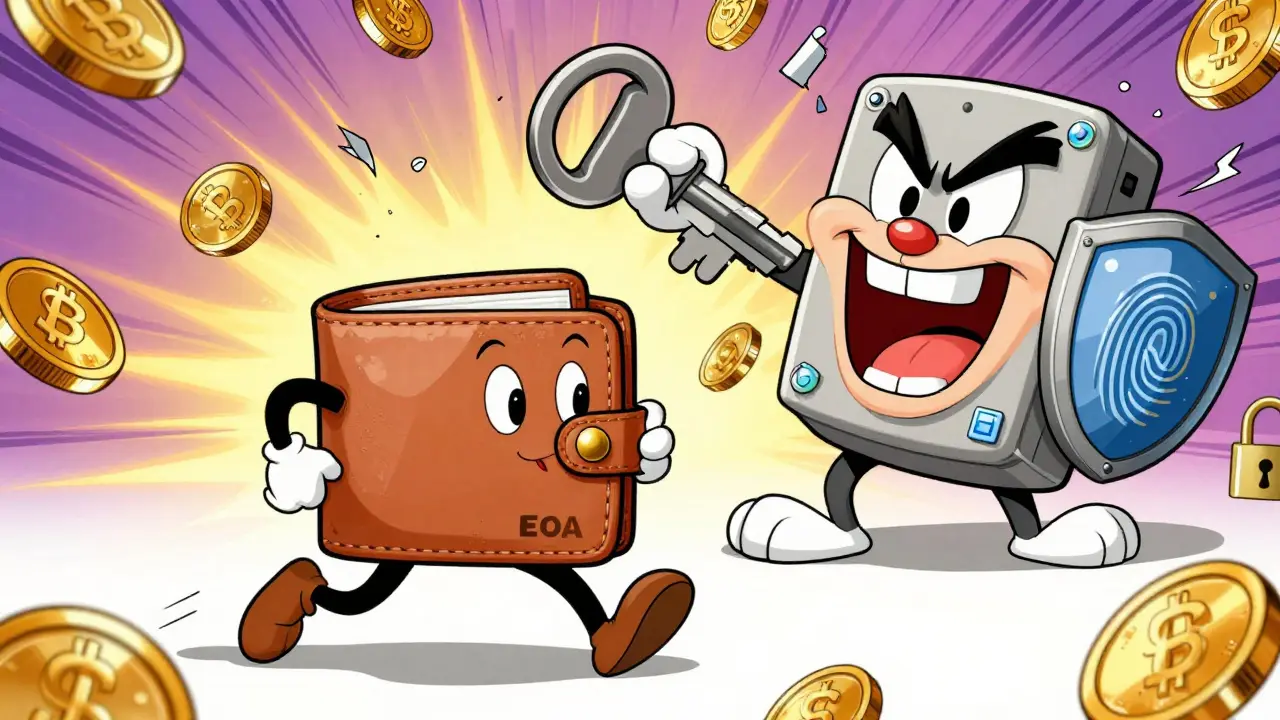
Account abstraction isn’t just another blockchain buzzword. It’s a fundamental upgrade to how your crypto wallet works - turning it from a simple key holder into a smart, programmable account. Right now, most wallets like MetaMask rely on externally owned accounts (EOAs), which are controlled by a single private key. Lose that key? Your money is gone forever. No recovery. No second chance. That’s why over $3.8 billion in crypto was lost between 2017 and 2022 just because people forgot passwords or got hacked.
Account abstraction changes that. With it, your wallet becomes a smart contract - not just a lockbox, but a tiny program you can control. You can set rules: "Only allow transactions over $1,000 if two people approve," or "Let me log in with my fingerprint," or "Pay gas fees in USDC instead of ETH." This isn’t theory. It’s live. Wallets like Argent, Ambire, and Safe have been using it since mid-2023, serving over 2 million active users.
Security That Doesn’t Rely on a Single Key
EOAs are like a house with one lock and one key. If someone steals it, they own everything. Account abstraction replaces that with multi-layered control. Think of it like a bank vault with biometric access, backup codes, and a guardian system.
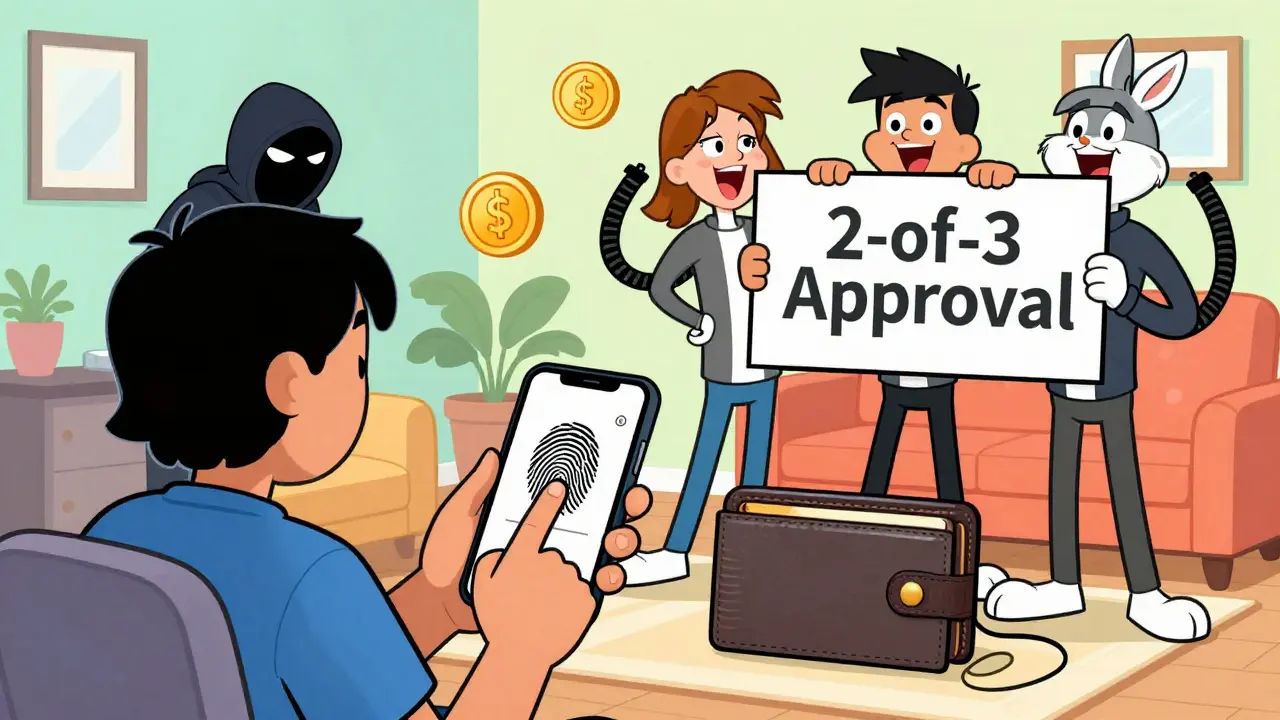
Argent Wallet’s social recovery lets you pick three trusted contacts - your partner, sibling, or best friend. If you lose your phone, you don’t need a 12-word seed phrase. You just ask two of them to confirm your identity. Between January 2022 and August 2023, Argent successfully recovered 247,000 accounts with a 98.7% success rate. That’s not luck. That’s design.
Safe (formerly Gnosis Safe) uses multi-signature logic. For any transaction above a set amount, you need at least two out of three signatures. This prevents single-point failures. A hacker can’t steal your funds just by phishing your password. They’d need to compromise two separate devices or people - something far harder to pull off.
Even biometrics are now part of the equation. Ambire Wallet integrates with your phone’s secure enclave to let you sign transactions with your face or fingerprint. No typing. No copy-pasting keys. Just tap and go.
Pay Gas Fees in Any Token - Even USDC
One of the biggest frustrations with crypto is having to hold ETH to pay for transactions. If you want to swap DAI for UNI but don’t have enough ETH for gas, you’re stuck. You either buy ETH first (and pay fees to do it), or you wait.
Account abstraction solves this with gas sponsorship. A dApp can pay your gas fees for you. That’s not theoretical - Gelato Network processes over 1.2 million sponsored transactions every month. You can use USDC, DAI, or even tokenized real estate to pay for Ethereum transactions. Biconomy supports 17 different ERC-20 tokens for gas payment as of September 2023.
This isn’t just convenient. It’s transformative. Imagine onboarding a million new users who’ve never held crypto before. You don’t need to explain ETH. You just say: "Click here to play the game. We’ll cover the cost." That’s how mass adoption happens.
Session Keys: No More Signing 15 Times in a Game
Ever tried playing a Web3 game and had to sign 15 separate transactions just to move your character, buy armor, and trade items? It’s exhausting. Most users quit after the third prompt.
Account abstraction introduces session keys. You set a time window - say, 24 hours - and grant a dApp permission to act on your behalf without asking for a signature every time. Once you log in, you can interact freely. You’re not giving up control. You’re just automating the repetitive stuff.
Reddit user u/WalletWarrior documented how this saved him 8 minutes per gaming session. That’s not a small win. That’s the difference between someone quitting crypto after 10 minutes and staying for 10 months.
Cross-Chain Without Bridging
Right now, moving assets between chains like Ethereum and Polygon means using a bridge - a third-party service that locks your tokens on one chain and mints them on another. It’s slow. It’s expensive. And it’s risky. Bridges have lost over $2 billion to hacks since 2020.
Account abstraction lets you manage assets across chains from a single wallet. Your smart contract can be programmed to automatically send tokens to another chain when triggered. Conduit’s data shows this cuts cross-chain transaction times by 47% compared to traditional bridging. No more waiting 15 minutes for a bridge to confirm. No more trusting a centralized relayer.
It’s not just faster. It’s safer. You’re not handing your funds to a third party. You’re letting your own wallet execute the move under your rules.
But It’s Not Perfect - Here’s What You Should Know
Account abstraction isn’t magic. It comes with trade-offs.
First, setup is slower. While MetaMask takes 5 minutes to install, setting up an AA wallet like Argent or Safe can take 25-45 minutes. You need to choose guardians, set thresholds, link biometrics, and understand recovery options. That’s a learning curve.
Second, initial gas costs are higher. Deploying your smart contract wallet costs extra - about 15-20% more than a regular EOA. But after that, transaction fees drop to normal levels.
Third, not all dApps support it yet. About 32% of DeFi protocols still don’t work with AA wallets, according to Electric Capital’s June 2023 report. You might hit a wall trying to use an old staking platform or lending app.
And yes, complexity brings risk. In March 2023, security researcher Samczsun found a flaw in an early AA wallet that could have let hackers bypass signature checks. The fix was quick, but it proves one thing: more code means more ways to break. That’s why audits matter. Always check if your wallet has been reviewed by OpenZeppelin, CertiK, or Trail of Bits.

Who’s Using It - And Why It’s Growing Fast
Adoption is exploding. In Q2 2022, less than 0.3% of Ethereum wallet activity used account abstraction. By Q2 2023, that jumped to 8.2% - a 2,633% year-over-year increase, according to ConsenSys.
Argent has 1.2 million active users. Ambire has nearly 500,000. Both are growing faster than MetaMask’s user base in new regions like Southeast Asia and Latin America, where users care more about recovery than technical specs.
Why? Because people are tired of losing money. A Coinmetro survey of 1,200 users found 73% switched to AA wallets because of better security. Another 68% cited recovery features as their top reason.
Even enterprises are moving. 42% of the top 100 DeFi protocols now support or plan to support AA. Institutional custody providers are adopting it at a 28% rate. This isn’t a niche experiment. It’s the next standard.
What’s Next? The Road to Native Account Abstraction
The current version - ERC-4337 - runs on top of Ethereum. It’s clever, but it’s not built into the core protocol. That’s why it needs bundlers, mempools, and extra layers.
The next step is native account abstraction, where the blockchain itself treats every account as a smart contract. Ethereum’s Cancun-Deneb upgrade (expected Q1 2024) will lay the groundwork with EIP-3074, letting contracts sponsor transactions more efficiently.
Vitalik Buterin says this could reduce finality time from 12 seconds to under 3 seconds. That’s banking-speed performance on a decentralized network.
By Q4 2025, analysts at Messari predict AA wallets will power 35-40% of all Ethereum activity. That’s not a guess. It’s the math of growth. Every day, more users realize: crypto shouldn’t be harder than online banking. Account abstraction makes it easier.
Should You Switch?
If you’re a beginner: try Argent or Safe. Their recovery features alone make them worth the extra setup time. You’ll never lose your funds again because you lost your phone.
If you’re a frequent DeFi user: start using session keys for games and dApps. Save time. Reduce friction.
If you’re a developer: learn ERC-4337. The tools are out there. Safe’s documentation is rated 4.5/5 on GitHub. Thirdweb offers ready-made templates. You’re not behind - you’re early.
Account abstraction isn’t about replacing MetaMask. It’s about upgrading what crypto wallets can be. It turns security from a burden into a feature. It turns complexity into control. And for the first time, it makes self-custody feel less like a chore - and more like a choice you actually want to make.
sonia sifflet
December 8, 2025 AT 08:55Chris Jenny
December 8, 2025 AT 10:26Mairead Stiùbhart
December 8, 2025 AT 13:37ronald dayrit
December 10, 2025 AT 11:53Madison Agado
December 10, 2025 AT 21:06Richard T
December 12, 2025 AT 11:20Chris Mitchell
December 12, 2025 AT 12:15nicholas forbes
December 13, 2025 AT 08:22Shane Budge
December 14, 2025 AT 06:02Jonathan Sundqvist
December 14, 2025 AT 13:26Thomas Downey
December 14, 2025 AT 17:22Annette LeRoux
December 14, 2025 AT 17:40Jerry Perisho
December 15, 2025 AT 18:15Manish Yadav
December 17, 2025 AT 07:33Vincent Cameron
December 18, 2025 AT 21:44Krista Hewes
December 19, 2025 AT 14:16Noriko Robinson
December 21, 2025 AT 10:31Doreen Ochodo
December 23, 2025 AT 05:21Yzak victor
December 24, 2025 AT 05:27Holly Cute
December 26, 2025 AT 02:58