Cross-border crypto services in EU under MiCA: Rules, Restrictions & Passport Guide
 Jun, 25 2026
The era of regulatory chaos for crypto-asset services in Europe is officially over. Since December 30, 2024, the Markets in Crypto-Assets (MiCA) Regulation has been fully operational, creating a single, unified rulebook for all 27 EU member states. If you are a crypto business looking to operate across borders, or an investor wondering why your favorite exchange suddenly asked for more ID, this shift explains everything. MiCA replaces fragmented national laws with a strict, harmonized framework that prioritizes consumer protection and financial stability.
For many, the headline is the "EU Passport." This mechanism allows a licensed provider to offer services anywhere in the bloc without needing separate licenses in every country. However, the reality on the ground involves significant restrictions, especially for non-EU firms and those handling stablecoins. Let’s break down exactly how this works, what it costs, and where the traps lie.
How the EU Crypto Passport Works
The core innovation of MiCA is the single market passporta mechanism allowing authorized entities to provide services across multiple jurisdictions under one license. Before MiCA, a crypto exchange might need to navigate different licensing requirements in France, Germany, and Italy separately. That complexity killed efficiency and scared away legitimate businesses.
Under the new rules, if you obtain authorization as a Crypto-Asset Service Provider (CASP)an entity authorized to provide services like exchange, custody, or trading of crypto-assets in your home member state, you can "passport" those rights to other EU countries. Here is the process:
- Home State Authorization: You get licensed by the competent authority in your primary operating country (e.g., BaFin in Germany or AMF in France).
- Notification: You notify your home regulator that you intend to operate in other specific EU member states.
- Automatic Recognition: The host countries must recognize your license. They cannot block you unless there are serious public policy concerns, which are rare.
This system mirrors the passporting rights used by traditional banks and investment firms. It reduces administrative overhead significantly. Instead of paying legal fees in seven different countries, you pay them once. But remember: getting that initial home-state license is not easy. Regulators now scrutinize your capital reserves, IT security, and anti-money laundering (AML) protocols with the same intensity applied to traditional banks.
Strict Rules for Non-EU Providers
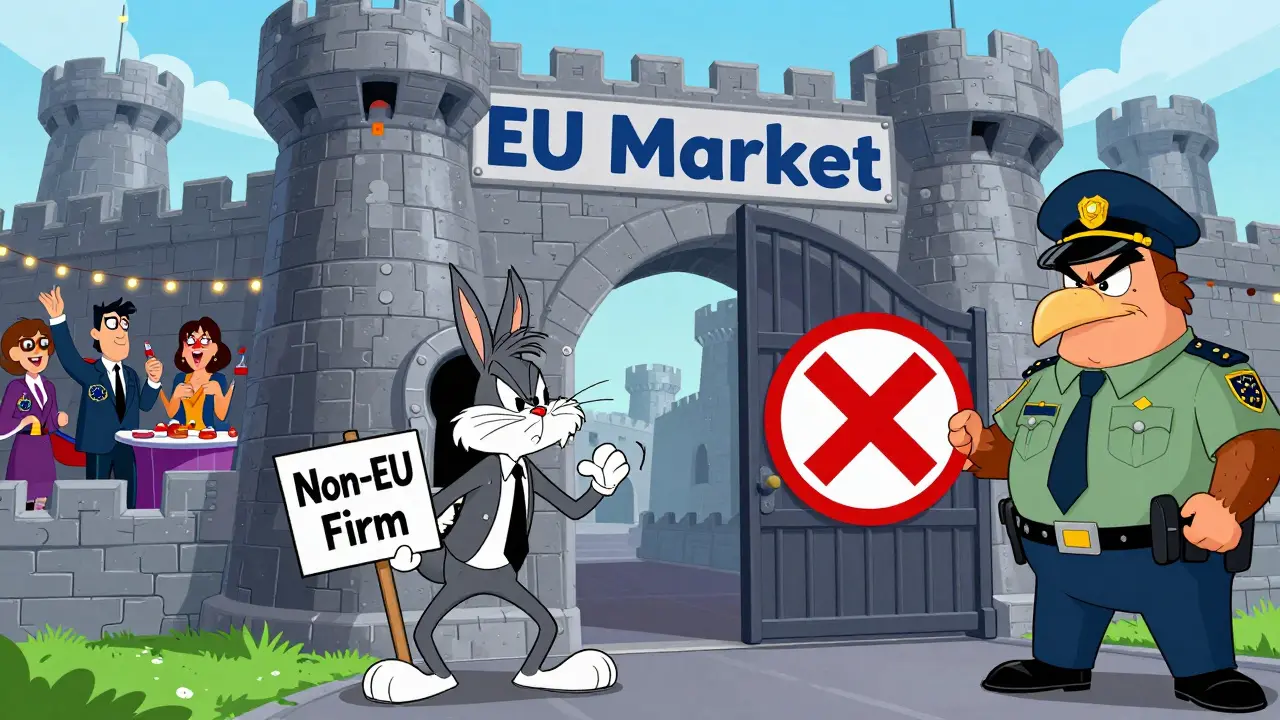
If you run a crypto platform outside the European Union-say, in the US, Singapore, or Dubai-the landscape has changed drastically. MiCA does not allow simple cross-border service provision from third countries. You cannot just market to EU users from abroad.
There are two paths for non-EU firms:
- Establish an EU Entity: You must set up a subsidiary within the EU and obtain full CASP authorization under MiCA. This is the only way to actively solicit clients, advertise, or promote your services to EU residents.
- Reverse Solicitation: You can serve EU clients if they approach you entirely on their own initiative. No marketing, no ads, no cold emails. If a user clicks a link you posted globally, that counts as promotion. ESMA (European Securities and Markets Authority) guidelines define "reverse solicitation" very narrowly. Any proactive contact voids this exception.
Many major global exchanges have already established EU subsidiaries to maintain access to this lucrative market. For smaller international startups, this creates a high barrier to entry. The cost of setting up an EU entity and achieving compliance often outweighs the potential revenue from individual retail traders.
Who Needs a License? Scope of MiCA
MiCA is activity-based, not company-type-based. This means it doesn’t matter if you are a tech startup, a bank, or a fintech app. If you perform any of the following activities involving crypto-assets, you fall under MiCA:
- Custody and Administration: Holding private keys on behalf of users. Even non-custodial wallet providers who assist in key management may face scrutiny.
- Exchange Services: Trading crypto for fiat (like EUR/USD) or crypto for crypto (like BTC/ETH).
- Order Matching: Operating a platform where buyers and sellers meet.
- Execution of Orders: Acting as an intermediary to complete trades.
- Portfolio Management: Managing crypto assets on behalf of clients.
Embedded finance platforms also need to watch out. If your e-commerce site allows payments in crypto and converts them automatically, you might be acting as an exchange. The regulation casts a wide net. Ignorance of these definitions is not a valid defense during audits.
Stablecoins and Asset-Referenced Tokens
While the general CASP rules kicked in late 2024, the rules for stablecoins arrived earlier. E-money tokens (EMT)tokens pegged 1:1 to a single official currency like the Euro and Asset-Referenced Tokens (ART)tokens designed to maintain a stable value by reference to several currencies or other assets have faced stricter controls since June 30, 2024.
Issuers of EMTs must hold reserves in high-quality liquid assets, such as cash or central bank deposits. They cannot invest these reserves in risky corporate bonds or equities. Furthermore, issuers must guarantee redemption rights at par value. If you hold an EMT, you should be able to swap it back for euros instantly.
ARTs face even heavier scrutiny because their pegging mechanisms are complex. Issuers must publish detailed white papers explaining their reserve management strategies. Large-scale stablecoin issuers (those with over €5 billion in transactions per month) are classified as "significant" and report directly to the European Central Bank (ECB), not just national regulators. This adds another layer of oversight and reporting burden.
Compliance Costs and Operational Requirements
Let’s talk about the money. Complying with MiCA is expensive. Authorized CASPs must maintain minimum own funds. While the exact amount depends on the size and risk profile of the business, expect to tie up significant capital that cannot be used for growth or marketing.
Beyond capital, you need robust operational resilience. Your systems must withstand cyberattacks and technical failures. MiCA requires regular stress tests and incident reporting. If your platform goes down for more than a few hours, you must notify authorities immediately. Transparency is mandatory. You must publish clear information about fees, risks, and the nature of the crypto-assets you handle.
Anti-money laundering (AML) obligations remain critical. MiCA complements the existing EU Anti-Money-Laundering Directive (AMLD). You must implement customer due diligence (KYC) measures. Know Your Customer checks are no longer optional; they are the baseline. Suspicious transaction reports must be filed promptly. National authorities share data on suspected financial crime, making it harder to hide illicit flows across borders.

Impact on Market Structure
Since full implementation in late 2024, the market has consolidated. Smaller, non-compliant players have exited the EU market or restricted access to non-EU users only. Larger, well-capitalized firms have gained market share because they can absorb the compliance costs. This benefits consumers through greater safety but may reduce competition and innovation in niche areas.
For investors, this means higher trust. Your funds are better protected against fraud and insolvency. Custodial wallets must segregate client assets from company assets. If the exchange goes bankrupt, your crypto should not be part of the creditor pool. This separation is a fundamental improvement over the wild west days of early crypto.
However, innovation in decentralized finance (DeFi) faces questions. MiCA primarily targets centralized intermediaries. Purely decentralized protocols without a identifiable operator exist in a gray area. Regulators are watching closely. Future guidance may clarify whether developers of smart contracts can be held liable as CASPs. Until then, most DeFi users interact with centralized gateways that are fully regulated.
Transition Periods and Local Variations
Although MiCA is EU-wide, implementation timelines varied slightly. Some member states adopted shorter transitional periods for local providers. By early 2025, 15 countries had moved faster than the standard 18-month window. This created a brief patchwork of deadlines, but now all providers must be fully compliant.
National competent authorities still play a role in supervision. They conduct audits and enforce penalties. Fines for non-compliance can reach millions of euros. Daily penalty payments may apply until violations are corrected. Regulatory arbitrage-trying to exploit differences between countries-is largely eliminated thanks to the passport system and coordinated supervision by ESMA.
| Feature | Pre-MiCA (Before Dec 2024) | Post-MiCA (Current) |
|---|---|---|
| Licensing | Fragmented national regimes | Single EU passport via home state |
| Non-EU Access | Unclear, often tolerated | Requires EU entity or reverse solicitation only |
| Stablecoins | Varied rules, some unregulated | Strict reserve and redemption rules |
| Consumer Protection | Inconsistent standards | Harmonized disclosure and compensation |
| Supervision | National focus | Coordinated via ESMA and ECB |
Future Outlook
MiCA positions the EU as a global leader in crypto regulation. Other jurisdictions are watching closely. The clarity provided by MiCA attracts serious institutional investors who previously stayed away due to regulatory uncertainty. Expect increased inflows into compliant EU-based products.
Technological evolution will test the framework. Developments in tokenization of real-world assets (RWAs) and advanced DeFi protocols may require updates. The European Commission has reserved the right to amend delegated acts. Keep an eye on ESMA guidelines, which provide practical interpretation of the law. For now, the foundation is solid. Compliance is not just a legal obligation; it is a competitive advantage in the mature EU market.
Can I use a US-based crypto exchange in the EU?
Only if the exchange has established an EU subsidiary and obtained MiCA authorization. If you signed up before the deadline and were approached by the exchange, you might still have access, but new sign-ups from the US version are generally blocked. Reverse solicitation applies only if you initiate contact without any marketing influence from the firm.
What happens if my crypto exchange goes bankrupt?
Under MiCA, custodial providers must keep client assets separate from their own funds. In case of insolvency, your crypto-assets should not be available to creditors. However, ensure you check if the provider actually complies with segregation requirements. Not all historical breaches are covered retroactively.
Do I need a license to issue a utility token?
Utility tokens generally do not require authorization from ESMA or national authorities for issuance, unlike ARTs or EMTs. However, if you offer trading or custody services for these tokens, you must be a licensed CASP. Issuers must still publish a white paper detailing the project’s features and risks.
How does MiCA affect DeFi protocols?
MiCA primarily targets centralized service providers. Purely decentralized protocols without a human operator are currently in a regulatory gray zone. However, if a DeFi protocol has a governance structure or team that can be identified as responsible, regulators may attempt to classify them as CASPs. Most users interact with DeFi via centralized bridges or wallets that are regulated.
What are the penalties for non-compliance?
Penalties vary by member state but can include substantial fines, temporary bans on certain activities, and revocation of authorization. Daily penalty payments may be imposed until compliance is restored. Serious violations can lead to criminal charges for individuals involved in money laundering or market manipulation.