ElonDoge x CoinMarketCap Airdrop: What Happened to EDOGE and Why It Matters
 Mar, 21 2026
Back in June 2021, CoinMarketCap users got a surprise: a free airdrop of ElonDoge (EDOGE) tokens. It wasn’t just another meme coin giveaway. This was a 5-day campaign tied to a real partnership between CoinMarketCap and the ElonDoge project, promising $20,000 worth of tokens to participants. People signed up, completed tasks, and waited for their free coins. But today, that same token trades at $0.000000004163 - nearly worthless. So what really happened? And why should you care about a project that’s faded into obscurity?
How the ElonDoge Airdrop Actually Worked
The ElonDoge x CoinMarketCap Mission airdrop wasn’t a random giveaway. It was structured like a mini-campaign: users had to complete specific actions over five days to qualify. Based on CoinMarketCap’s usual format, those tasks likely included watching educational videos about the ElonDoge ecosystem, answering quiz questions, and possibly following social media accounts. This wasn’t just about handing out free tokens - it was about teaching people what the project stood for. CoinMarketCap has always used airdrops as a learning tool. Their goal wasn’t to pump a coin. It was to get people to understand how new blockchain projects operate. In this case, they introduced users to the idea of a meme coin with a twist: governance. The ElonDoge team didn’t just want holders. They wanted participants. The airdrop distributed EDOGE tokens - the main currency of the ecosystem. But there was another piece: EDAO, the governance token. For every EDOGE you got, you might’ve also received EDAO. That token gave you voting rights on future decisions - like which NFTs to auction, which partnerships to pursue, or even how to run the ElonFuel launchpad. In theory, this turned passive token holders into active community members.Why EDOGE Wasn’t Just Another Doge Clone
Most Doge-inspired tokens in 2021 had one thing in common: they were jokes. MOONDOGE. DOGE-1. SHIBA INU. They had no utility, no roadmap, no real team. But ElonDoge tried something different. It launched EDAO with 100,000 tokens at genesis. Two percent of those were locked in liquidity on PancakeSwap - a small but meaningful step toward stability. The project didn’t just say, “We’re a meme.” It said, “We’re a meme with a system.” EDAO wasn’t just a token. It was a voting mechanism. Holders could vote on:- Which NFTs get auctioned
- How the treasury is managed
- Which new projects get listed on ElonFuel
- Whether to partner with other blockchain initiatives
The Market Reality: What EDOGE Is Worth Today
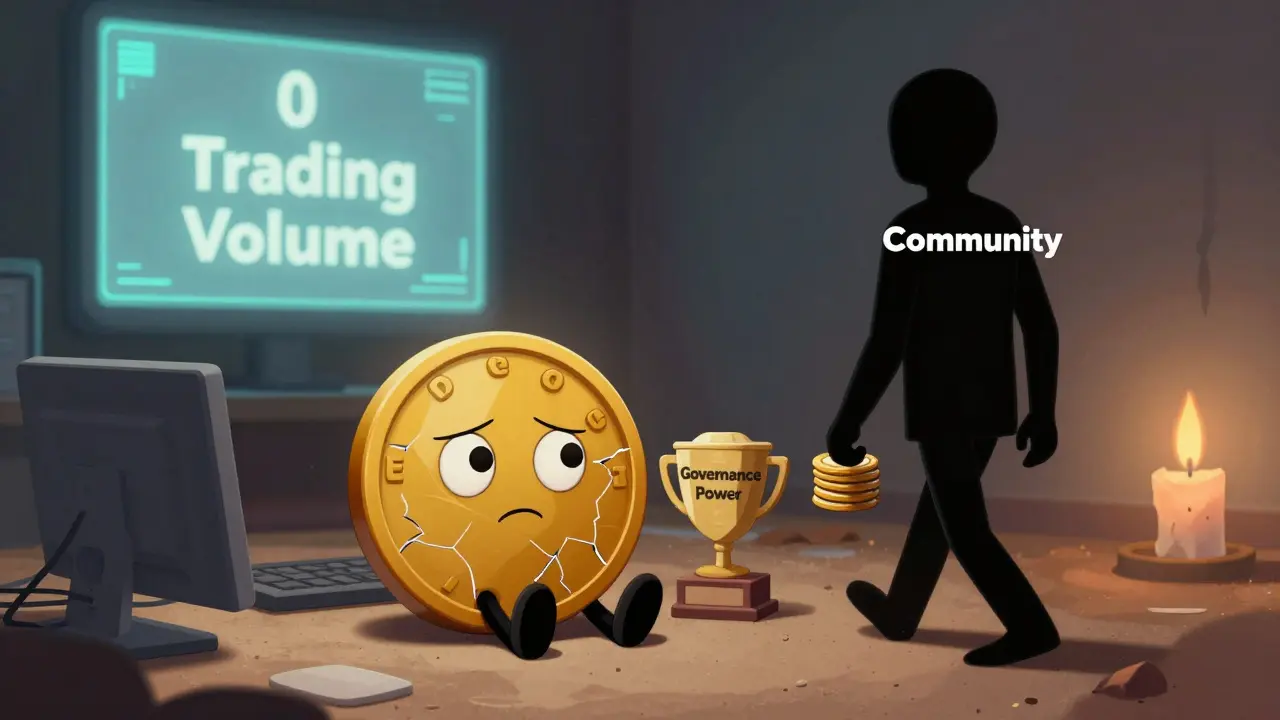
Right now, EDOGE trades at $0.000000004163. That’s less than one-hundredth of a cent. Its 24-hour trading volume? Barely noticeable. You’d need billions of tokens to make even a dollar. Compare that to other meme coins from the same era:- MOONDOGE: $0.0000828, $2,395 daily volume
- MOON DOGE: $0.00000000000007076, $42.59 daily volume
- Doge-1: $124,170 market cap, 2,240 holders
What Went Wrong?
The problem wasn’t the idea. It was execution - and timing. 2021 was the peak of meme coin mania. Dogecoin surged because of Elon Musk’s tweets. Shiba Inu exploded because of Reddit hype. Everyone thought, “If Dogecoin can go up 10,000%, why not this?” But when the market cooled, the lack of real utility showed. EDAO had voting power - but no one voted. The NFT auctions never gained traction. The ElonFuel launchpad never attracted serious projects. Without ongoing activity, the token lost its reason to exist. Also, CoinMarketCap’s involvement didn’t guarantee success. Their users were curious, but not committed. Getting 10,000 people to claim EDOGE didn’t mean 10,000 people would hold it. Most sold immediately. A few held. A handful tried to build something. None succeeded.What This Airdrop Teaches Us About Crypto
The ElonDoge airdrop is a case study in how not to build long-term value - even with good intentions. First, free tokens don’t create loyalty. People took EDOGE because it was free. They didn’t care about the mission. They didn’t read the whitepaper. They didn’t join the Discord. They just cashed out. Second, governance tokens need active users. EDAO was designed to be democratic. But democracy requires participation. Without regular votes, updates, or transparency, the system became meaningless. Third, partnerships with big platforms don’t guarantee survival. CoinMarketCap gave EDOGE visibility. But visibility doesn’t equal adoption. The platform didn’t endorse the project - it just hosted the airdrop. Once the campaign ended, the connection faded.
Is There Any Value Left in EDOGE?
Technically? No. Financially? No. But historically? Yes. The ElonDoge x CoinMarketCap airdrop is a snapshot of a moment in crypto history - when meme coins tried to grow up. It’s proof that even well-designed projects can fail if they don’t keep users engaged. If you held EDOGE from 2021, you’re not rich. But you’re part of a quiet experiment. You saw how a token with governance ambitions collapsed under its own weight. And if you’re considering a new airdrop today? Ask yourself: Is this just a free token? Or is there a real system behind it? Does the team update their roadmap? Do they hold votes? Do they respond to feedback? Because free coins are easy. Building something that lasts? That’s the real challenge.What Happened to CoinMarketCap’s Airdrop Program?
CoinMarketCap used to run airdrops like clockwork. “Learn and earn” campaigns were common. You’d watch a video, pass a quiz, and get USDT, NFTs, or tokens. They even ran a YouTube event offering $10,000 in rewards. But today? Their airdrop page shows zero active campaigns. Historical data doesn’t load. It’s as if they paused everything. Why? Probably because the market changed. Airdrops became saturated. People stopped taking them seriously. Projects stopped delivering value. And CoinMarketCap, as a data platform, didn’t want to be associated with dead tokens. The ElonDoge airdrop was one of the last major ones they ran. It wasn’t the end - but it was a turning point.Final Thoughts: The Ghost of EDOGE
ElonDoge didn’t vanish overnight. It faded slowly - like a candle left in an empty room. No drama. No crash. Just silence. But its story matters. It reminds us that crypto isn’t about hype. It’s about persistence. It’s about building systems that outlast trends. If you’re looking for the next big airdrop, don’t chase free coins. Chase real teams. Real utility. Real conversations. Because the tokens that survive aren’t the ones with the biggest launch. They’re the ones with the quietest, most consistent effort.Did the ElonDoge airdrop actually give people real value?
At the time, yes - $20,000 worth of EDOGE was distributed, and participants received tokens with potential governance rights through EDAO. But the value was entirely speculative. Most recipients sold immediately, and today, EDOGE is worth nearly nothing. The real value wasn’t in the tokens - it was in the lesson: free crypto doesn’t mean lasting value.
Is EDOGE still tradable today?
Yes, but barely. EDOGE is still listed on CoinMarketCap and trades on PancakeSwap. However, its 24-hour trading volume is near zero, and the price hovers around $0.000000004163. You can technically buy or sell it, but there’s no liquidity, no buyers, and no sellers actively trading it.
What was EDAO, and what did it do?
EDAO was the governance token of the ElonDoge ecosystem. It gave holders voting rights on key decisions like NFT auctions, treasury management, and which projects got listed on the ElonFuel launchpad. Unlike EDOGE, which was a meme coin, EDAO was meant to give the community control. But without active participation, the governance system became inactive.
Why did CoinMarketCap partner with ElonDoge?
CoinMarketCap partnered with ElonDoge to promote crypto education. Their standard model was "learn and earn" - users completed educational tasks to receive tokens. The goal wasn’t to promote ElonDoge as a good investment, but to introduce users to how decentralized ecosystems work. It was a teaching tool disguised as a giveaway.
Can I still claim EDOGE from the 2021 airdrop?
No. The 5-day airdrop campaign ended in June 2021. There are no active claims, no wallet recovery options, and no official portal to access old rewards. Even if you participated, the tokens were distributed once and only once. Any website claiming to help you claim them now is likely a scam.
Kevion Daley
March 21, 2026 AT 22:42Tammy Stevens
March 23, 2026 AT 16:05Justin Credible
March 23, 2026 AT 21:04Dheeraj Singh
March 25, 2026 AT 15:27Nicolette Lutzi
March 25, 2026 AT 16:15Domenic Dawson
March 26, 2026 AT 20:47Sam Harajly
March 28, 2026 AT 02:37Alice Clancy
March 28, 2026 AT 20:16Jenni Moss
March 29, 2026 AT 11:40Florence Pardo
March 31, 2026 AT 03:44Alicia Speas
March 31, 2026 AT 21:40Mansoor ahamed
April 2, 2026 AT 00:52Anand Makawana
April 2, 2026 AT 23:46Mohammed Tahseen Shaikh
April 3, 2026 AT 00:13Sarah Terry
April 4, 2026 AT 05:31Shayne Cokerdem
April 5, 2026 AT 10:35