Honeyswap Crypto Exchange Review: Is It Worth Your Time in 2026?
 May, 5 2026
You want to trade crypto without paying Ethereum gas fees that cost more than your actual trade. That is exactly why Honeyswap exists. Launched in September 2020 as a fork of Uniswap V2, this decentralized exchange (DEX) lives on the Gnosis Chain (formerly xDai Chain). It was built by the 1Hive community to solve one specific problem: high transaction costs on the Ethereum mainnet. If you are looking for a platform to move millions of dollars quickly, Honeyswap is not it. But if you need cheap, reliable swaps for smaller amounts or specific tokens on Gnosis, it might be your best option. Let’s break down whether this niche DEX still holds up in 2026.
What Exactly Is Honeyswap?
Honeyswap is a non-custodial automated market maker (AMM). Unlike centralized exchanges like Binance or Coinbase, you do not deposit funds into an account. Instead, you connect your wallet-like MetaMask, WalletConnect, or Fortmatic-and trade directly from liquidity pools. The platform is governed by the 1Hive DAO through the HNY token. This means decisions about protocol upgrades and fee structures are voted on by the community, not a corporate board.
The core value proposition here is simplicity and low cost. By operating primarily on Gnosis Chain, Honeyswap offers transactions that are nearly instant and cost fractions of a cent. In 2025, the platform expanded to include Polygon, with plans to integrate Arbitrum and other EVM-compatible chains. This multi-chain approach allows users to access liquidity across different networks while maintaining the low-fee advantage of Gnosis.
Trading Costs and Fee Structure
Fees are where Honeyswap shines compared to its competitors. The standard swap fee is 0.30%. Here is how that money is split:
- 0.25% goes directly to liquidity providers who fund the pools.
- 0.05% goes to the protocol fund.
- Specifically, 1/12 of the swap fees are allocated to Honey tokens, and another 1/12 goes to the local Comb token.
This structure incentivizes both global governance participation via HNY and local chain activity via Comb tokens. For comparison, Uniswap charges a similar 0.30% fee, but the gas fees on Ethereum can easily add another $5-$50 to your transaction depending on network congestion. On Gnosis Chain, those gas fees are negligible. If you are swapping $50 worth of tokens, Honeyswap saves you real money.
| Feature | Honeyswap | Uniswap | SushiSwap |
|---|---|---|---|
| Primary Network | Gnosis Chain, Polygon | Ethereum Mainnet, L2s | Multichain |
| Swap Fee | 0.30% | 0.30% (standard) | 0.30% |
| Avg. Gas Cost | <$0.01 | $5 - $50+ | Varies by chain |
| Total Value Locked (TVL) | ~$1.04 million | Billions | Billions |
| 24h Volume | ~$31,000 - $32,000 | Billions | Millions |
Liquidity and Trading Limits
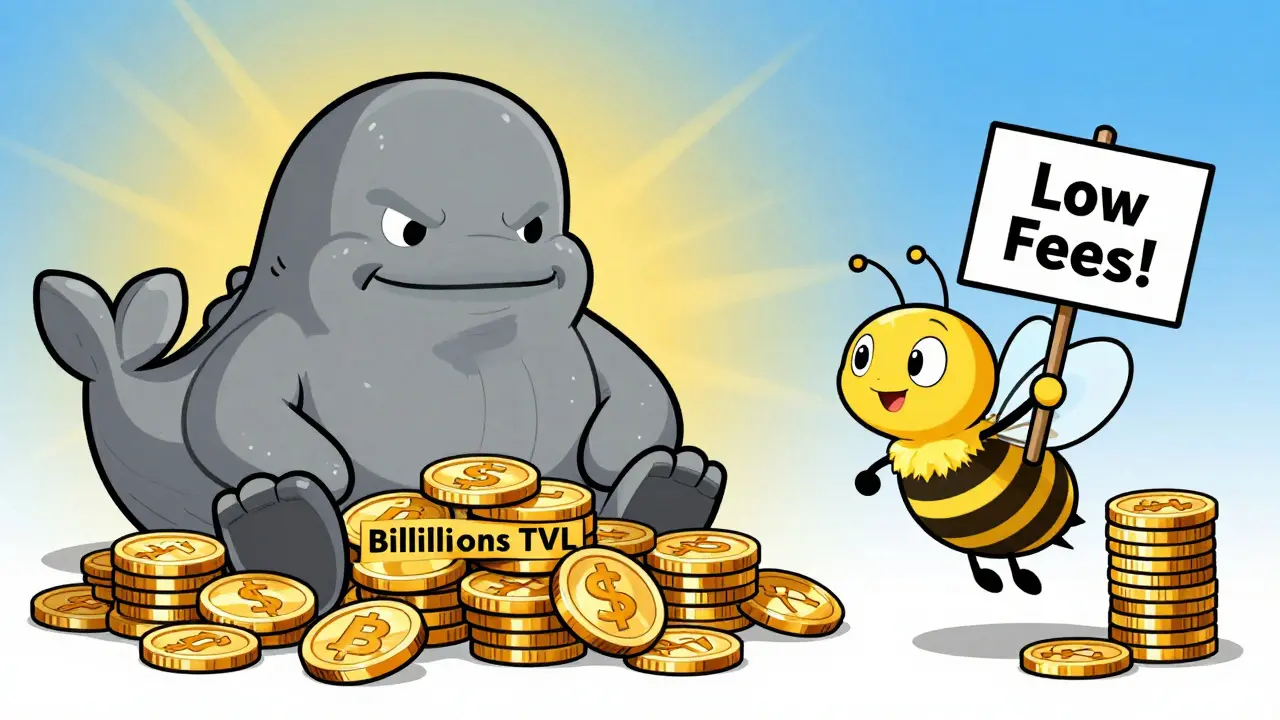
Here is the catch: Honeyswap is small. As of 2025, the total value locked (TVL) is approximately $1.04 million. To put that in perspective, Uniswap has billions in TVL. This means Honeyswap supports only 26 coins and 40 trading pairs. You will find major tokens like Dai, USDC, and ETH, but you won’t find the latest meme coin or obscure altcoin here.
The average bid-ask spread is 0.662%, which is reasonable for a DEX of this size. However, slippage becomes a real issue for larger trades. If you try to swap more than $5,000, you might see slippage above 2%. For micro-transactions or daily DeFi yield farming, this is fine. For serious trading volume, you will likely get better prices on larger platforms. The 24-hour trading volume hovers around $31,000-$32,000, indicating that most users are engaging in small-scale activities rather than heavy trading.
Security and Trust
When you use a DEX, you are interacting directly with smart contracts. Security is paramount. Honeyswap’s contracts have been audited by CertiK, a leading blockchain security firm. This provides a baseline level of trust. Additionally, because it is a fork of Uniswap V2, it benefits from years of battle-tested code. Uniswap has never suffered a major hack due to contract vulnerabilities, and Honeyswap inherits that robust architecture.
However, remember that being non-custodial means there is no customer support to refund stolen funds if you send them to the wrong address or fall for a phishing scam. You are responsible for your own keys. The platform does not require KYC (Know Your Customer) verification, which preserves anonymity but also means less regulatory oversight. As EU and US regulations tighten on DeFi in 2025-2026, keep an eye on how Honeyswap adapts to these changes.
User Experience and Accessibility
If you have used Uniswap before, Honeyswap will feel familiar. The interface is clean and straightforward. You select your input token, output token, and execute the swap. The learning curve is minimal for anyone already comfortable with Web3 wallets.
For new users, the biggest hurdle is setting up the correct network. You must configure your wallet to recognize the Gnosis Chain (xDai) or Polygon. Honeyswap provides guides for this, but it requires a bit of technical know-how. The platform also features the Honeycomb asset manager, which simplifies managing DeFi positions like deposits and withdrawals from Comb Farms. Support is community-driven via Discord and forums, with response times averaging 12-24 hours. Don’t expect live chat support.
Who Should Use Honeyswap?
Honeyswap is not for everyone. It is a specialized tool. You should consider using it if:
- You frequently transact on the Gnosis Chain and want to avoid Ethereum gas fees.
- You are participating in 1Hive ecosystem projects and need to swap HNY or Comb tokens.
- You prefer low-cost micro-transactions over high-volume trading.
- You value community governance and want to vote on protocol changes.
On the other hand, stick to larger DEXs like Uniswap or SushiSwap if you need deep liquidity, a wide variety of tokens, or plan to trade large sums regularly. The limited selection and lower volume on Honeyswap make it unsuitable for professional traders or those seeking exotic assets.
Future Outlook
The future of Honeyswap depends heavily on the adoption of the Gnosis Chain and broader EVM compatibility. Plans for 2025-2026 include expanding to Arbitrum and enhancing cross-chain functionality via OmniBridge. Industry analysts note that while the current revenue model generates only ~$20,000 annually, the strong community foundation could sustain growth if sidechain usage increases. Consensys projects 15-25% annual growth for sidechain DEXs as Ethereum Layer 2 solutions mature. Honeyswap is positioned to ride that wave, but it must compete with established players entering the same space.
Is Honeyswap safe to use?
Yes, Honeyswap is considered safe. Its smart contracts are audited by CertiK, and it uses the battle-tested Uniswap V2 architecture. However, as with all DeFi platforms, you are responsible for securing your own wallet and avoiding phishing scams. Always verify URLs and double-check transaction details.
Why is Honeyswap cheaper than Uniswap?
The swap fees are similar (0.30%), but Honeyswap operates on the Gnosis Chain, which has near-zero gas fees. Uniswap primarily runs on Ethereum Mainnet, where gas fees can be very high during peak usage. This makes Honeyswap significantly cheaper for small transactions.
Can I trade any cryptocurrency on Honeyswap?
No. Honeyswap currently supports only 26 coins and 40 trading pairs. It focuses on major assets like Dai, USDC, and ETH within the Gnosis and Polygon ecosystems. You will not find many obscure altcoins or new meme coins here.
What is the HNY token used for?
HNY is the governance token for the 1Hive DAO. Holders can vote on protocol upgrades, fee structures, and treasury allocations. It also receives a portion of swap fees, aligning incentives between users and developers.
Does Honeyswap require KYC?
No. Honeyswap is a non-custodial decentralized exchange. You only need a compatible Web3 wallet like MetaMask to access the platform. There is no identity verification process.