Global Bitcoin Hash Rate Distribution: Where is the Mining Power?
 Apr, 19 2026
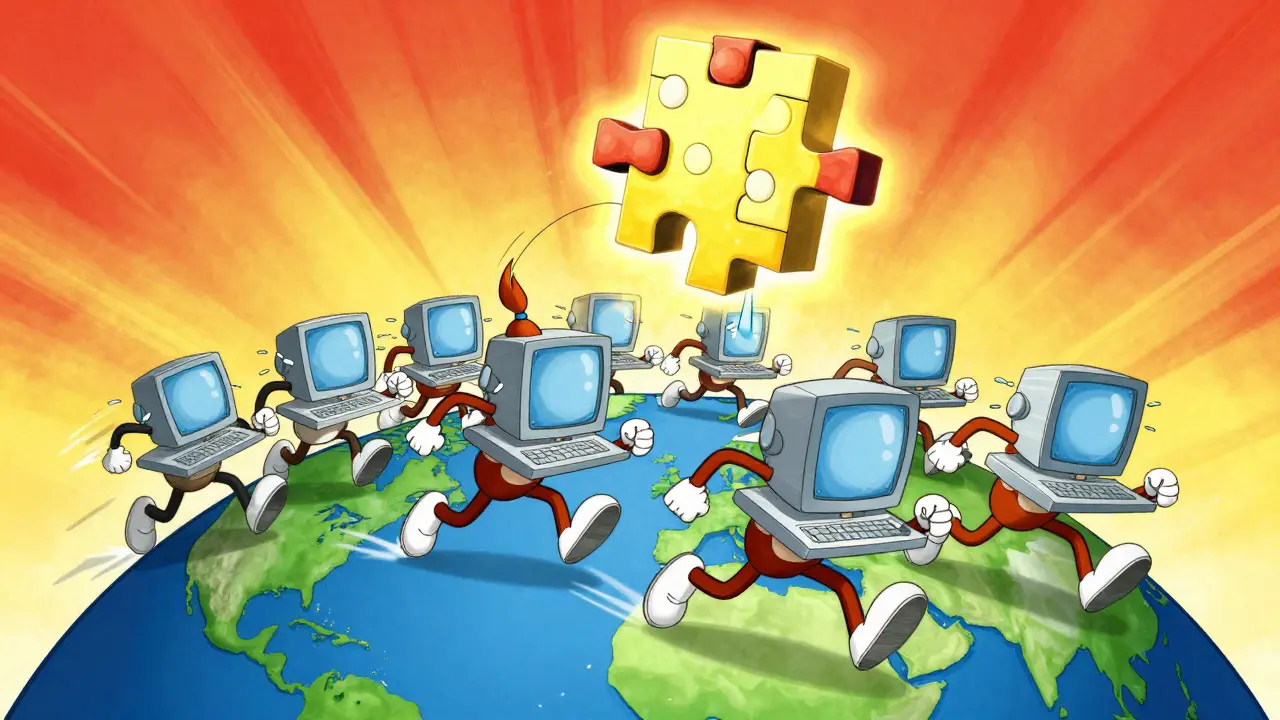
Imagine a global race where millions of high-powered computers compete to solve a single mathematical puzzle every ten minutes. The winner gets a pile of Bitcoin, but the real story isn't just about the reward-it's about where those computers are actually plugged in. If too many of these machines end up in one country or under one government's thumb, the "decentralized" dream of Bitcoin starts to look a lot more like a centralized corporate office. That's why tracking the Bitcoin hash rate distribution is the closest thing we have to a geopolitical map of the network's health.
The Big Shift: From Hobbyists to Industrial Giants
In the early days, you could mine Bitcoin on a laptop in your bedroom. Today, that's a fantasy. We've moved into the era of industrial-scale mining, where the main drivers aren't passion, but electricity costs and political stability. The most dramatic change occurred in June 2021 when China, which once dominated the map, banned mining. This created a massive "mining migration," pushing thousands of rigs across the globe in search of cheap power.
Now, the landscape is dominated by ASICs (Application-Specific Integrated Circuits), which are machines designed for one purpose only: mining. These aren't your average computers. By 2025, next-generation ASICs have improved performance by about 35% over older models. This creates a constant cycle: newer, more efficient machines enter the market, making older ones obsolete and pushing the hash rate higher while concentrating power in the hands of those who can afford the latest hardware.
Who Controls the Power? Geographic Breakdown
The distribution of mining power is rarely an accident; it's a calculation of where energy is cheapest and laws are clearest. Currently, the United States is the heavyweight champion, commanding roughly 44% of the global hash rate. Texas has become a particular hotspot because of its deregulated energy market and a surprising amount of renewable energy incentives.
Beyond the US, a few other players hold significant slices of the pie. Kazakhstan and Russia have leveraged their abundance of fossil fuels to attract miners, though they face more regulatory volatility than the Americans. Meanwhile, the Nordic countries are playing the long game with sustainability. Iceland, for example, powers over 92% of its mining via geothermal and hydro sources, making it a haven for companies trying to keep their carbon footprint low.
| Country | Approx. Market Share | Primary Energy Driver | Regulatory Environment |
|---|---|---|---|
| United States | 44% | Mixed/Renewables | Stable / State-led competition |
| Kazakhstan | 12% | Low-cost Coal/Gas | Fluctuating |
| Russia | 10.5% | Flare Gas/Hydro | Supportive of energy waste recovery |
| Canada | 9% | Hydroelectric | Stable / Green focus |
| Iran | 4.2% | Subsidized Energy | Restricted / Sanctioned |
The Role of Mining Pools: The Invisible Middlemen
You might think individual miners are the ones controlling the map, but most are actually part of a Mining Pool is a joint cooperative where multiple miners combine their computational power to increase their chances of finding a block . Instead of gambling on a solo win, miners contribute their hash rate to a pool and split the rewards based on how much work they did. This makes income predictable, but it introduces a new risk: concentration.
If a single pool-like Foundry or ViaBTC-controls more than 51% of the hash rate, they could theoretically manipulate the blockchain. While we aren't seeing a total monopoly yet, the trend toward larger pools means we are moving away from a network of thousands of small players toward a network of a few dozen powerful entities. This is a critical point for anyone worried about the true decentralization of the system.
Energy, Climate, and the "Green" Migration
The conversation around Bitcoin always hits a wall when electricity comes up. In the early 2020s, the network's power consumption was staggering, sometimes exceeding the national usage of Finland. However, by 2025, the footprint has stabilized to levels comparable to medium-sized countries like the Netherlands or Australia. The real shift isn't just in *how much* energy is used, but *what kind*.
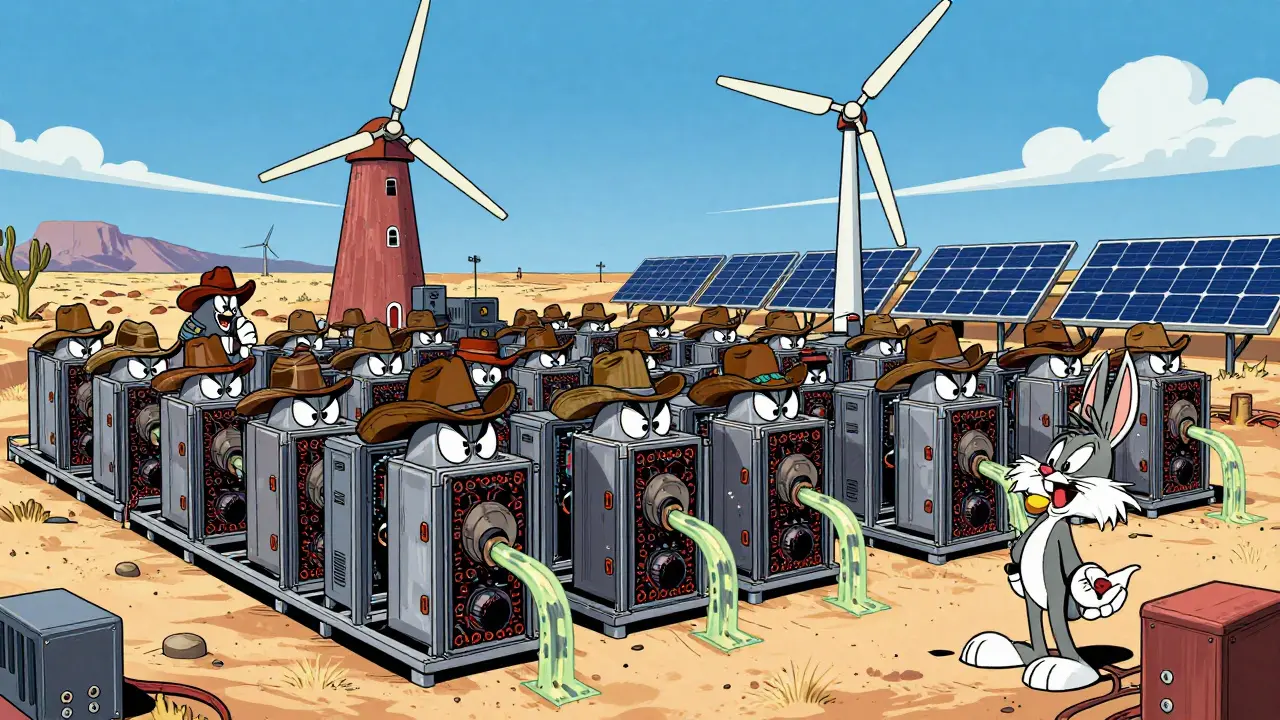
We're seeing a trend where mining is used as a tool for energy grid stabilization. In Russia, miners are using "flare gas"-gas that would otherwise be burned off and wasted during oil extraction-to power their rigs. In Norway, 96% of mining is powered by hydropower. This turns Bitcoin mining into a way to monetize stranded energy, which is a much easier sell to environmental regulators than building new coal plants to mine coins.

What Happens When the Difficulty Spikes?
Bitcoin has a built-in thermostat called the difficulty adjustment. Every 2,016 blocks (roughly every two weeks), the network looks at how fast blocks are being found. If the hash rate spikes because a new fleet of ASICs just arrived in Texas, the network makes the puzzles harder. This ensures that blocks are found every ten minutes regardless of how much power is thrown at the problem.
This creates a brutal economic environment. When difficulty rises, the profit margin for miners using old hardware disappears. If you're running a machine that's two generations old, you might find that you're spending more on electricity than you're making in Bitcoin. This "survival of the fittest" mechanism is what forces the hash rate to keep migrating toward regions with the absolute lowest electricity costs and the newest hardware.
Does a higher hash rate make Bitcoin more secure?
Yes. A higher hash rate means more computational work is required to alter the blockchain. For an attacker to perform a 51% attack, they would need to acquire and power an amount of hardware that exceeds the current global output, which becomes exponentially more expensive and physically difficult as the hash rate grows.
Why did mining move out of China?
The Chinese government launched a massive crackdown in June 2021, banning cryptocurrency mining and trading. Since China previously hosted the majority of the world's mining operations due to cheap hydropower (especially in Sichuan), this caused a global redistribution of hash rate to the US, Kazakhstan, and Canada.
What is an exahash per second (EH/s)?
An exahash is one quintillion hashes per second. When we say the Bitcoin network is at 1,000 EH/s, it means the global network is performing one quintillion guesses per second to solve the cryptographic puzzle required to mine a block.
Can I still mine Bitcoin at home?
Technically yes, but practically no. Because of the massive hash rate provided by industrial farms using ASICs, a home computer (even a powerful gaming PC) cannot compete. You would likely spend far more on electricity than you would ever earn in Bitcoin unless you have free, surplus electricity.
How does the location of miners affect the price of Bitcoin?
Location doesn't directly change the price, but it affects the network's stability. If mining is concentrated in one country and that country bans it, a large chunk of the hash rate disappears instantly, which can cause temporary volatility in block production times, though the difficulty adjustment eventually fixes this.
Next Steps for Following the Map
If you're tracking these trends, keep an eye on the Cambridge Blockchain Network Sustainability Index. It's one of the most reliable ways to see how the hash rate shifts month-to-month. Also, watch for new energy regulations in the US and Canada, as a single change in electricity tariffs can move thousands of miners across a border in a matter of weeks.
For those looking at the investment side, remember that the "arms race" of ASIC hardware means that operational efficiency (watts per terahash) is the only metric that truly matters. The winners won't necessarily be the ones with the most machines, but the ones who can find the cheapest, greenest power and the most stable political ground to plant their rigs.
John and Lauren Busch
April 21, 2026 AT 03:50Sure, let's just pretend that 44% in the US is totally decentralized and not just a few corporate farms in Texas lol.
Evan Iacoboni
April 22, 2026 AT 01:11The shift to ASICs basically killed the little guy. It's just a game of who has the biggest wallet and the cheapest power contract now.
Robert Preston
April 23, 2026 AT 09:07It is worth noting that the energy grid stabilization mentioned is actually a huge win for the network's long-term viability. By utilizing stranded energy like flare gas, mining transforms a waste product into a financial asset, which mitigates the environmental backlash and creates a symbiotic relationship with energy producers.
Abhinav Chaubey
April 23, 2026 AT 23:31Typical western obsession with Texas. India is becoming a powerhouse in tech and it's only a matter of time before we dominate the hash rate too. We have the talent and the infrastructure to blow these numbers out of the water regardless of what the current map says.
Saurav Bhattarai
April 25, 2026 AT 22:14Imagine thinking that a few wind farms in the US make the network "stable." How quaint. The sheer arrogance of assuming the US is the pinnacle of mining just because they have a few deregulated zones is honestly laughable. 🙄
Michael Harms
April 26, 2026 AT 15:04I love how this explains the move to greener energy! It's awesome to see Iceland and Norway leading the way. If we keep pushing for renewables, the whole network becomes a catalyst for green energy investment worldwide. Keep it up guys!
Anna Grealis
April 28, 2026 AT 06:00The whole thing is rigged anyway... these "mining pools" are just fronts for the central banks to keep control while we think its decentralised. probably just a way for them to track every single satoshi moving through the system using those asics to monitor traffic flow. wake up people.
siddharth narula
April 28, 2026 AT 10:42One must contemplate the spiritual void inherent in this relentless pursuit of computational dominance. 🧘♂️ We seek a digital utopia yet we tether our souls to the consumption of electrons and the cooling of metal. Is this not merely a modern iteration of the Sisyphus myth, where the boulder is a blockchain that grows ever heavier? 🕉️
Adam Mann
April 29, 2026 AT 00:11I really think it's great that there's so much information available now for people who are just starting to get into this world. It can be really overwhelming at first with all the talk of exahashes and ASICs and difficulty adjustments, but when you break it down like this, it starts to make sense. It's just a big global competition and as long as we keep welcoming new people and helping them understand how to get started without losing their shirts on electricity bills, the community will keep growing in a healthy way. I remember when I first heard about Bitcoin and I had no clue what a hash rate even was, so seeing this kind of breakdown is just wonderful for the newcomers who want to contribute to the network's security while also being mindful of the planet.
Keri Pommerenk
April 29, 2026 AT 07:13just keep learning everyone. the tech moves fast but the basics of energy and cost always stay the same
Tracy Sperandio
April 30, 2026 AT 22:07Absolutely electric breakdown! The way the hash rate just leaped across borders after the China ban was a total whirlwind of chaos and opportunity. It's a vivid testament to the sheer resilience of the code-you can't just flip a switch and kill a global network! The energy migration is a dazzling display of economic agility!
Karen Mogollon Gutierrez
May 2, 2026 AT 20:32It is an absolute travesty that the integrity of a decentralized currency is now so perilously dependent on the whims of the Texas energy grid. The sheer audacity of imagining this as "secure" while the power is concentrated in a handful of industrial conglomerates is utterly exhausting. I find the state of these affairs to be nothing short of catastrophic for the original vision of the blockchain.
Shannon Kelly Smith
May 4, 2026 AT 16:24Focus on the efficiency guys! 🚀 The transition to next-gen ASICs is just evolution. Let's help each other find the best setups! ⚡️💎
Gillian Kent
May 5, 2026 AT 17:47i think its cool that iceland is using volcano heat lol. kinda weird but works i guess.
Mike Kempenich
May 7, 2026 AT 01:08The difficulty adjustment is the real MVP here. It keeps everything fair and balanced, making sure the network doesn't crash just because someone bought a thousand new rigs. It's a solid system that proves the design is robust.