How Citizens in Banking-Restricted Countries Access Crypto Exchanges
 Sep, 14 2026
Imagine trying to buy a loaf of bread, but the shopkeeper refuses your local currency because it’s "too volatile." Now imagine that same shopkeeper also bans you from using credit cards, PayPal, or bank transfers. This is the daily reality for millions of people living in countries where governments have slapped strict bans on cryptocurrency. From China’s total prohibition to Nigeria’s banking blockade, the regulatory landscape is hostile. Yet, if you look at the data, adoption isn’t dying-it’s adapting. In 2024 alone, restricted nations accounted for $1.27 trillion in crypto transaction volume. So, how do these citizens actually get their hands on digital assets when their banks say no? They’ve built a shadow economy of workarounds that would make a spy thriller blush.
The Reality of Banking Bans
First, let’s be clear about what we’re dealing with. It’s not just that banks are slow; they are often legally prohibited from touching crypto. As of 2025, nine countries-including Afghanistan, Algeria, Bangladesh, and China-have implemented complete Bitcoin bans. Others, like Turkey and Vietnam, enforce severe restrictions that effectively lock out traditional financial rails. In Algeria, violating anti-money laundering laws by trading crypto can land you in prison. In Bangladesh, the Money Laundering Prevention Act classifies crypto trading as illegal. The Central Bank of Nigeria has maintained a banking ban since 2017, reinforcing penalties for any financial institution that facilitates crypto payments.
This isn’t just an inconvenience; it’s a barrier to entry. When your bank freezes your account for sending money to an exchange, or when you can’t convert your local currency into USDT because the exchange doesn’t accept your country’s IP address, you need a plan B. And usually, that plan involves technology, community trust, and a bit of nerve.
The Power of Peer-to-Peer (P2P) Trading
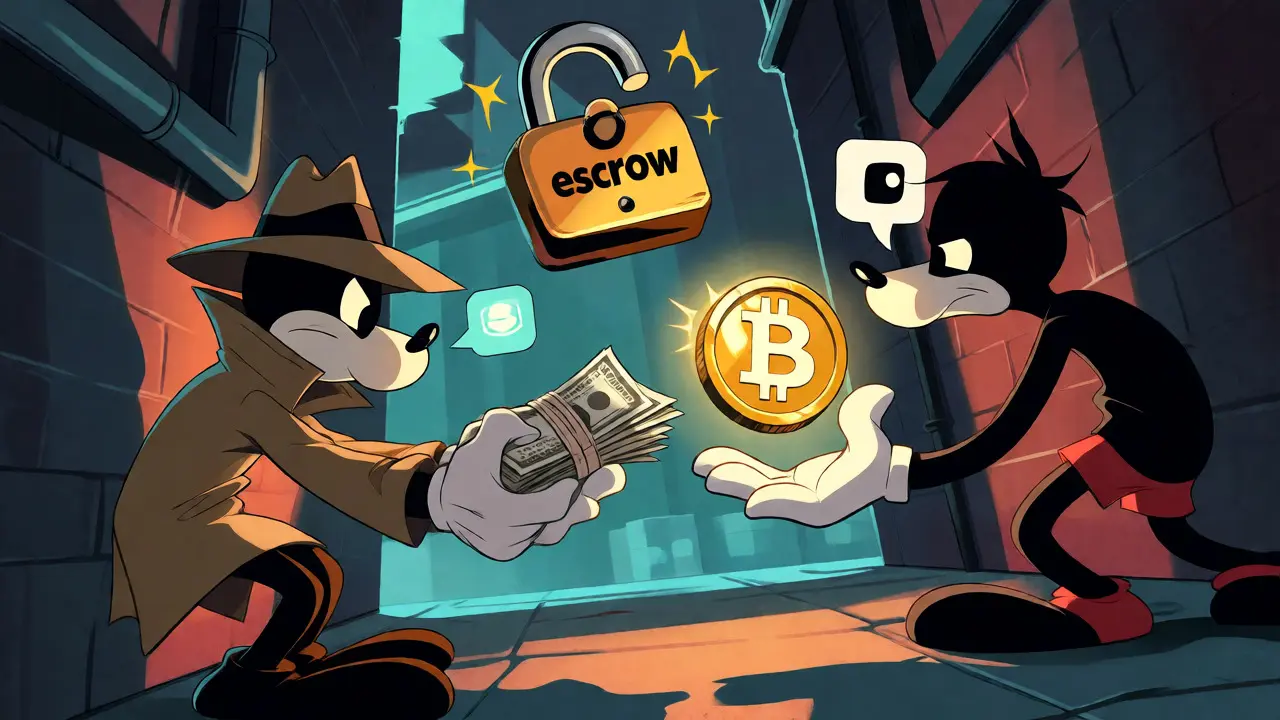
If there’s one method that dominates in restricted zones, it’s Peer-to-Peer (P2P) trading. Unlike centralized exchanges that require direct bank deposits, P2P platforms connect buyers and sellers directly. You send money via a local bank transfer, mobile money service, or even cash deposit to another user, and the platform releases the crypto from escrow. No bank sees a transaction labeled "Bitcoin"; they just see a standard transfer between two individuals.
Platforms like Binance P2P, Paxful, and LocalBitcoins are lifelines here. In Q1 2025, Paxful reported 1.2 million active users from Nigeria, Venezuela, and Argentina alone. Why does this work? Because it bypasses the institutional chokehold. A user in Lagos might buy USDT from a seller in London using a local bank transfer. The blockchain settles the asset, while the fiat moves through normal domestic channels. However, it’s not without friction. Vietnamese users report paying a 2.5% premium over market rates to compensate middlemen for the risk. And yes, scams exist. Trustpilot reviews for some P2P sites show low ratings due to transaction delays exceeding 72 hours, so vetting your counterparty is non-negotiable.
Decentralized Exchanges: The No-KYC Haven
For those who want to avoid handing over their passport to a foreign entity, decentralized exchanges (DEXs) offer a different path. Platforms like Uniswap, PancakeSwap, and Bisq don’t ask for Know Your Customer (KYC) verification. You connect a wallet, swap tokens, and walk away. According to Koinly’s October 2025 analysis, there are over 20 no-KYC exchanges facilitating private trading.
The trade-off? Liquidity and usability. While Coinbase processes billions daily, Bisq averages only $1.2 million in daily volume. For a small trader, this means slippage-the price changes significantly while your order is executing. But for privacy-conscious users in Iran or North Korea, anonymity is worth the cost. Following OKX’s expansion of restrictions in January 2025, which cut off dozens of countries, Uniswap v4 saw a 187% spike in users from restricted regions. These users aren’t looking for the best price; they’re looking for the ability to transact without being watched.
| Method | Privacy Level | Liquidity | Technical Barrier | Risk Factor |
|---|---|---|---|---|
| P2P Platforms | Medium | High | Low | Counterparty Scams |
| No-KYC CEXs | Medium-High | Medium | Low | Account Freezes |
| DEXs | Very High | Low-Medium | High | Smart Contract Bugs |
| Gift Card Arbitrage | Medium | Low | Low | Fraudulent Cards |
| Hawala Networks | Very High | Variable | Low | Trust Dependency |
Masking Your Location: VPNs and Tor
Even if you find a platform that allows your country, many exchanges block IPs from restricted jurisdictions automatically. Enter the Virtual Private Network (VPN). NordVPN reported a 342% increase in users from Nigeria and a 217% increase from China between late 2023 and 2024. By masking your geographic location, you can access interfaces that would otherwise be geo-blocked.
But a VPN isn’t magic. If you log into Binance with a Nigerian phone number and a German IP address, algorithms flag it. Users often combine tools: a reputable VPN (like ExpressVPN, costing around $12/month) paired with a browser fingerprint changer. In more extreme cases, like in North Korea or parts of Iran, the Tor browser becomes essential. Tor Project metrics show a 223% adoption growth in North Korea. It’s slower, clunkier, and requires more technical know-how, but it keeps the connection encrypted and routed through multiple nodes, making surveillance harder.
Creative Fiat On-Ramps: Gift Cards and Hawala
What if you can’t even use a bank transfer? Some users turn to gift card arbitrage. You buy Steam, iTunes, or Amazon gift cards with local cash or retail purchases, then sell them on platforms like Paxful for crypto. Chainalysis documented $427 million in gift card-based crypto transactions from restricted countries in 2024. It’s inefficient-you lose value in the spread-but it works when other doors are closed.
In the Middle East, traditional informal value transfer systems known as Hawala have adapted. Instead of moving physical cash across borders, brokers now settle debts using stablecoins. Dubai’s VARA-compliant exchanges process over $30 billion in such transactions annually. This hybrid model leverages centuries-old trust networks with modern blockchain settlement, allowing users to move value without ever touching a Western bank account.

The Hidden Costs and Risks
Don’t let the innovation fool you: this ecosystem is fragile. A survey by Datawallet found that 63% of users rely on VPNs, and nearly half experience service interruptions during government-imposed internet blackouts. Worse, security risks are high. Professor David Yermack of NYU Stern notes that 67% of users in restricted countries report at least one security incident. Twelve percent lost significant funds to scams specifically targeting no-KYC exchange users.
There’s also the issue of support. Only 37% of no-KYC exchanges offer multilingual customer service, with average response times hitting 58 hours for non-English queries. If your funds are stuck, you’re largely on your own. Community-driven resources like the 'Crypto Without Borders' Telegram channel (with 147,000 members) fill some gaps, offering country-specific guides, but they can’t replace regulated recourse.
Looking Ahead: Surveillance vs. Privacy Tech
The cat-and-mouse game is accelerating. Governments are enhancing blockchain surveillance capabilities, meaning simple VPN tricks may soon fail. In response, adoption of privacy coins like Monero and Zcash has spiked-up 317% in China since 2023. Gartner predicts that zero-knowledge proof implementations will grow by 340% in restricted markets by 2026. These technologies allow users to prove they have funds without revealing their identity or transaction history.
For now, resilience wins. Despite the bans, Nigeria ranks 4th globally in grassroots crypto adoption. Citizens aren’t waiting for permission; they’re building infrastructure in the cracks. If you live in a restricted zone, start small. Test a P2P trade with a small amount. Learn to manage your seed phrases offline. Don’t put all your eggs in one basket-or one jurisdiction.
Can I use my local bank account to buy crypto in a banned country?
Directly, usually no. Banks often freeze accounts associated with crypto exchanges. However, you can use your bank account for P2P transfers to individual sellers. The key is ensuring the transfer looks like a standard payment between friends or family, avoiding keywords like "Bitcoin" or "Exchange" in the memo field.
Are no-KYC exchanges safe?
They offer privacy but carry higher risks. Without KYC, there is less regulatory oversight, meaning fewer consumer protections if the platform collapses or runs a scam. Always check liquidity levels and community reputation before depositing large amounts. Decentralized exchanges (DEXs) are generally safer regarding custody since you hold your own keys, but smart contract risks remain.
Do I need a VPN to access crypto exchanges?
Often, yes. Many exchanges geoblock users from restricted countries based on IP address. A reliable paid VPN helps mask your location. However, be aware that some exchanges detect and block common VPN IP ranges, so you may need to switch servers or providers occasionally. Free VPNs are rarely recommended due to poor speeds and potential data logging.
What is the most secure way to store crypto in restricted countries?
Hardware wallets (cold storage) are the gold standard. Since you control the private keys, no exchange can freeze your funds. For software options, non-custodial wallets like Trust Wallet or MetaMask are popular. Never leave large amounts on an exchange, especially in jurisdictions where regulators can force exchanges to seize assets.
Why do P2P trades sometimes take days?
Delays occur due to time zone differences, weekend banking closures, or disputes requiring manual intervention by platform moderators. In restricted countries, banks may also hold suspicious transfers for review, slowing down the release of funds. Always communicate clearly with your counterparty and keep receipts for all fiat transfers.