Token Swap Crypto Exchange Review: Uniswap, Binance, and GhostSwap Compared (2026)
 Aug, 4 2026
You want to trade Bitcoin for Ethereum or swap some stablecoins for a new altcoin. You don't necessarily want to sell everything back to dollars first. That is where token swap services come in. They let you exchange one cryptocurrency for another directly, instantly, and often without leaving your wallet.
But here is the catch: there isn't just one 'Tokenswap' app you download and forget about. The term usually refers to a feature found across dozens of platforms, from giant centralized exchanges like Binance to decentralized protocols like Uniswap. Picking the wrong one can cost you hundreds of dollars in hidden fees or leave your funds stuck in a failed transaction.
In this review, we break down the actual landscape of token swapping in 2026. We look at who runs these services, how much they really cost, and which ones are safe enough for your savings versus which are better for quick, small trades.
How Token Swaps Actually Work
Before comparing specific platforms, it helps to understand what happens behind the scenes when you click 'Swap.' There are two main models dominating the market right now: Centralized Exchanges (CEX) and Decentralized Exchanges (DEX).
The choice between them depends on what you value more: speed and ease of use (CEX) or privacy and self-custody (DEX). According to Messari's Crypto Outlook 2025 report, the sector has grown by 34.5% year-over-year since 2023, driven largely by users seeking faster alternatives to traditional buy/sell flows.
Top Token Swap Platforms Reviewed
Let’s look at the heavy hitters. If you are searching for 'token swap,' you will likely encounter these three names most often: Binance, Uniswap, and GhostSwap. Each serves a different type of user.
| Platform | Type | Avg. Fee/Cost | KYC Required? | Best For |
|---|---|---|---|---|
| Binance | CEX | 0.1% service fee + spread | Yes | High-volume traders, fiat on-ramps |
| Uniswap | DEX | Variable gas ($1-$15+ on ETH) | No | Ethereum native tokens, privacy seekers |
| GhostSwap | Cross-chain DEX | Low network fees (~$0.10) | No | Cross-chain swaps (ETH to SOL, etc.) |
Binance: The Volume King
Binance dominates the space with 22.1% of the global swap market share as of September 2025. Their swap feature is incredibly convenient if you already have an account. You can convert USDT to BTC in seconds with near-zero slippage because their liquidity pools are massive-processing $227 billion in daily trading volume according to their Q2 2025 financial disclosure.
However, convenience comes with a price. While advertised rates look good, many users report hidden costs. On Reddit's r/CryptoCurrency, a common complaint in late 2025 was that the swap fee calculator didn't reflect the final charge. One user noted getting charged 0.5% instead of the advertised 0.1% on low-volume pairs. Plus, you must complete KYC (Know Your Customer) verification, which can take anywhere from 12 to 72 hours depending on your region.
Uniswap: The DeFi Standard
If you live in the world of Ethereum, Uniswap is unavoidable. Launched in 2018, it pioneered the AMM model. As of 2026, Uniswap V4 handles transactions across 11 blockchain networks. It holds a staggering $4.2 billion in Total Value Locked (TVL), making it the deepest source of liquidity for ERC-20 tokens.
The big advantage? No account needed. You connect your MetaMask or Trust Wallet, and you’re done. But be warned: gas fees on Ethereum can be brutal. Post-Dencun upgrade, average gas fees sit between 12-18 gwei, but during busy periods, swapping $100 worth of tokens could cost you $15 in network fees. Uniswap excels for large trades where percentage fees matter less than absolute cost, or for obscure tokens not listed on centralized exchanges.
GhostSwap: The Cross-Chain Contender
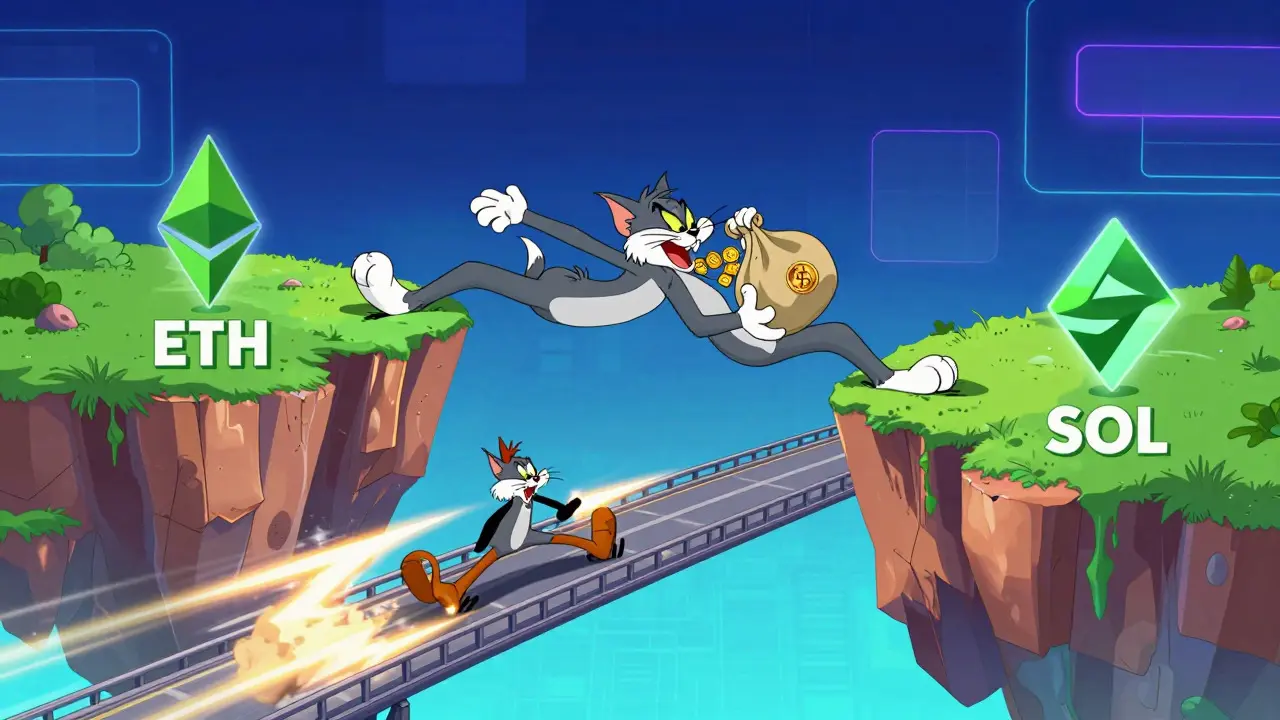
GhostSwap has emerged as a serious alternative for users tired of bridge risks. Highlighted in CoinGape's October 2025 review, it supports over 1,500 cryptocurrencies and enables atomic swaps between 12 major blockchains. This means you can swap ETH for Solana (SOL) directly without sending funds through a risky third-party bridge.
It captures 78% of the cross-chain swap niche, according to TokenInsight. Fees are significantly lower than Ethereum-based DEXs, often under $0.10 per transaction. It requires no KYC and processes transactions with a 99.98% success rate. For power users moving assets between chains, this is currently the most efficient tool available.
Hidden Costs: Slippage, Gas, and MEV
When reviewing any swap service, the headline fee is rarely the full story. You need to watch out for three invisible costs that eat into your profits.
- Slippage: This is the difference between the expected price of your trade and the executed price. In thin liquidity pools, slippage can exceed 1%. University of Zurich research from September 2025 shows that while average DEX slippage has dropped to 0.37% in 2025 (down from 1.8% in 2022), it remains a risk for large orders.
- Gas Fees: On DEXs, you pay the network, not the platform. A simple swap on Polygon might cost $0.01, while the same swap on Ethereum Mainnet could cost $5.00. Always check the current gas tracker before initiating a DEX swap.
- MEV (Maximal Extractable Value): Bots monitor pending transactions to front-run your trade, buying the asset before you do and selling it back to you at a higher price. Flashbots data reveals users lost $47.8 million to MEV attacks in Q3 2025 alone. Aggregators like 1inch help mitigate this by routing your trade through the most efficient path.
Security Risks: Who Holds Your Keys?
Security is the biggest differentiator between CEX and DEX swaps. Chainalysis' Q2 2025 security report found that 92.7% of swap-related hacks occurred on centralized exchanges, compared to just 7.3% on properly configured DEXs.
Why? Because on a CEX like Binance, you are trusting a company to safeguard your funds. If their hot wallets are compromised-as seen in the $285 million Binance hack in July 2025 documented by the Blockchain Transparency Institute-you rely on insurance or customer support to get paid back. There is no guarantee.
On a DEX like Uniswap or GhostSwap, your funds never leave your wallet unless you approve a swap. The risk shifts from 'will the exchange steal my money?' to 'did I approve a malicious contract?' To stay safe:
- Always double-check the contract address before approving unlimited spending.
- Use hardware wallets (Ledger/Trezor) for large amounts.
- Revoke unused approvals regularly using tools like Revoke.cash.
Regulatory Reality Check for 2026
The regulatory landscape is tightening. The EU's MiCA framework requires all swap platforms to implement Travel Rule compliance by January 2026. This could force many non-KYC DEXs to integrate identity checks or face bans in European jurisdictions.
SEC Commissioner Hester Peirce cautioned during DC Fintech Week 2025 that platforms offering cross-chain functionality without KYC, like GhostSwap, operate in gray areas. Meanwhile, the SEC filed charges against three swap platforms in September 2025 for unregistered securities trading. If you are in a highly regulated jurisdiction, sticking to compliant CEXs like Binance may offer more legal protection, even if it sacrifices privacy.
How to Choose the Right Swap Platform
So, which one should you use? Here is a simple decision tree based on your needs:
- Use Binance (CEX) if: You are trading large volumes, need fiat on/off ramps, or prioritize simplicity over privacy. Ensure you enable 2FA and withdraw funds to a cold wallet after trading.
- Use Uniswap (DEX) if: You are trading Ethereum-native tokens, want access to thousands of unlisted altcoins, or prefer self-custody. Be prepared to pay higher gas fees during peak hours.
- Use GhostSwap (Cross-Chain DEX) if: You frequently move assets between different blockchains (e.g., ETH to SOL, AVAX to MATIC). It offers the best balance of low fees and security for multi-chain users.
For beginners, the learning curve for DEXs is steep. The Ethereum Foundation's 2025 study found users need approximately 8.7 hours of learning time to confidently use DEX features, compared to just 1.2 hours for CEX swaps. Start small. Test with $10 before moving your life savings.
What is the cheapest way to swap crypto in 2026?
The cheapest method depends on the blockchain. For Ethereum-based tokens, using Layer 2 solutions like Arbitrum or Optimism via Uniswap reduces gas fees to pennies. For cross-chain swaps, GhostSwap typically offers the lowest total cost due to low network fees on chains like BNB Smart Chain or Polygon, avoiding expensive Ethereum mainnet gas entirely.
Is it safer to swap on Binance or Uniswap?
It depends on your definition of safety. Uniswap is safer from exchange hacks because you retain custody of your funds; however, you bear the risk of interacting with buggy smart contracts or phishing sites. Binance is safer from user error (no seed phrases to manage) but carries counterparty risk-if the exchange fails or gets hacked, your funds are at risk. Statistically, DEXs have had fewer massive fund losses in recent years.
Do I need KYC to use a token swap service?
Not always. Decentralized exchanges (DEXs) like Uniswap, PancakeSwap, and GhostSwap generally do not require KYC because they run on public blockchains. Centralized exchanges (CEXs) like Binance, Coinbase, and Kraken almost always require KYC verification to comply with anti-money laundering laws.
What causes high slippage in token swaps?
Slippage occurs when there isn't enough liquidity in the trading pair to fill your order at the current price. This is common with new, low-cap tokens or large trade sizes. To minimize slippage, set a tight slippage tolerance (0.5%-1%) in your wallet settings and consider breaking large trades into smaller chunks.
Can I swap crypto anonymously?
Yes, using a DEX like Uniswap or GhostSwap allows for pseudonymous trading. Since no account is created, only your wallet address is visible on the blockchain. However, if you transfer funds from a KYC'd exchange to your wallet, your identity is still linked to that address history. True anonymity requires careful chain-hopping practices.
Matt Kay
August 6, 2026 AT 05:21too much reading for a simple swap
Dave Kjendal
August 7, 2026 AT 08:42the essence of the matter is not the platform but the trust we place in it. people think they are free when they use uniswap but they are just slaves to gas fees. binance is a cage with gold bars. ghostswap is a mirage. none of them are real. you are just moving numbers on a screen that someone else controls. why do we bother? because we are addicted to the green candles. it is pathetic really. we chase yield like rats in a maze. the house always wins. even if the house is decentralized. it is still a house.
Kat Bennett
August 8, 2026 AT 07:58i actually found this breakdown super helpful especially since i have been trying to figure out how to move my eth to sol without losing half my money in bridge fees or waiting three days for confirmation which is just so frustrating and honestly kind of scary when you see all the news about hacks lately so i am really glad someone took the time to lay out the differences between cex and dex clearly because i was always confused about why i needed kyc for some things and not others and now i understand that it has to do with who holds the keys which is such an important distinction for peace of mind when you are dealing with your savings. thanks for sharing this perspective it makes me feel more confident about trying ghostswap next time i need to cross chains instead of just suffering through high ethereum gas prices every single day which is exhausting.
Candice Cornett
August 9, 2026 AT 15:52you guys are missing the point entirely. the problem isnt the fee structure or the slippage. the problem is that you are letting corporations dictate your financial freedom. binance is evil. uniswap is elitist. ghostswap is probably a scam. but here is the truth. you should just hold bitcoin. everything else is noise. stop swapping. stop trading. just hodl. if you are swapping you are gambling. gamblers lose. it is that simple. no amount of low fees will save you from your own greed. wake up sheeple.
Lance Jantz
August 10, 2026 AT 14:15ah the sweet nectar of decentralization! 🍷 i must say the comparison is quite exquisite though i find myself gravitating towards the poetic tragedy of the centralized exchange. there is something beautifully ironic about trusting a faceless entity with your digital soul while preaching 'not your keys not your coins' isn't there? it is a delightful paradox. however for those of us who appreciate the finer nuances of cross-chain liquidity ghostswap does offer a rather charming solution to the bridging conundrum. one must admire the audacity of atomic swaps. truly a symphony of code and chaos.
Don Fizy
August 11, 2026 AT 19:19great overview! :) i always tell my friends to start small with dexs. dont rush into large trades until you understand gas mechanics. it is a learning process. take your time. happy swapping! :)
Phil Babb
August 12, 2026 AT 02:45LISTEN UP!!! IF YOU ARE NOT USING A HARDWARE WALLET YOU ARE DOING IT WRONG!! STOP LEAVING YOUR COINS ON BINANCE!!! THEY WILL GET HACKED!!! I TOLD YOU SO!!! USE LEDGER!!! USE TREZOR!!! PROTECT YOUR ASSETS!!! THIS IS NOT A DRILL!!! THE SEC IS WATCHING!!! BE FREE OR DIE TRYING!!!
Qolbina Islami
August 13, 2026 AT 05:35typical western propaganda pushing these decentralized scams. in america you trust a company to steal your money and call it security. in our countries we know the value of real assets. crypto is a bubble created by tech bros to avoid taxes. soon the government will shut it all down and then where will you be? crying in the streets. join the resistance against digital slavery.
SUBHAM CHOUDHURY
August 15, 2026 AT 01:44very informative article. keep going. you can do it. believe in yourself. crypto is the future. stay positive. good luck everyone.
Joy Kwant
August 16, 2026 AT 14:25i just feel so drained after reading this. why is everything so complicated? i just want to trade without worrying about mev bots or slippage or gas wars. it feels like the system is designed to make us fail. every time i try to learn something new i get hit with another hidden cost. it is exhausting. maybe i should just give up and go back to fiat. at least banks don't ask me to understand smart contracts before they take my money. sigh.
amy miranda
August 17, 2026 AT 21:32The author fails to mention the environmental impact of proof-of-work chains which are still relevant in some contexts. It is irresponsible to recommend platforms without discussing their carbon footprint. We owe it to the planet to choose sustainable options. The moral decay of the crypto community is evident in its disregard for ecological consequences. One must question the ethics of profiting from energy-intensive networks. It is simply unacceptable.
Pernelia Wahkan
August 19, 2026 AT 05:58the interplay between liquidity providers and market makers is a fascinating dance. consider how the automated market maker formula creates a dynamic equilibrium that shifts with every transaction. it is almost organic in its complexity. yet beneath the surface lies a rigid mathematical structure that governs value exchange. understanding this duality is key to mastering the art of swapping. one must look beyond the interface to see the underlying machinery.
Subhash Kashyap Dm
August 19, 2026 AT 09:52they want you to think you have choice. you dont. binance is controlled by the deep state. uniswap is a honeypot for feds. ghostswap is a front for laundering. all data is tracked. all transactions are linked. the blockchain is a surveillance tool. wake up. the matrix is real. trust no one. verify everything. but mostly just hide your wealth in cold storage and pray.
Billy Cunningham
August 19, 2026 AT 13:43ugh 😩 why is it so hard
Ed Wallace
August 20, 2026 AT 05:48there is a profound beauty in the concept of permissionless finance. it challenges the very notion of gatekeepers. when we swap tokens we are participating in a global experiment in trustless cooperation. it is messy and chaotic but also incredibly liberating. the friction we experience is the growing pain of a new paradigm. embrace the uncertainty. it is where innovation thrives.
Joshua Hofford
August 21, 2026 AT 04:43hey folks! great read. i love how this breaks down the cultural shift from traditional banking to web3. it is like watching history unfold in real time. each platform represents a different philosophy about money and control. cool stuff!
Marcia Albert
August 22, 2026 AT 18:59just vibing with the idea of atomic swaps. it feels like magic. one second you have eth the next you have sol. no bridges no waiting. just pure flow. the tech is getting smoother every year. nice writeup.
Emma Smith
August 24, 2026 AT 11:27look at the contract address before you approve spending limits. most people ignore this step and wonder why their wallet gets drained. it is basic hygiene. if you cant read a line of code you are playing russian roulette with your funds. stop being lazy. check the docs. verify the source. do not let your ego blind you to risk.
Ed Mitchell
August 25, 2026 AT 17:56The regulatory framework is a facade designed to protect institutional interests while crushing retail participation. The SEC's actions are nothing short of economic warfare against the common man. They fear decentralization because it strips them of power. Do not let them intimidate you. Use DEXs. Avoid KYC. Resist the narrative. The truth is buried under layers of bureaucratic jargon. Stay vigilant.