What Happens If You Lose Your Private Key? The Permanent Loss of Cryptocurrency
 Jan, 25 2026
Imagine waking up one morning and realizing you can’t find your private key. Not the password to your email. Not your bank login. Your private key - the one and only thing that lets you spend your Bitcoin, Ethereum, or any other cryptocurrency. You check your phone, your laptop, your USB drive. You dig through old notebooks. Nothing. That’s it. The money is still on the blockchain. It’s still there. But you can’t touch it. Not ever again.
This isn’t science fiction. It happens every day. Around 3.7 million Bitcoin - worth over $248 billion as of January 2026 - is locked away forever because someone lost the key. No one can recover it. Not the exchange. Not the government. Not even the creators of Bitcoin. The system was built this way on purpose. And once you lose that key, you lose everything.
Why There’s No ‘Forgot Password’ Button for Crypto
Traditional banking works because there’s a middleman. If you forget your password, you call customer service. They verify your identity with your birthdate, your mother’s maiden name, a photo ID. Then they reset it. Simple.
Cryptocurrency doesn’t work like that. There’s no bank. No customer service line. No one holding your money. Your wallet is controlled by a 256-bit number - a string of 64 random letters and numbers - or a 12- to 24-word recovery phrase. This key is mathematically tied to your wallet address. And the math? It’s one-way. You can generate a public address from the private key. But you can’t go backward. Not even with a supercomputer.
The system is designed to be trustless. That means no one else should be able to access your funds - not even the developers. That’s the whole point. But it also means if you mess up, there’s no safety net. As Andreas Antonopoulos put it in Mastering Bitcoin: “There is no such thing as a lost bitcoin, only lost private keys.” The coins are still there. They’re just locked in a vault… and you lost the key.
What Does a Private Key Actually Look Like?
Most people don’t see the raw 64-character hex string. They use a wallet app that hides it. What you usually see is a recovery phrase - a list of 12 or 24 words like:
- apple banana cherry dragon eagle fruit grape honey ice juice kite lion
This is called a BIP-39 mnemonic phrase. It’s just a human-readable version of your private key. If you lose this phrase, you lose access. Even if you still have your phone, your hardware wallet, or your paper copy - if the words are gone, you’re locked out.
There are 1.1579209 × 10⁷⁷ possible combinations for a 12-word phrase. That’s more than the number of atoms in the observable universe. Brute-forcing it is impossible. Quantum computers won’t help. No algorithm exists to reverse-engineer a key from a public address. The only way in is with the exact phrase.
How People Actually Lose Their Keys
You might think losing a private key means dropping your hardware wallet into the ocean. But most losses are way more ordinary.
- Forgetting the recovery phrase - 68.7% of cases, according to OSL Academy. People write it down, then misplace the paper. Or they memorize it, then forget after a few years.
- Hardware wallet failure - 22.4% of losses. A Ledger or Trezor breaks. The device is dead. No backup was made.
- Accidental deletion - Someone deletes a wallet file on their phone or computer, thinking it’s just an app. They don’t realize it’s the key.
- Death without documentation - A husband dies. His wife has no idea where his crypto is. No recovery phrase. No access. $1.2 million gone, as one Reddit user described.
- Phishing or scams - Someone tricks you into giving up your recovery phrase. You think you’re logging in to your wallet. You’re not.
It’s not always dramatic. Often, it’s just carelessness. People treat crypto like an app - something they download and forget. But it’s not. It’s a bank. And you’re the only teller.
What Happens to the Money?
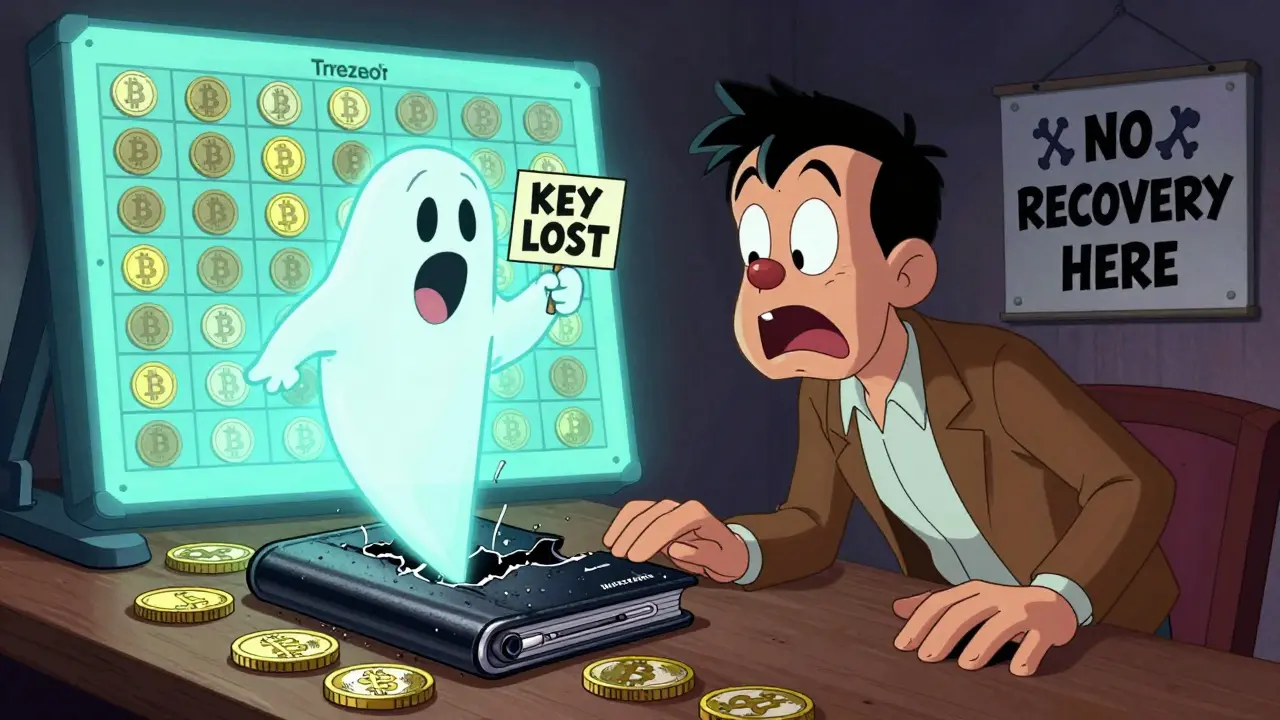
Here’s the cold truth: your coins don’t disappear. They’re still on the blockchain. They’re still visible. You can see them in a block explorer. But no one can move them. They’re frozen. Forever.
Some people call this “dead coins.” They sit there, collecting dust. No one spends them. No one transfers them. They’re like cash burned in a fireplace - the ashes are still there, but the value is gone.
There’s no legal way to reclaim them. Courts can’t force someone to give up a key they don’t have. And if someone claims they lost it to avoid paying taxes or debts? Judges have no way to prove they’re lying. That’s why Professor Aaron Wright at Cardozo Law School says this creates “legal uncertainty.”
Some people try to recover funds by bribing hackers or hiring “crypto recovery” services. Most are scams. They’ll ask for a small fee upfront - then vanish. There’s no legitimate service that can recover a lost key. If someone tells you otherwise, they’re lying.
Can You Recover a Lost Key? (Spoiler: No)
Let’s be clear: there is no recovery method for a lost private key. Not one that works.
Some wallets offer “social recovery.” Argent, for example, lets you name three trusted friends. If you lose your key, they can help you reset it. But that only works if you set it up before you lost the key. And it’s not true decentralization - you’re trusting people instead of math.
Companies like Coinbase are testing recovery services for institutional clients. But these use multi-signature setups, time locks, and legal contracts. They’re not for regular users. And they still require you to have backups in place.
Hardware wallet makers like Trezor and Ledger say: “We can’t help you.” Their support teams will tell you the same thing: “If you don’t have your recovery phrase, we can’t restore your wallet.” That’s not them being unhelpful. That’s the system working as designed.

How to Never Lose Your Key (The Real Solution)
Since you can’t recover a lost key, the only option is to never lose it in the first place. Here’s how:
- Write it down. On paper. Use a pen. Not a printer. Not a note on your phone. Paper doesn’t get hacked. It doesn’t crash. It doesn’t get deleted.
- Make three copies. Store one at home. One in a safety deposit box. One with a trusted family member. The Trezor “3-2-1 rule” says: three copies, two different media (paper + metal), one offsite.
- Use a metal backup. Buy a steel plate like CryptoSteel or Billfodl. Engrave your recovery phrase. It survives fire, water, and time.
- Never store it digitally. No screenshots. No emails. No cloud drives. No encrypted files on your computer. If it’s on a device, it can be stolen or corrupted.
- Test your backup. After writing it down, go to a new device. Import the phrase. Make sure it works. Do this once. Then lock the paper away.
- Tell someone you trust. Not your partner? Not your kid? Then who? Pick one person who knows where your backup is. Give them instructions. Not the key. Just where to find it.
These aren’t tips. They’re survival rules. And they’re not optional. If you hold crypto, you’re responsible for this. No one else is.
The Bigger Picture: Why This Matters
This isn’t just about money. It’s about control. Cryptocurrency promises freedom - no banks, no governments, no intermediaries. But freedom comes with responsibility. If you don’t manage your key, you lose everything.
That’s why the EU’s MiCA regulation now requires exchanges to warn users about irreversible loss. That’s why New York now forces custodians to verify backup procedures. That’s why insurance companies are selling policies for private key loss - even though most won’t pay if you were careless.
And that’s why institutions are switching to MPC wallets - Multi-Party Computation. These split your key across multiple devices. No single point of failure. But again - you still need to set it up right.
For most people, the answer is simple: use a hardware wallet. Write down the recovery phrase. Store it safely. Test it. Tell someone. And never, ever assume you’ll remember it later.
Final Reality Check
Here’s what no one tells you: if you lose your private key, your crypto is gone. Not temporarily. Not until you find a solution. Gone. Forever.
There’s no magic fix. No hidden backdoor. No secret hotline. The blockchain doesn’t care if you’re sad. It doesn’t care if you lost your job, your loved one, or your memory. It just follows the code.
So ask yourself: do you really understand what you’re holding? Or are you treating it like a game? Because if you don’t treat your private key like your life depends on it - it might.
Nathan Drake
January 26, 2026 AT 10:02It’s wild how crypto forces you to confront the weight of ownership. No one’s holding your hand. No safety net. Just you and a string of numbers that, if gone, turns your life’s work into digital dust. It’s like being handed the keys to a Ferrari… then told you can’t leave a copy anywhere. The philosophical irony is thick: we built this system to be free from institutions… only to become slaves to our own memory.
Dave Ellender
January 28, 2026 AT 05:50I’ve seen people lose six figures because they thought ‘writing it down’ meant scribbling it on a sticky note next to their coffee mug. It’s not a tech problem-it’s a human one. We treat digital assets like apps. But crypto isn’t Instagram. It’s your bank, your will, your legacy. And if you don’t treat it like that, you deserve what happens.
Barbara Rousseau-Osborn
January 30, 2026 AT 02:15Oh my god. Another person who thinks ‘write it on paper’ is enough? 😒 You think your grandma’s handwriting won’t fade? You think a fire won’t burn it? You think a kid won’t throw it out thinking it’s junk? You’re not ‘secure’-you’re just delusional. Get a metal plate. Engrave it. Hide it in a wall. And stop pretending you’re doing enough. You’re not.
Arnaud Landry
January 30, 2026 AT 21:53Let me ask you something… if the blockchain is so immutable and decentralized… why are governments and institutions suddenly rushing to regulate ‘key loss’? Isn’t that the whole point? No middlemen? No oversight? Now we’re being told we need insurance, legal docs, and corporate-backed recovery systems? Sounds like the system was never meant to be trustless… just… profitable for someone else.
george haris
January 30, 2026 AT 23:24Man, I lost my phone last year with my wallet on it. I panicked for three days. Then I remembered-I had the phrase written on a piece of paper in my drawer. I imported it on a new device and… boom. All there. No drama. No crying. Just discipline. If you’re not prepared, you’re not a crypto holder-you’re just someone who bought a lottery ticket and forgot to check the numbers.
David Zinger
January 31, 2026 AT 01:48steven sun
February 1, 2026 AT 17:04bro i had a wallet on my phone and i thought i deleted the app to free up space… turned out it was the whole key 😭 i cried for like 2 hours then i just went to mcdonalds and ate a whole big mac and felt better. crypto is a vibe not a bank. if you lose it you lose it. life goes on. 🍔
Athena Mantle
February 3, 2026 AT 05:18It’s not about the money-it’s about the metaphysics of control. We’re living in a world where your identity is tied to a 12-word phrase you wrote on a napkin. The entire concept of ‘self-sovereignty’ is a beautiful lie. You’re not free-you’re just terrified. And you’re terrified because you know, deep down, you’re not smart enough to hold this power. So you pretend it’s ‘liberty.’ It’s not. It’s a trap dressed as enlightenment.
carol johnson
February 3, 2026 AT 21:46OMG I just found out my ex kept a crypto wallet in his name and never told me… and now he’s dead 💔 I had no idea… $800k just… gone. Like, I can’t even cry about it because I didn’t even know it existed. What kind of cruel world is this? 😭💔 I just wanted to remember his birthday, not inherit his blockchain ghost.
Paru Somashekar
February 5, 2026 AT 02:09It is imperative to note that the loss of private keys is not merely a technical issue, but a profound failure of education and institutional support. In developing nations, where digital literacy is still emerging, the consequences are exponentially more severe. We must advocate for community-based mnemonic training programs, and integrate crypto literacy into primary education curricula. The technology is not the problem-the lack of guidance is.
Steve Fennell
February 6, 2026 AT 12:05I’ve been teaching crypto safety to my neighbors since 2021. One lady, 72, lost her husband. Found his metal plate tucked in his Bible. She’s now running a small crypto workshop in her church basement. That’s the real story. Not the $248 billion. Not the scams. It’s people helping people. We don’t need new tech. We need to talk to each other.
Heather Crane
February 7, 2026 AT 06:02I know it sounds scary, but you’re not alone. I’ve helped three friends recover from key loss by just sitting with them, helping them write backups, and reminding them it’s okay to be scared. Crypto isn’t about being a hacker or a genius-it’s about being responsible. And responsibility? That’s a skill you can learn. You’re not failing. You’re just getting started.
Catherine Hays
February 9, 2026 AT 02:17Chidimma Catherine
February 9, 2026 AT 22:27