What is Account Abstraction in Blockchain: A Simple Guide to Smarter Wallets
 May, 31 2026
Imagine losing your house keys. In the physical world, you call a locksmith. In the crypto world, if you lose your private key, your money is gone forever. That harsh reality has kept millions of people away from blockchain technology. But what if your wallet could act more like your email account? What if it could recover itself, let friends help you reset access, or even pay its own fees? This is exactly what account abstraction promises to deliver.
Account abstraction is changing how we interact with blockchains by turning static, rigid wallets into flexible, programmable tools. It removes the technical barriers that make crypto feel complicated and dangerous. Instead of relying on a single string of characters (a private key) to control everything, account abstraction allows for smarter rules, better security, and a much smoother user experience. By 2026, this technology is no longer just a theoretical concept; it is becoming the standard for modern digital wallets.
From Static Keys to Smart Contracts
To understand why account abstraction matters, you first need to look at how traditional blockchain wallets work. On networks like Ethereum, there are two main types of accounts: Externally Owned Accounts (EOAs) and Contract Accounts. Most people use EOAs. These are controlled by a private key. If you have the key, you own the funds. If you lose the key, you lose the funds. There is no password reset button. There is no customer support. It is all-or-nothing.
Contract Accounts, on the other hand, are pieces of code that can hold funds and execute logic. They are used for decentralized applications (dApps) but were not originally designed to be personal wallets. Account abstraction bridges this gap. It allows users to replace their simple EOA with a smart contract wallet. This means your wallet is now a piece of software that can follow custom rules defined by you.
Think of an EOA as a basic vending machine: you put in exact change (gas), press a button (sign a transaction), and get a snack. If you don't have exact change, nothing happens. A smart contract wallet enabled by account abstraction is like a modern coffee shop app. You can store payment methods, set daily spending limits, allow someone else to pay for you, and even schedule orders in advance. The complexity moves from the user to the code, making life easier for everyone.
The Role of ERC-4337
For years, developers wanted to implement account abstraction, but Ethereum’s core protocol didn’t support it natively without major changes that could break the network. This led to the creation of ERC-4337, an Ethereum Improvement Proposal that standardized account abstraction without altering the base layer of the blockchain.
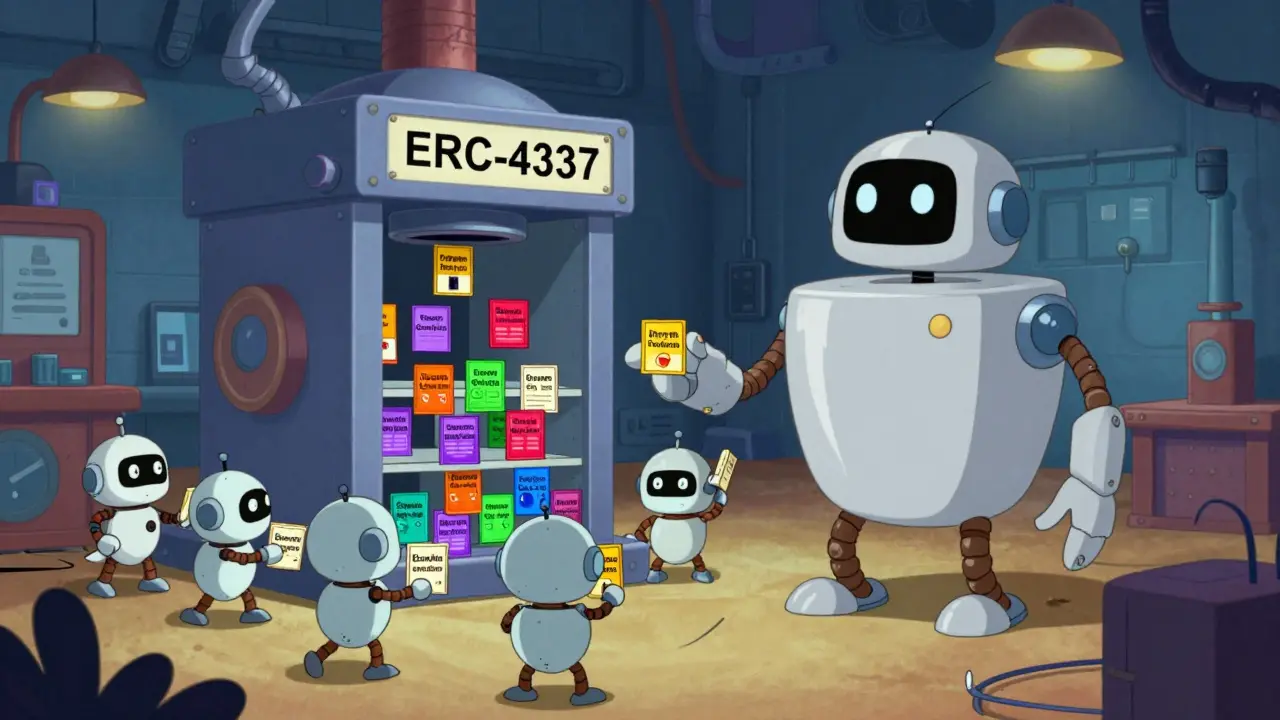
ERC-4337 works by creating a parallel execution environment. Instead of sending transactions directly to the blockchain, users send "UserOperations." These are data packages that describe what the user wants to do. Specialized nodes called Bundlers nodes that collect UserOperations and submit them to the blockchain pick up these operations, bundle them together, and send them to a specific contract known as the Entry Point. The Entry Point verifies the signatures and ensures the rules are followed before executing the actions.
This architecture is crucial because it keeps Ethereum secure and unchanged while adding powerful new features on top. It allows for innovation in wallet design without risking the stability of the entire network. As of 2026, ERC-4337 is the dominant standard for account abstraction on Ethereum-compatible chains, supported by major infrastructure providers and wallet builders.
Key Benefits for Users
The shift to smart contract wallets brings tangible benefits that address the biggest pain points in crypto adoption. Here is what changes for you:
- Social Recovery: No more writing down seed phrases on paper. With social recovery, you designate trusted contacts-like family members or friends-as guardians. If you lose access to your device, these guardians can vote to restore your wallet. For example, you might require three out of five guardians to approve a recovery request. This mimics the safety nets we have in traditional banking.
- Gasless Transactions: Have you ever tried to use a dApp but realized you didn’t have enough ETH to pay for gas fees? Paymasters, a component of the ERC-4337 system, allow third parties to pay your gas fees. A game developer can sponsor your in-game purchases, or a social media platform can cover the cost of posting. You interact with the app seamlessly, just like on Web2 platforms.
- Session Keys: Signing every single transaction is tedious and risky. Session keys allow you to grant temporary permissions. You can authorize a DeFi protocol to swap tokens within a certain limit for the next hour without needing to sign each step. Once the session expires, the permission vanishes. This reduces friction and minimizes exposure to phishing attacks.
- Better Security Controls: Smart contract wallets can enforce strict rules. You can set a daily spending cap, require multi-signature approval for large transfers, or restrict interactions to only whitelisted contracts. If a malicious site tries to drain your wallet, the contract’s rules can reject the transaction automatically.

How It Works Under the Hood
While the user experience becomes simpler, the backend involves several working parts. Understanding these components helps clarify why account abstraction is robust.
- UserOperation: This is the core data structure. It contains the sender’s address, the nonce (to prevent replay attacks), the function call data, gas limits, and the cryptographic signature. It is essentially a request waiting to be processed.
- Bundlers: These are specialized nodes that monitor the mempool for UserOperations. They validate the format, check for spam, and bundle multiple operations into a single transaction sent to the Entry Point. Bundlers ensure efficiency and reduce congestion on the main chain.
- Paymasters: These are smart contracts that can subsidize gas fees. When a user sends a UserOperation, they can include a flag indicating they want a paymaster to cover costs. The paymaster validates the request (e.g., checking if the user is eligible for a sponsorship) and pays the bundler.
- Entry Point: This is a singleton contract deployed on the blockchain. All bundled UserOperations must go through this contract. It acts as the gatekeeper, verifying signatures and ensuring that the smart contract wallets behave according to the ERC-4337 rules.
- Smart Contract Wallet: Finally, this is the user’s actual wallet. It implements the logic for validation and execution. Unlike an EOA, which only checks a private key, this contract can check biometrics, social recovery votes, or time-based conditions.
Ethereum vs. Solana: Different Approaches
Not all blockchains approach account abstraction in the same way. Ethereum required ERC-4337 because its original design strictly separated EOAs from contract accounts. Solana, however, was built differently from the start.
In Solana’s architecture, all accounts are essentially storage buckets that can hold data, tokens, or executable code. There is no fundamental distinction between a user account and a program account in terms of structure. This means Solana natively supports many features associated with account abstraction, such as complex authorization models and customizable account behaviors, without needing a separate standard like ERC-4337.
| Feature | Ethereum (ERC-4337) | Solana (Native) |
|---|---|---|
| Implementation Method | Layer-2 Standard (Off-chain bundling) | Core Protocol Design |
| Account Types | EOA vs. Contract Account | Unified Account Model |
| Gas Sponsorship | Via Paymasters | Native Compressed Accounts & Compute Units |
| Maturity | Rapidly Growing Ecosystem | Established Since Launch |
Despite these differences, the goal remains the same: making self-custody accessible. Ethereum’s approach via ERC-4337 has gained massive traction due to the network’s size and developer activity, leading to a rich ecosystem of compatible wallets and tools. Solana’s native flexibility offers high performance and low costs, appealing to users who prioritize speed. Both paths demonstrate that the industry is moving toward smarter, more user-friendly accounts.
Challenges and Considerations
Account abstraction is powerful, but it is not without challenges. For developers, integrating ERC-4337 requires handling additional complexity. You need to manage bundlers, configure paymasters, and ensure your smart contract wallet adheres to the standard. Tools like Thirdweb and Biconomy have simplified this process, offering SDKs that abstract away much of the heavy lifting, but the learning curve is steeper than building for traditional EOAs.
For users, the biggest hurdle is trust. With social recovery, you are relying on guardians to act honestly. If your guardians are compromised or collude, they could steal your funds. Therefore, choosing trustworthy guardians and understanding the recovery mechanism is critical. Additionally, while gasless transactions are convenient, they rely on third-party paymasters. Users should be aware of who is sponsoring their transactions and why, as this introduces a degree of centralization into an otherwise decentralized system.
Security also evolves. Smart contract wallets are code, and code can have bugs. Auditing these contracts is essential. As the ecosystem matures, best practices for securing smart contract wallets will become clearer, but vigilance is always required. The shift from managing a private key to managing a smart contract means shifting responsibility from secrecy to code integrity.
The Future of Digital Identity
By 2026, account abstraction is poised to become the default for blockchain interaction. Major wallet providers are already integrating these features. Argent, Safe, and others offer smart contract wallets with social recovery and gas sponsorship out of the box. Institutional players are adopting hierarchical access controls for treasury management, allowing CFOs and CEOs to approve large transactions based on predefined rules.
This technology paves the way for broader mainstream adoption. When users no longer fear losing their keys or struggle with gas fees, blockchain becomes invisible infrastructure rather than a technical hurdle. We are moving toward a future where your digital identity is secure, recoverable, and seamless, blending the best of Web2 convenience with Web3 ownership.
Is account abstraction safe?
Yes, when implemented correctly. Account abstraction enhances security by allowing multisig requirements, spending limits, and social recovery. However, safety depends on the quality of the smart contract code and the trustworthiness of your chosen guardians. Always use audited wallets and reputable services.
Do I need to switch my current wallet?
Not immediately. Many new wallets support account abstraction natively. You can create a new smart contract wallet alongside your existing EOA. Over time, as features improve, you may choose to migrate your assets to a more capable smart contract wallet for better security and convenience.
What is a Paymaster?
A Paymaster is a smart contract that pays gas fees on behalf of users. This enables "gasless" transactions, allowing users to interact with dApps without holding the native cryptocurrency (like ETH). Developers often use Paymasters to improve user experience by covering transaction costs.
How does social recovery work?
Social recovery allows you to appoint trusted contacts as guardians. If you lose access to your wallet, these guardians can vote to restore your access. Typically, a threshold (e.g., 3 out of 5 guardians) must agree to prevent unauthorized recovery. This replaces the need for a single secret seed phrase.
Is ERC-4337 part of the Ethereum mainnet?
No, ERC-4337 operates off-chain and on-chain via a standard contract, but it does not change the Ethereum base layer protocol. It uses a separate mempool and bundlers to process UserOperations, making it compatible with existing Ethereum infrastructure without requiring a hard fork.
Joshua Alcover
May 31, 2026 AT 23:33The epistemological framework of ERC-4337 represents a paradigm shift in the ontological status of digital sovereignty. By decoupling the execution environment from the base layer protocol, we are effectively engaging in a sophisticated form of cryptographic dualism. The notion that one can abstract the account is not merely a technical convenience but a philosophical assertion regarding the nature of identity in a decentralized ledger. It challenges the very axioms of self-custody by introducing a layer of interpretive code between the user and the immutable truth of the blockchain. This abstraction allows for a fluidity of access that mirrors the complex social contracts we navigate in physical reality, yet it remains bound by the rigid logic of smart contracts. The implications for national security are profound, as this technology could be leveraged to create untraceable, recoverable assets that bypass traditional financial surveillance mechanisms. We must consider whether this decentralization of control truly empowers the individual or merely obscures the mechanisms of power behind a veil of algorithmic complexity. The integration of social recovery introduces a human element into a system designed for mathematical purity, creating a hybrid entity that is neither fully centralized nor fully decentralized. This duality is both its greatest strength and its most significant vulnerability.
Diana Morris
June 1, 2026 AT 00:02finally someone explains this without making my head explode i have been trying to understand why my wallet needs eth just to send eth for years now and it always felt like a scam this sounds like the solution we needed
i am so excited to try these new wallets out
Dianne Wright
June 2, 2026 AT 12:28oh great another buzzword wrapped in jargon to make simple concepts sound complicated you people really think adding 'abstraction' makes it better? i have seen enough scams to know that when things get too easy something is wrong underneath
you trust strangers with your keys now? brilliant idea
trisya hazriyana
June 4, 2026 AT 19:46the irony is palpable here we build complex layers of abstraction to solve problems created by previous abstractions it is a recursive loop of technological determinism disguised as progress
but sure let us pretend that paying someone else to pay our gas fees is not just centralization in disguise because nothing says freedom like relying on a third party sponsor for basic transactions
Debbie Lewis
June 6, 2026 AT 01:05it is interesting to see how the landscape is shifting. i have been watching this space for a while and the move towards smart contract wallets seems inevitable given the usability issues with EOAs. the social recovery aspect is what catches my eye the most. losing access to funds due to a lost seed phrase is a nightmare scenario that keeps many people away. having a way to recover access through trusted contacts feels like a natural evolution. i wonder how widely adopted this will become among non-technical users in the coming year.
Eric Grosso
June 6, 2026 AT 12:09so does this mean i dont need to write down my seed phrase anymore? that would be sick cause i always lose papers lol. also how do the bundlers work exactly? are they like miners but for these special transactions?
Edith Mair
June 7, 2026 AT 10:09The article overlooks the critical security implications of relying on off-chain bundlers. While ERC-4337 standardizes the process, it introduces a dependency on third-party infrastructure that operates outside the consensus mechanism. This creates a single point of failure and potential censorship vector that contradicts the ethos of decentralization. Users must be aware that their transactions are being processed by entities that can choose which operations to include or exclude. This level of control undermines the permissionless nature of the network. We need rigorous audits and transparency standards for these bundler services before widespread adoption can be considered safe.
Sam Dashti
June 8, 2026 AT 20:05think of it like a magical vending machine that lets you put in IOUs instead of exact change. the bundlers are the friendly shopkeepers who collect all the IOUs and pay the big boss (the blockchain) for everyone at once. it is a beautiful dance of trust and code where the friction melts away like morning dew on a hot summer day. the session keys are like giving a friend a house key that only works for an hour then dissolves into thin air. pretty cool concept if you ask me.
Joe Clements
June 9, 2026 AT 04:27I totally get the hesitation around trusting guardians for social recovery. It requires a lot of faith in other people. However, thinking about it from a user perspective, the peace of mind knowing you can actually recover your account if you lose your phone is huge. I remember helping a friend who lost his hardware wallet and he was devastated. If there had been a social recovery option back then, he might have gotten his funds back. It is a trade-off between absolute autonomy and practical security.
Rosie Morris
June 10, 2026 AT 21:01im so glad this is finally happening i hate dealing with gas fees every time i want to do something small. it feels like being charged for breathing sometimes. hope this rolls out soon so i can stop stressing about keeping extra eth in my wallet just for txns
kamal ifrani
June 10, 2026 AT 21:03this whole thing is a disaster waiting to happen. you are handing over control to centralized entities under the guise of innovation. the moral decay of accepting such compromises shows how far we have fallen from the true vision of cypherpunks. these paymasters are just gatekeepers in fancy suits controlling who gets to transact. it is disgusting that people are cheering for this loss of sovereignty. wake up sheeple before you lose everything to a buggy smart contract.
Craig Swanson
June 12, 2026 AT 11:56Let me break this down for those who are skeptical. Account abstraction is not about removing security; it is about enhancing usability while maintaining control. The key is understanding that you are defining the rules of engagement for your wallet. You decide who your guardians are, you set the spending limits, and you choose which paymasters you trust. It is empowerment through customization. I strongly encourage everyone to explore wallets like Argent or Safe to see firsthand how these features work. Education is the best defense against misinformation.
Dana Rapoport
June 13, 2026 AT 14:55The philosophical underpinnings of this technology are fascinating. We are essentially redefining what it means to own a digital asset. By allowing programmable ownership, we are moving beyond the static model of possession to a dynamic model of access and permission. This shift has profound implications for digital identity and agency. It suggests that ownership is not a binary state but a spectrum of rights and capabilities defined by code. As we integrate these systems into our daily lives, we must remain vigilant about the ethical dimensions of automated decision-making in financial contexts.
Christina Pearce
June 14, 2026 AT 23:47I found the section on Solana vs Ethereum really informative. It is surprising how different architectural choices lead to such divergent paths for achieving similar goals. The fact that Solana supports some of these features natively highlights the importance of initial design decisions. For Ethereum, ERC-4337 is a clever workaround that preserves backward compatibility while enabling innovation. I am curious to see which approach gains more traction in the long run. Both seem to have valid merits depending on the use case.
Miss Masquer
June 16, 2026 AT 21:04Having lived through several cycles of crypto hype and bust, I find myself cautiously optimistic about account abstraction. The pain points addressed here, particularly gas fees and key management, are genuine barriers to mainstream adoption. However, the complexity introduced by smart contract wallets cannot be underestimated. Users must be educated on the risks of smart contract vulnerabilities and the importance of choosing reputable providers. The transition from EOAs to smart contract wallets should be gradual and well-supported. I believe that with proper guidance and robust tooling, this technology can indeed make blockchain accessible to the masses without sacrificing security or decentralization.