What is End Federal Reserve (EFR) Crypto? A Deep Dive into the Meme Token
 Aug, 14 2026
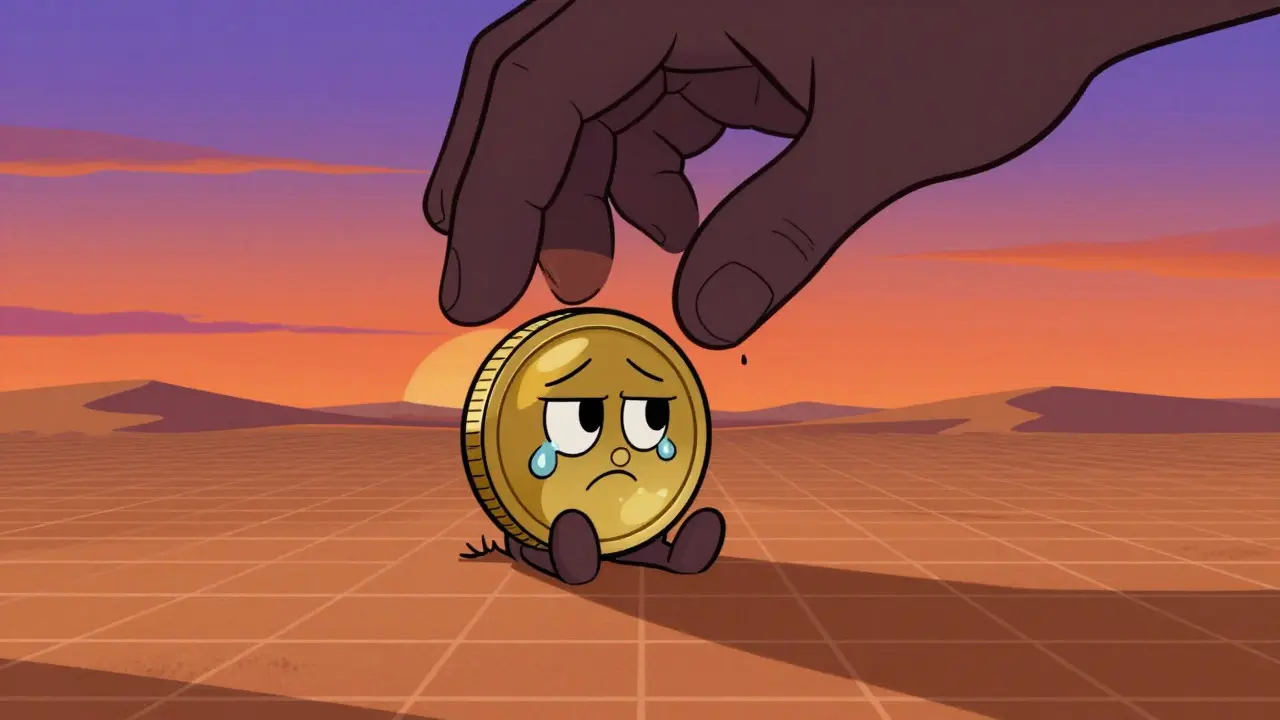
Imagine a cryptocurrency that doesn’t promise faster transactions, better security, or decentralized governance. Instead, its entire value proposition rests on a political slogan and internet humor. That is exactly what End Federal Reserve (EFR) is. It is a speculative, low-capitalization token built on the Solana blockchain, designed primarily as a protest asset rather than a functional financial tool.
If you have stumbled upon EFR while scrolling through social media or checking new listings on exchanges, you are likely wondering if this is the next big thing or just another fleeting meme. The short answer is that it falls squarely into the latter category for now. As of mid-2026, EFR remains a micro-cap asset with negligible market dominance, extreme volatility, and no clear utility beyond speculation. Understanding what drives this token requires looking past the catchy name and examining the raw data behind its supply, trading venues, and price history.
The Basics: What Exactly Is EFR?
End Federal Reserve (EFR) is a digital asset that operates purely on sentiment and brand recognition. Unlike established cryptocurrencies like Bitcoin or Ethereum, which have complex technical architectures and widespread adoption, EFR is defined by its simplicity and its provocative branding. The name itself suggests a political stance against the U.S. central banking system, appealing to libertarians, anti-establishment traders, and meme coin enthusiasts who enjoy high-risk bets.
There is no whitepaper, no public founding team, and no legal entity behind the project. Major data aggregators like CoinMarketCap and CoinGecko list it simply as a standalone token. This lack of transparency is typical for many tokens launched on decentralized platforms, where anonymity is common. However, it also means there is no roadmap to follow and no development updates to track. You are buying a ticker symbol, not a technology.
Tokenomics: Supply and Circulation
One of the few concrete details available about EFR is its token supply. Across multiple sources, including CoinGecko, CoinMarketCap, and CoinStats, the total supply hovers around one billion tokens. Specifically, most platforms report a maximum and circulating supply of approximately 999.97 million to 1 billion EFR.
This near-perfect alignment between total and circulating supply is significant. It means there are no locked tokens, no vesting schedules for early investors, and no future inflation from staking rewards or mining emissions. Every single EFR token exists right now. For traders, this implies that price movements are driven entirely by current buy and sell pressure, without the fear of sudden unlocks dumping millions of new tokens onto the market. However, it also means there is no mechanism to reward long-term holders, making it purely a vehicle for short-term speculation.
| Metric | Value / Detail |
|---|---|
| Blockchain | Solana |
| Total Supply | ~1 Billion (999.97M - 1B) |
| Circulating Supply | ~1 Billion (Fully Diluted) |
| Market Cap (Aug 2026) | ~$5,900 USD |
| Primary Trading Venue | Raydium (DEX) |
| Secondary Venue | MEXC (CEX) |
Where Can You Trade EFR?
Liquidity is the lifeblood of any cryptocurrency, and for EFR, it is extremely thin. The primary marketplace for EFR is Raydium, a leading decentralized exchange (DEX) on the Solana network. Most trading occurs in the EFR/SOL pair, meaning you need wrapped SOL to swap for EFR. There is also an EFR/WSOL pair available.
For those who prefer centralized exchanges, EFR is listed on MEXC. Here, you can trade EFR against USDT. However, the volume on MEXC is significantly lower than on Raydium. In late 2024, Holder.io reported that Raydium accounted for over 96% of all cross-exchange volume for EFR. This concentration indicates that the core community consists of Solana-native traders comfortable using DEX interfaces.
Trading EFR requires caution due to low liquidity. On days with minimal activity, the 24-hour trading volume can drop to less than $10 USD. This means even a small order of a few hundred dollars could cause massive price slippage, drastically changing the price against your entry point. Always check the order book depth before executing trades.

Price History and Volatility
The price chart of EFR is a rollercoaster, characteristic of micro-cap meme coins. In November 2024, EFR was trading at roughly $0.000018 to $0.000019 USD. By March 2025, it had surged to around $0.000201 USD, representing a gain of over 1,000%. Then, in mid-to-late 2025, speculative interest drove prices up further, with some trackers like Blockworks showing values near $0.01 USD and daily volumes spiking to nearly $6 million.
However, these spikes were short-lived. By early 2026, the price had crashed back down. As of August 2026, EFR is trading around $0.000059 USD, with a market capitalization of just under $6,000. This dramatic swing-from fractions of a cent to nearly a penny and back-highlights the extreme risk involved. Without fundamental utility to support the price, rallies are often fueled by hype and quickly reverse when interest fades.
Risks and Considerations for Traders
Before adding EFR to your portfolio, consider these critical factors:
- No Utility: EFR does not power a protocol, offer staking yields, or provide governance rights. Its value is derived solely from trader sentiment.
- Thin Liquidity: Low trading volumes mean it can be difficult to exit large positions without impacting the price negatively.
- Anonymity: With no known team or audit, there is a higher risk of rug pulls or abandonment, although the fully circulating supply mitigates some of this concern.
- Regulatory Uncertainty: As a meme token with political branding, it may face scrutiny or delisting risks if regulators target speculative assets more aggressively.
If you decide to trade EFR, treat it as entertainment money. Only invest what you are willing to lose entirely. Use reputable wallets compatible with Solana, such as Phantom or Solflare, and double-check contract addresses to avoid scams.
Is End Federal Reserve (EFR) a safe investment?
No, EFR is considered a high-risk, speculative asset. It has a micro-cap market size, extreme volatility, and no underlying utility. Prices can swing by hundreds of percent in short periods, and liquidity is often very low, making it difficult to sell large amounts without significant slippage.
Which blockchain is EFR built on?
EFR is built on the Solana blockchain. This is evident because its primary trading venue is Raydium, a Solana-based decentralized exchange, and it trades primarily against SOL or wrapped SOL.
Where can I buy EFR tokens?
You can trade EFR on the decentralized exchange Raydium (using SOL) and on the centralized exchange MEXC (using USDT). Ensure you use a Solana-compatible wallet for DEX trading.
Does EFR have a limited supply?
Yes, EFR has a fixed maximum supply of approximately 1 billion tokens. Almost all of these tokens are already in circulation, meaning there is no future inflation from minting new tokens.
Who created the End Federal Reserve token?
The identity of the creator or development team behind EFR is unknown. Major data aggregators do not list a founding team, legal entity, or official whitepaper, which is common for anonymous meme coins.