What is StakeStone (STO)? Tokenomics, STONE Liquid Staking, and Risks Explained
 Aug, 6 2026
You’ve probably seen the ticker STO popping up on your exchange dashboard or heard whispers about "omnichain" staking. But what actually is StakeStone? It’s not just another coin hoping for a quick pump. It’s a protocol designed to solve one of the biggest headaches in decentralized finance: making staked assets like Ethereum and Bitcoin truly liquid across different blockchains.
If you’re trying to figure out whether this project has legs or if it’s just hype, you need to look past the marketing jargon. Let’s break down exactly how the protocol works, what the STO token does, and why the distinction between STO and its sister token, STONE, matters for your wallet.
The Core Concept: Omnichain Liquid Staking
At its heart, StakeStone is a decentralized, omnichain liquidity infrastructure and liquid staking protocol. That’s a mouthful, so let’s translate it into plain English.
Traditionally, when you stake Ethereum (ETH), your coins are locked up. You earn rewards, sure, but you can’t easily move those coins to another blockchain or use them in a lending market on a Layer 2 network without unstaking first-which can take days. StakeStone changes that by issuing Liquid Staking Tokens (LSTs) that represent staked assets and can be traded or used in DeFi while earning yield.
What makes StakeStone different from older protocols is its "omnichain" approach. It uses LayerZero, a cross-chain interoperability protocol that enables seamless asset transfers between different blockchains technology to create tokens that aren’t stuck on one network. This means you could theoretically deposit ETH on Ethereum mainnet, receive a liquid token, and then move that token to a cheaper Layer 2 chain like Manta Pacific to trade or lend it, all without unlocking your original stake.
STO vs. STONE: Understanding the Two Tokens
This is where most people get confused. StakeStone isn’t just one token; it’s an ecosystem with two distinct assets that serve very different purposes. Knowing the difference is crucial before you buy anything.
| Feature | STO | STONE |
|---|---|---|
| Primary Function | Governance & Utility | Liquid Yield-Bearing Asset |
| Underlying Value | Protocol growth & voting power | Backed by staked ETH (plus yields) |
| Supply Cap | 1,000,000,000 (Fixed) | Infinite (Minted upon deposit) |
| Price Driver | Demand for governance/rewards | Price of ETH + Accumulated Staking Rewards |
| Risk Profile | High (Speculative governance token) | Medium (Dependent on ETH price & smart contract security) |
STO is the governance token. It’s the "vote" in the system. If you want to influence how the protocol operates or earn incentives for providing liquidity, you hold STO. Its value is speculative-it goes up if the protocol becomes more popular and people demand more voting power.
STONE is the actual product. When you deposit ETH into the StakeStone vault, you get STONE back. It’s a non-rebase ERC-20 token. What does "non-rebase" mean? It means your wallet balance doesn’t change every day as rewards accumulate. Instead, the exchange rate between STONE and ETH increases. If you have 10 STONE today, you’ll still have 10 STONE next year, but those 10 tokens will redeem for more ETH than they did today because the underlying staking rewards have compounded.
How the Protocol Actually Works
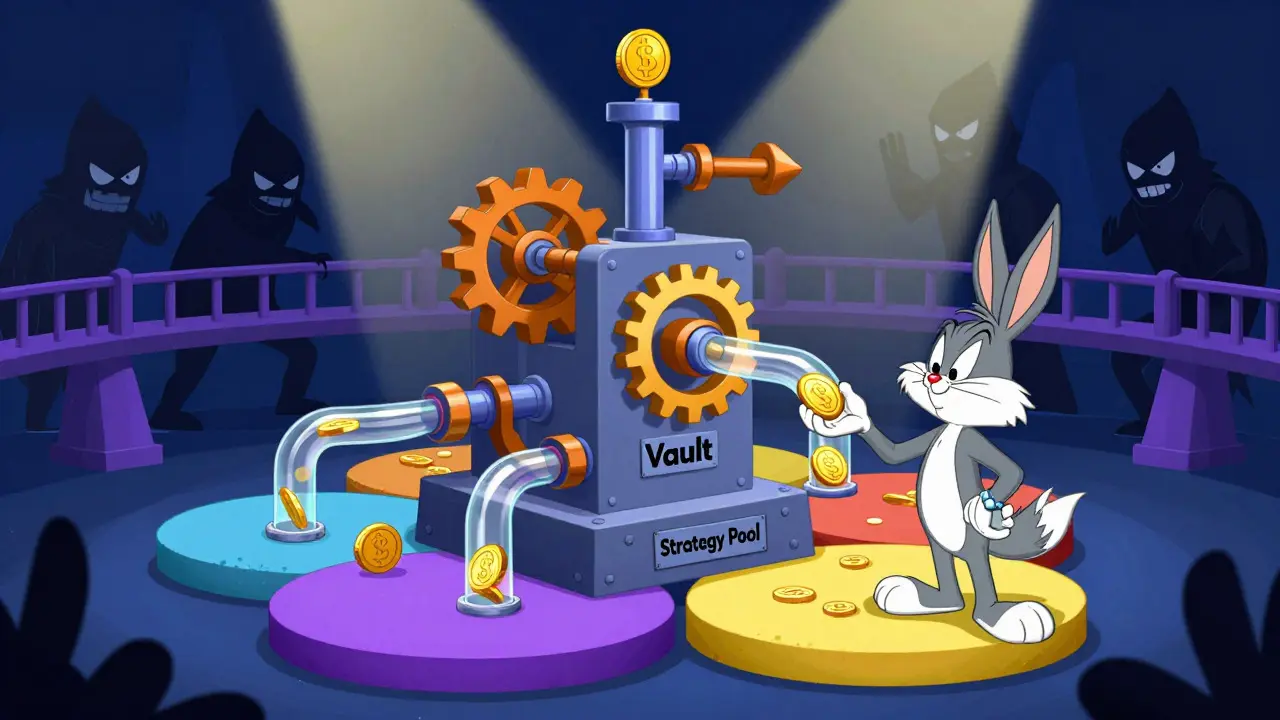
The magic happens under the hood through three main components described in their developer documentation:
- The Vault: This is where you deposit your base assets (like ETH). The vault doesn’t just send your money to one place; it acts as an entry point for the optimization engine.
- The Strategy Pool: This is the brain. Using a mechanism called OPAP (Optimizing Portfolio and Allocation Proposal), the pool distributes your deposited ETH across various strategies. These might include standard staking via Lido (stETH), restaking via EigenLayer, a restaking protocol that allows validators to secure multiple networks simultaneously, or other DeFi yield farms. The goal is to maximize yield while spreading risk so you aren’t reliant on a single validator set.
- The Minter: Once your ETH is allocated, the Minter creates the corresponding amount of STONE tokens and sends them to your wallet at the current exchange rate.
Because STONE is built as an Omnichain Fungible Token (OFT) using LayerZero standards, these tokens can bridge between chains instantly. For example, you could bridge your STONE from Ethereum to Manta Pacific to access lower gas fees for trading, all while your original ETH continues to earn staking rewards in the background.
Tokenomics: Supply, Circulation, and Price
Let’s talk numbers, because tokenomics often reveal whether a project is sustainable or prone to massive inflation dumps.
The STO token has a strict maximum supply cap of 1,000,000,000 units with no further inflation beyond this ceiling. As of late July 2026, data from tracking services shows that approximately 225.33 million STO tokens are in circulation. This means roughly 77.5% of the total supply is still locked, reserved, or unissued.
This is a double-edged sword. On one hand, a fixed cap prevents endless dilution. On the other hand, nearly 80% of the tokens are yet to hit the market. If large tranches are unlocked quickly for team incentives or future development, it could create selling pressure. Always check the vesting schedules if you’re planning a long-term hold.
In terms of market performance, STO has been trading in a narrow band around $0.044-$0.045 throughout mid-2026. With a circulating supply of ~225 million, this puts the fully diluted valuation (FDV) significantly higher than the current market cap of roughly $10 million. This gap suggests the market is currently pricing STO based on its active float rather than its potential future supply, which is common for mid-tier DeFi projects.
Is StakeStone Safe? Assessing the Risks
No DeFi protocol is risk-free. While StakeStone offers attractive features, you need to understand where things could go wrong.
- Smart Contract Risk: Like any protocol, if there’s a bug in the Vault, Strategy Pool, or Minter code, funds could be drained. StakeStone relies on complex interactions between multiple contracts and cross-chain messaging.
- Cross-Chain Bridges: By using LayerZero, StakeStone depends on the security of the LayerZero network itself. Historically, bridges have been high-value targets for hackers. If the messaging layer fails, your ability to move STONE between chains could be frozen.
- Strategy Complexity: Because STONE yields come from a mix of sources (standard staking, EigenLayer restaking, etc.), you inherit the risks of all those underlying strategies. If a specific DeFi farm exploits a vulnerability, it could impact the value of the basket backing your STONE.
- Liquidity Depth: While daily volumes for STO exceed $5 million, the liquidity for STONE on secondary markets is much thinner (often under $3,000 daily). If you try to sell a large amount of STONE quickly, you might face significant slippage.
It’s worth noting that as of August 2026, there are no major reported exploits or catastrophic failures associated with StakeStone. However, the absence of bad news isn’t proof of safety-it’s just history so far.
Who Is This For?
StakeStone isn’t really for the casual holder who wants to buy and forget. It’s designed for active DeFi participants who:
- Want to earn staking yields on ETH or BTC but don’t want their capital locked up.
- Operate across multiple chains and hate paying high gas fees to bridge assets manually.
- Believe in the long-term vision of omnichain interoperability and want governance rights via STO.
If you’re looking for a simple savings account equivalent, traditional staking might be safer. But if you want to put your idle crypto to work across the entire DeFi landscape, StakeStone provides the infrastructure to do just that.
What is the difference between STO and STONE?
STO is the governance token used for voting and protocol incentives, with a fixed supply of 1 billion. STONE is a liquid staking token backed by staked Ethereum; you receive STONE when you deposit ETH, and its value appreciates over time as staking rewards accumulate.
Is StakeStone safe to use?
Like all DeFi protocols, StakeStone carries smart contract and cross-chain bridge risks. While no major exploits have been reported as of mid-2026, users should only invest what they can afford to lose and understand the complexity of the underlying strategies, including EigenLayer restaking.
How does StakeStone generate yield?
StakeStone aggregates deposited assets and allocates them across multiple strategies, including standard Ethereum staking (via providers like Lido), restaking on EigenLayer, and other DeFi yield opportunities. This diversification aims to maximize returns compared to single-source staking.
Can I withdraw my funds instantly?
Yes, one of StakeStone’s key features is instant withdrawal. Because STONE is a liquid token, you can redeem it for the underlying ETH on any connected chain without waiting for traditional validator withdrawal queues, though slippage may apply depending on pool liquidity.
What is the total supply of the STO token?
The STO token has a hard cap of 1,000,000,000 tokens. As of late July 2026, approximately 225.33 million tokens were in circulation, meaning the majority of the supply remains locked or reserved for future distribution.
Which blockchains does StakeStone support?
StakeStone is an omnichain protocol built on LayerZero. It currently supports Ethereum mainnet and Manta Pacific, with the architecture designed to expand to additional Layer 2 networks and blockchains seamlessly.