What is XRP Crypto Coin? Speed, Supply, and Why It’s Different
 Feb, 16 2026
XRP isn’t another Bitcoin clone. It wasn’t built to be digital gold or a decentralized social network. It was designed for one thing: moving money across borders faster and cheaper than banks can. If you’ve ever sent money overseas and waited days for it to arrive - or paid $50 in fees - XRP exists to fix that.
What Exactly Is XRP?
XRP is the native digital asset of the XRP Ledger, a decentralized blockchain-like network launched in August 2012. Unlike Bitcoin or Ethereum, XRP wasn’t mined. All 100 billion XRP tokens were created at launch. Today, about 57.1 billion are in circulation, with the rest held by Ripple Labs, the company behind the ledger’s development.
The XRP Ledger doesn’t use proof-of-work or proof-of-stake. Instead, it runs on something called the Ripple Protocol Consensus Algorithm (RPCA). Think of it like a voting system: a network of 35 independent validators around the world agree on transaction order every 3 to 5 seconds. Ripple runs 6 of those validators - about 17% - which has sparked criticism, but the rest are universities, exchanges, and financial firms. That’s more decentralized than many assume.
Why XRP Is Built for Payments
Here’s where XRP stands out: speed and cost.
- Transaction time: 3-5 seconds
- Fee per transaction: $0.0002
- Throughput: 1,500 transactions per second (TPS)
Compare that to Bitcoin (10 minutes, $1.85, 7 TPS) or Ethereum (12-15 seconds, $1.20, 30 TPS). Even SWIFT, the global banking network, takes 2-5 days. XRP cuts that to seconds.
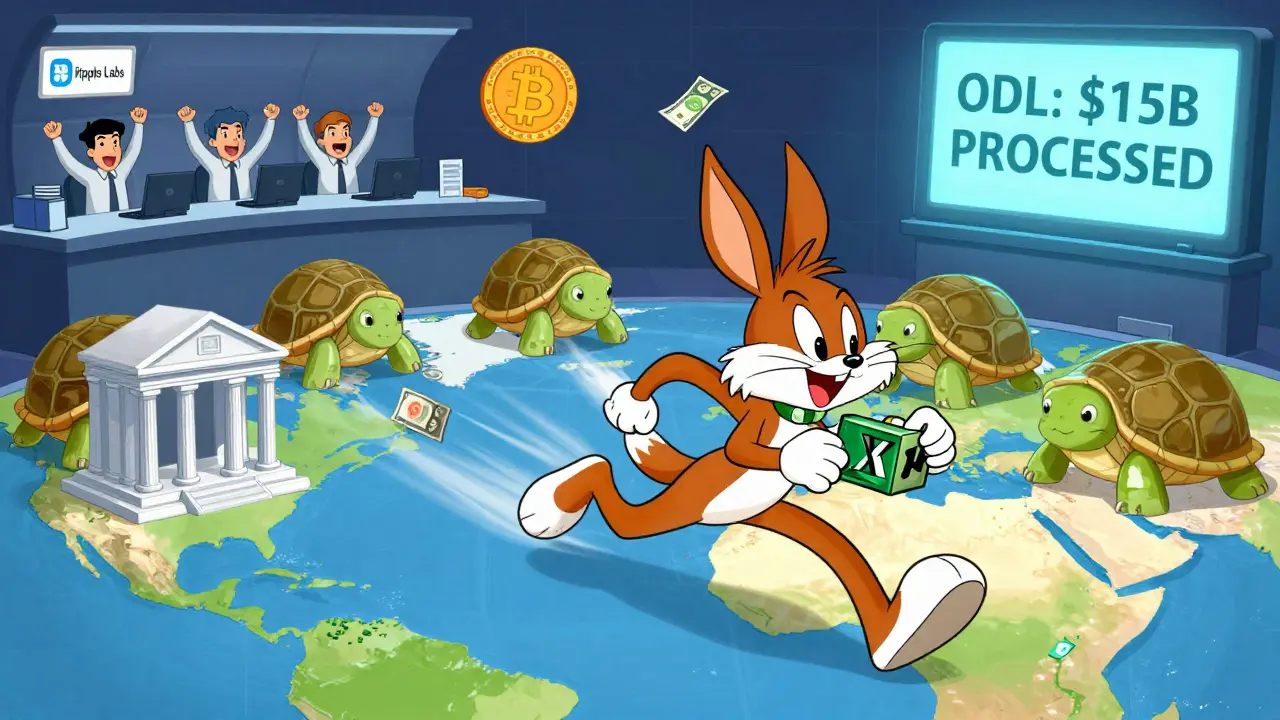
That’s not theoretical. Banks like Santander and Bank of America use Ripple’s On-Demand Liquidity (ODL) service, which moves money using XRP as a bridge currency. In 2025, ODL processed over $15 billion in total volume. One user in the Philippines reported sending $5,000 to family in Manila in 4 seconds for 20 cents. That’s not hype - it’s daily reality for thousands.
How XRP Compares to Other Crypto Payment Solutions
Stellar (XLM) is often mentioned as a competitor. Both focus on payments. But XRP handles more transactions per second and has deeper institutional adoption. While Stellar processed $4.2 billion via its network, Ripple’s ODL hit $15 billion.
But XRP isn’t trying to beat Ethereum at smart contracts. That changed in June 2024 with the Hooks Amendment, which added basic smart contract functions. Still, Ethereum has 450,000 daily active users on dApps. XRP has around 1.2 million daily transactions - mostly payments, not DeFi apps.
And then there’s JPMorgan’s JPM Coin. It’s faster and cheaper than traditional banking, but it’s only for JPMorgan’s internal use. XRP is open to anyone - banks, fintechs, remittance services. That’s why it holds 12.3% of the non-stablecoin cross-border crypto market, ahead of Stellar (9.8%) and behind stablecoins like USDC (78.5%).
Regulation and the SEC Lawsuit
XRP’s biggest cloud has been legal. In 2020, the U.S. Securities and Exchange Commission (SEC) sued Ripple, claiming XRP was an unregistered security. The case dragged on for three years. Then, in July 2023, a judge ruled that programmatic sales of XRP on exchanges were not securities - a huge win. But the SEC still argued that institutional sales (like Ripple selling to investors) were.
That gray area remains. Thailand still classifies XRP as a security. The U.S. doesn’t. That patchwork of rules makes some exchanges delist XRP, and others keep it. Investors are cautious. In February 2025, XRP dropped 42% in one month after Ripple sold $1 billion in XRP from its escrow accounts - a move that sent shockwaves through retail holders.
Market Position and Price Outlook
As of October 2025, XRP’s market cap sits at $178 billion, making it the 6th-largest cryptocurrency. Its price hovers around $3.12. Analysts are split.
- Bullish view: CoinCentral predicts a 40% surge if six pending XRP ETF applications are approved between October 18-25, 2025. Historical data shows XRP gains an average of 51% in Q4 since 2020.
- Conservative view: Kraken’s model forecasts $3.39 by 2026, $4.12 by 2030. That’s a slow, steady climb.
- Skeptical view: CoinLedger says hitting $1,000 is mathematically impossible - it would require a $57 trillion market cap, more than twice the entire U.S. GDP.
Technical analysis also shows trouble. XRP has been forming lower highs while Bitcoin climbs. The MACD indicator turned negative in September 2025, suggesting downward momentum. Retail sentiment on Reddit is 58% positive, but Trustpilot reviews of RippleNet services average just 3.7/5, with complaints about integration complexity.

Can You Use XRP Today?
Yes - but how depends on who you are.
If you’re a retail investor: You can buy XRP on Coinbase, Binance, Kraken, or KuCoin. Setting up a wallet takes 15 minutes. It’s easy. But don’t expect to pay for coffee with it. No major merchants accept XRP directly.
If you’re a business: Ripple’s ODL service lets banks and payment providers use XRP to move money without holding it. They convert USD to XRP, send it across the ledger, then convert to local currency at the other end. No need for pre-funded accounts in foreign banks. That’s how Santander saves $1.2 million per day in liquidity costs.
If you’re a developer: The XRP Ledger is open-source. You can build on it. But the API is complex. GitHub forums show 41% of complaints are about documentation being tailored for enterprises, not hobbyists. Hiring an XRP developer costs $145,000 a year.
Is XRP a Good Investment?
It’s not about speculation. It’s about utility.
XRP’s value comes from real-world use, not memes or hype. Ripple has 130+ financial institutions using its tech across 55 countries. The National Payments Corporation of India just partnered with Ripple to process $50 billion a year. That’s not a rumor - it’s a public announcement.
But risks are real. Ripple still holds 44.5 billion XRP. If they dump even 10% of that, prices could crash. Regulatory uncertainty remains. And while the ledger is fast, it’s not as decentralized as Bitcoin or Ethereum.
If you believe global payments will shift from SWIFT to blockchain-based systems, XRP is one of the few coins built for that future. If you think crypto’s future is in DeFi, NFTs, or AI agents, XRP might not be your play.
What’s Next for XRP?
Two big things are coming in 2026.
- XLS-30d Amendment: Scheduled for Q1 2026, this will add privacy features - like shielded transactions - without breaking compliance. It’s a quiet upgrade, but it matters.
- ETF Decisions: Six rulings on XRP ETFs will drop between October 18-25, 2025. If even one gets approved, institutional money could flood in. If all six are denied, XRP could slump below $2.00.
Ripple’s revenue hit $540 million in Q3 2025, up 27% from last year. They’re not going away. Whether XRP becomes the backbone of global payments - or just another crypto footnote - depends on regulation, adoption, and whether the market believes in its purpose.
It’s not about becoming the next Bitcoin. It’s about becoming the next SWIFT.
Is XRP a good investment?
XRP isn’t a traditional investment like Bitcoin. Its value comes from real-world use in cross-border payments. If you believe banks and payment networks will adopt blockchain to replace SWIFT, XRP has strong fundamentals. But it’s risky. Ripple controls 44.5 billion XRP, and regulatory uncertainty remains. Only invest what you can afford to lose.
Can I use XRP to pay for goods and services?
Not directly. Very few merchants accept XRP for everyday purchases. Its main use is for institutional payments and as a bridge currency in remittance flows. Retailers use stablecoins like USDC or USDT, not XRP. If you want to spend it, you’ll likely need to convert it first.
Why is XRP so cheap compared to Bitcoin?
XRP has 57.1 billion tokens in circulation. Bitcoin has only 19.7 million. Even if XRP’s market cap is high, its price per coin is low because supply is massive. Price per coin doesn’t reflect value - market cap does. XRP’s $178 billion market cap puts it in the top 10 cryptocurrencies, despite its low per-token price.
Is the XRP Ledger decentralized?
It’s partially decentralized. The XRP Ledger uses 35 validators from 15 countries. Ripple runs 6 of them (17.1%), which is why critics call it centralized. But the other 29 are independent - universities, exchanges, and financial firms. It’s more decentralized than most people think, but less than Bitcoin or Ethereum.
What happened in the SEC lawsuit against Ripple?
In July 2023, a U.S. judge ruled that XRP is not a security when sold on public exchanges - a major win for Ripple. But the court still considered sales to institutions as securities. That gray area means regulators can still challenge large institutional sales. The ruling didn’t end the legal risk, but it removed the biggest threat: classifying XRP as a security outright.
kieron reid
February 17, 2026 AT 02:40Ian Plunkett
February 17, 2026 AT 16:23Avantika Mann
February 19, 2026 AT 13:35yogesh negi
February 20, 2026 AT 02:39Nikki Howard
February 20, 2026 AT 04:32Tarun Krishnakumar
February 21, 2026 AT 20:40jennifer jean
February 22, 2026 AT 23:46Sasha Wynnters
February 23, 2026 AT 23:42george chehwane
February 25, 2026 AT 18:09Charrie VanVleet
February 27, 2026 AT 12:14Scott McCrossan
March 1, 2026 AT 02:11Beth Erickson
March 1, 2026 AT 08:48Jenn Estes
March 1, 2026 AT 19:56Anandaraj Br
March 3, 2026 AT 18:36AJITH AERO
March 4, 2026 AT 14:58Geet Kulkarni
March 5, 2026 AT 21:13Paul David Rillorta
March 6, 2026 AT 07:42andy donnachie
March 6, 2026 AT 16:51Lauren Brookes
March 6, 2026 AT 18:19Chris Thomas
March 7, 2026 AT 16:58James Breithaupt
March 8, 2026 AT 08:17Alex Williams
March 9, 2026 AT 14:30Kyle Tully
March 9, 2026 AT 22:23Rajib Hossaim
March 11, 2026 AT 19:37kieron reid
March 12, 2026 AT 00:59Charrie VanVleet
March 12, 2026 AT 11:08