What is BOB (BOB) Crypto Coin? The Hybrid Bitcoin-Ethereum Layer 2 Explained
 Feb, 8 2026
The BOB crypto coin isn't another meme or speculative token. It's a Layer 2 blockchain built to solve one of the biggest problems in crypto: why is Bitcoin, the largest crypto asset by market cap, barely used in DeFi? While Ethereum has billions locked in lending, trading, and yield protocols, Bitcoin's $1.2 trillion value sits mostly idle. BOB, short for Build on Bitcoin, was designed to change that - without wrapping BTC or trusting third parties.
What BOB Actually Is
BOB is a hybrid blockchain that connects Bitcoin and Ethereum. It uses Ethereum's speed and tooling - but secures transactions with Bitcoin's proof-of-work. Think of it as a bridge, but one that doesn't just move assets back and forth. Instead, BOB lets you use Bitcoin directly inside Ethereum DeFi apps - like lending BTC to earn yield or using it as collateral for loans - all without needing a custodian to hold your coins.
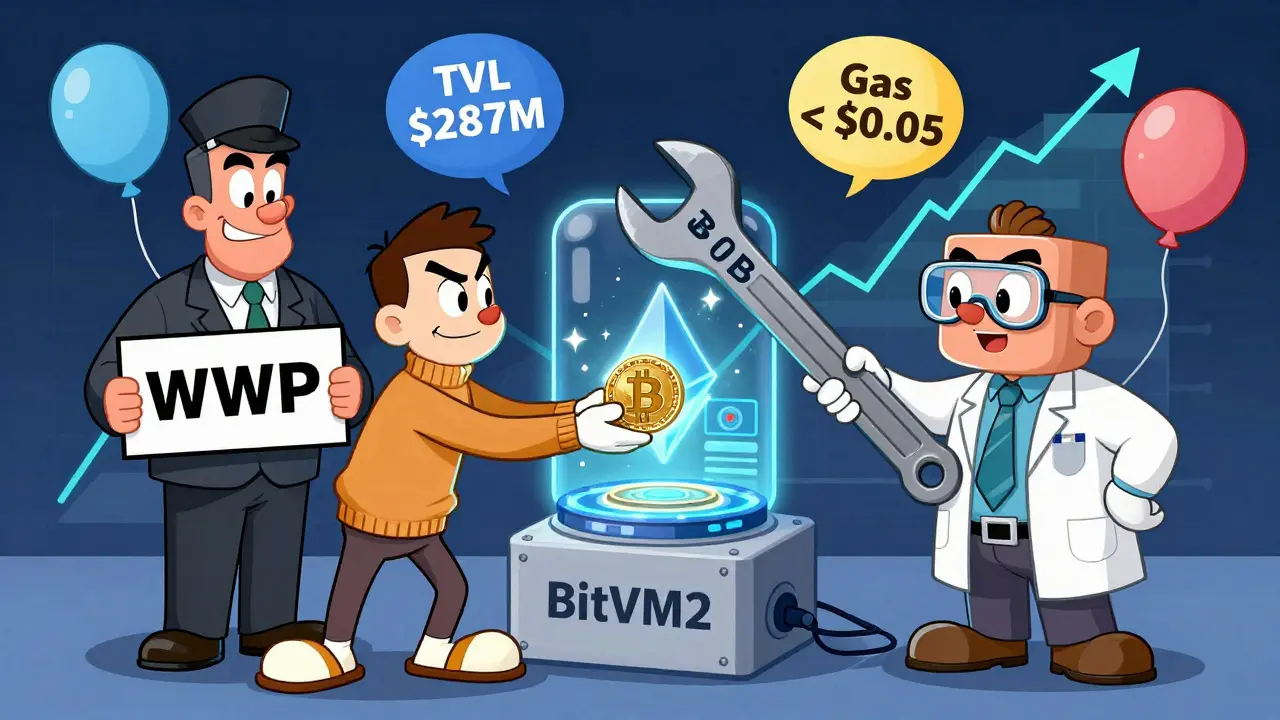
Launched in late 2023, BOB runs on the OP Stack, the same technology behind Optimism and other Ethereum scaling solutions. This means developers can use familiar tools like MetaMask, Solidity, and Remix without learning anything new. The network has 2-second block times and gas fees under $0.05. That’s faster and cheaper than Ethereum L1, and far more efficient than trying to run DeFi directly on Bitcoin.
How BOB Works: The Technical Core
BOB isn’t just another rollup. It’s built on four key layers:
- The Rollup Layer - Uses Bitcoin’s PoW security. Transactions are batched and anchored to Bitcoin’s blockchain.
- The EVM Core - Fully compatible with Ethereum. You can deploy smart contracts, use ERC-20 tokens, and interact with DeFi protocols as if you’re on Ethereum.
- The Bitcoin Bridge - Uses a Bitcoin light client to verify BTC transactions without trusting anyone. This is where BOB differs from wrapped BTC (wBTC). You’re not getting a token that represents BTC - you’re using real BTC, verified on-chain.
- The Rust zkVM - Powered by RISC Zero, this lets BOB run Bitcoin’s native code inside Ethereum’s environment. It’s what makes trustless verification possible.
BOB’s big innovation is BitVM2 - a technical blueprint co-authored by the team behind the project. BitVM2 allows Bitcoin’s logic to be checked on Ethereum without requiring Bitcoin nodes to run Ethereum code. This is a major leap forward in cross-chain security.
Why BOB Matters: The $750 Billion Opportunity
Only 0.3% of Bitcoin’s total market cap is currently used in DeFi. That’s about $3.6 billion out of $1.2 trillion. Meanwhile, Ethereum has 30% of its market cap locked in DeFi. BOB’s entire mission is to close that gap.
As of February 2025, BOB has $287 million in total value locked (TVL) across 17 DeFi protocols. That’s still small compared to Ethereum L2s like Arbitrum or Optimism, but it’s growing fast. The TVL in Bitcoin DeFi as a whole jumped from $500 million to $3.7 billion in just one year - a 640% increase. BOB is positioned to capture a large chunk of that growth.
Protocols like Sovryn have already moved to BOB, making it the first multi-chain DeFi app that works natively on both Bitcoin and Ethereum. That’s a sign developers see real value here.
BOB vs. Other Solutions
Let’s compare BOB to the alternatives:
| Feature | BOB | Wrapped BTC (wBTC) | Stacks | Rootstock (RSK) |
|---|---|---|---|---|
| Security Model | Bitcoin PoW + EVM | Custodial (centralized) | Bitcoin PoW only | Bitcoin PoW only |
| Gas Token | ETH | ETH | STX | RSK |
| EVM Compatibility | Yes | Yes | No | Yes |
| Native BTC Access | Yes | No (tokenized) | Yes (via sidechain) | Yes (via sidechain) |
| Transaction Speed | 2 sec blocks | 15 sec blocks (Ethereum L1) | 10 sec blocks | 30 sec blocks |
| Gas Fees | <$0.05 | $1-$10 | $0.10-$0.50 | $0.20-$1.00 |
BOB stands out because it’s the only solution that combines:
- Bitcoin’s security (no custodians)
- Ethereum’s speed and tooling
- Direct use of native BTC in DeFi
Wrapped BTC (like wBTC) is the most common way people use Bitcoin in DeFi - but it requires trusting a central entity to hold the real BTC. BOB removes that risk. Stacks and Rootstock let you use Bitcoin in DeFi, but they’re not EVM-compatible. That means developers have to rebuild everything from scratch. BOB lets them use their existing code.
Current State and Roadmap
As of February 2026, BOB is in Phase 2 of its roadmap:
- Phase 1 (Completed) - Launched as an ETH rollup using OP Stack. Secured by Ethereum.
- Phase 2 (In Progress) - Adding Bitcoin PoW security via merged mining. Bitcoin miners are now securing BOB transactions.
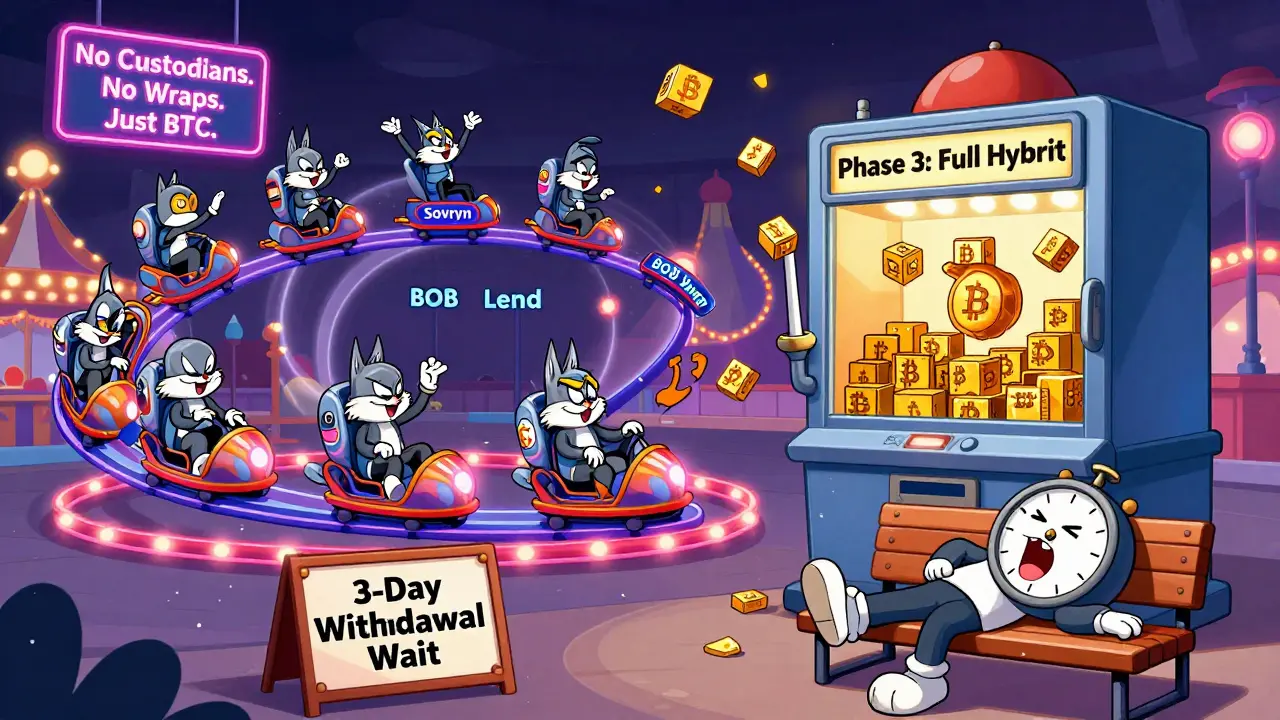
- Phase 3 (Target: Q3 2025) - Full BitVM implementation. BOB will settle transactions on both Bitcoin and Ethereum. This is when it becomes truly trustless.
- Phase 4 (Future) - Full Bitcoin rollup. BOB could eventually become a Bitcoin-native chain with Ethereum-style smart contracts.
Phase 3 is critical. Until then, BOB still relies partially on Ethereum for security - a potential weakness that has drawn criticism. But the team is on track. The BitVM2 implementation has been tested extensively, and the first merged mining miners went live in Q1 2025.
Pros and Cons
Pros:
- Zero custodial risk - you hold your own BTC
- Uses Ethereum tooling - easy for developers
- Low fees and fast transactions
- Backed by serious engineering - co-authors of BitVM2
- Strong community and developer support
Cons:
- Still partially reliant on Ethereum for security (until Phase 3)
- 3-day withdrawal window to Ethereum L1 - too slow for traders
- Complex architecture - hard to understand for Bitcoin-only users
- Previous exploit in September 2024 ($1.2M) - though funds were recovered
The withdrawal delay is a common complaint. If you send BTC from BOB back to Ethereum, you must wait 3 days and 12 hours. That’s because of the challenge period needed to verify Bitcoin transactions on Ethereum. It’s a trade-off for security.
Who Is BOB For?
BOB isn’t for casual investors looking to flip a coin. It’s for:
- DeFi developers who want to build on Bitcoin without rewriting their code.
- Bitcoin holders who want to earn yield without giving up control of their coins.
- Ethereum users who want access to Bitcoin’s liquidity without bridging through risky wrappers.
Community feedback on Reddit and Trustpilot is mostly positive. Developers say it cuts development time in half. Bitcoin users appreciate the lack of custodians. But newcomers often get lost in the terminology - “BitVM,” “zkVM,” “OP Stack.” The documentation is solid, but the learning curve is steep.
What’s Next?
If BOB succeeds, it could unlock $100 billion in Bitcoin liquidity for DeFi. Analysts at Delphi Digital project BOB could capture 15-20% of the Bitcoin DeFi market within three years. That’s not a guarantee - but the technical foundation is one of the most solid in crypto.
BOB’s biggest threat isn’t competition. It’s execution. The roadmap is ambitious. Phase 3 - the full Bitcoin-Ethereum hybrid - must work perfectly. One major bug could shake confidence. But so far, the team has delivered on every milestone.
And remember: there are other coins called BOB - meme tokens on Binance Chain or based on old YouTube characters. They have nothing to do with this project. This BOB is serious infrastructure.
How to Get Started
If you’re ready to try BOB:
- Get an Ethereum wallet (MetaMask, Coinbase Wallet).
- Add the BOB network manually using its RPC details (available on gobob.xyz).
- Use the BOB bridge to move BTC from your wallet to BOB. It’ll appear as native BTC on-chain.
- Start using DeFi apps like Sovryn, BOB Lend, or BOB Swap.
Developers can use the BOB SDK to deploy contracts. It’s built to work with existing Ethereum tooling - no new languages, no new frameworks.
Is BOB a cryptocurrency or a blockchain?
BOB is a blockchain - specifically, a Layer 2 network built on the OP Stack. The native token is also called BOB, but it’s primarily used for governance and staking. Unlike most crypto projects, BOB doesn’t rely on its token for security or transaction fees. Gas is paid in ETH, and Bitcoin provides the underlying security.
Can I earn yield with BOB?
Yes. BOB hosts DeFi protocols that let you stake native BTC to earn yield. For example, Sovryn on BOB lets you lend BTC and earn interest directly from Bitcoin liquidity. There are no wrapped tokens - you’re using real BTC, verified on-chain. APYs range from 3% to 12%, depending on the protocol and demand.
Is BOB safer than wrapped BTC?
Yes, significantly. Wrapped BTC (like wBTC) requires a trusted custodian - often a company like BitGo or Circle - to hold your real Bitcoin. If they get hacked or go bankrupt, your BTC is at risk. BOB uses BitVM2 to verify Bitcoin transactions directly on-chain. No middleman. No custodian. Your BTC stays in your control.
Why does BOB use ETH as gas instead of BTC?
Because Ethereum has the most mature tooling, wallets, and developer ecosystem. If BOB used BTC for gas, developers would need to build everything from scratch. Using ETH lets developers use MetaMask, Etherscan, and Solidity without change. It’s a practical bridge. Eventually, BOB plans to let users pay gas with BTC, but ETH remains the default for now.
Is BOB a good investment?
BOB isn’t a speculative asset like a meme coin. Its value comes from utility. If it succeeds in unlocking Bitcoin’s DeFi potential, the BOB token could gain value as governance participation grows. But most users won’t hold BOB for price gains - they’ll use it to access Bitcoin DeFi. The real investment opportunity is in the infrastructure: the protocols built on BOB, the yield you can earn, and the liquidity it unlocks.
BOB doesn’t promise to make you rich. It promises to make Bitcoin useful. And in a world where trillions sit idle, that’s worth paying attention to.
Taybah Jacobs
February 9, 2026 AT 23:29While I appreciate the technical ambition behind BOB, I must emphasize that the integration of Bitcoin's proof-of-work with Ethereum's EVM introduces a non-trivial layer of complexity that may not be sustainable in the long term. The architectural elegance is undeniable, yet operational overhead and maintenance costs could outweigh the benefits for smaller DeFi applications. A more modular approach might yield greater adaptability.
Alisha Arora
February 11, 2026 AT 16:38so u mean btc is just sitting there like a lazy cat while eth gets all the attention? lol. finally someone made a bridge that doesnt need a middleman. took long enough.
Mrs. Miller
February 13, 2026 AT 07:26It’s fascinating how we’ve built an entire ecosystem around the idea that Bitcoin should be ‘digital gold’-a store of value-while ignoring its potential as a utility layer. BOB doesn’t just bridge chains; it challenges our cultural assumptions about what crypto should be. Are we clinging to Bitcoin as a symbol of purity… or are we afraid of its real power? The answer might say more about us than the tech.
Reda Adaou
February 13, 2026 AT 08:08I’ve been testing BOB on my dev wallet for a few weeks now. The gas fees are insane-like, under a nickel per tx. And the fact that I can use my existing Solidity contracts without rewriting anything? Huge win. The bridge is a bit slow, but I get why. Security first. I’m optimistic.
perry jody
February 15, 2026 AT 03:00YESSSS this is what we needed 😎🔥 finally btc can do more than just sit and appreciate the view. BOB is the real MVP. DeFi on Bitcoin? Yes please. I’m in. Let’s gooooo!
Danica Cheney
February 15, 2026 AT 03:13bitvm2 sounds like a buzzword salad. who even cares if its trustless if no one can use it
David Bain
February 15, 2026 AT 05:05The assertion that BOB eliminates custodial risk is technically accurate, yet misleading. While the settlement layer is decentralized, the operational dependencies on Ethereum’s infrastructure-particularly during Phase 2-introduce a non-trivial attack surface. The 3-day withdrawal window is not a trade-off; it is a necessary safeguard against the inherent latency of cross-chain verification. One must not confuse security with convenience.
Deeksha Sharma
February 16, 2026 AT 02:49This is the future. Bitcoin finally waking up and joining the real party. I’ve been waiting for this for years. BOB is not just a tech upgrade-it’s a cultural shift. The energy here is electric. Let’s build together.
Freddie Palmer
February 17, 2026 AT 20:30Wait-so you’re saying the gas token is ETH, but the security is Bitcoin? That’s… oddly brilliant. But also, doesn’t that mean you’re still reliant on Ethereum’s network congestion? And what if ETH gas spikes? Wouldn’t that bottleneck BOB’s usability? I feel like this creates a new vulnerability.
Jesse Pasichnyk
February 18, 2026 AT 14:27USA built Bitcoin. USA should own the future of DeFi. Why are we letting Ethereum take the spotlight? BOB is the answer. This is American innovation at its finest. We don’t need foreign chains to make Bitcoin useful. We did it ourselves. BOB is the future, and it’s red, white, and blue.
Alex Garnett
February 19, 2026 AT 16:48Another Layer 2 trying to be the savior of Bitcoin? How quaint. You’re not building infrastructure-you’re building a casino with better branding. The fact that you need Ethereum’s tooling to make Bitcoin useful is the ultimate admission of failure. Bitcoin was meant to be sovereign. This is just another dependency chain wrapped in a whitepaper.
Ryan Chandler
February 20, 2026 AT 03:59Imagine this: You hold Bitcoin. Not a token. Not a wrapper. Not a promise. REAL BTC. And you lend it. You swap it. You earn yield on it. All without handing your keys to some company. That’s not innovation. That’s liberation. BOB doesn’t just connect chains-it reconnects us to the original promise of crypto. I’m not just using it. I’m believing in it again.
Ajay Singh
February 20, 2026 AT 19:15BOB is the real deal. Fast cheap secure. No middlemen. BTC in DeFi at last. I’m staking my coins. You should too.
Oliver James Scarth
February 22, 2026 AT 13:51One cannot help but admire the audacity of this endeavour. To marry the stolid, time-tested integrity of Bitcoin’s consensus with the fluid, programmable dynamism of Ethereum is to attempt the alchemical transformation of financial architecture itself. The implications for decentralised governance, asset interoperability, and economic sovereignty are not merely profound-they are epochal.
Kieren Hagan
February 24, 2026 AT 10:56The technical documentation for BOB is among the clearest I’ve encountered in the DeFi space. The architecture is well-reasoned, and the phased rollout demonstrates disciplined execution. That said, the 3-day withdrawal window remains a legitimate usability concern. I would recommend the team implement a liquidity pool for instant exits-perhaps backed by bonded ETH-to mitigate friction without compromising security.
sachin bunny
February 25, 2026 AT 08:01lol this is all a fed scheme. btc was never meant to be used. they want to turn it into another credit card. watch how they shut it down after it gets big. they hate freedom. boomer crypto bros are being played.
🫣💣🪙
Olivette Petersen
February 26, 2026 AT 09:26I love how this brings Bitcoin into the modern DeFi world without forcing people to choose between security and functionality. It’s like finally giving Bitcoin a pair of sneakers instead of boots. I’ve started using Sovryn on BOB and the yield is actually decent. No hype, just solid tech. Keep going!
Michelle Anderson
February 27, 2026 AT 01:08TVL of $287M? That’s cute. For context, Uniswap V3 has over $10B. You’re not a solution-you’re a footnote. And that exploit last year? Yeah, that’s not a ‘recovered’ glitch. That’s a vulnerability. Don’t call this innovation. Call it aspirational.
Shruti Sharma
February 27, 2026 AT 03:42why is gas in eth if btc is the whole point? this is so dumb. why not just use btc for fees? ugh i hate this overcomplicated mess
sabeer ibrahim
February 27, 2026 AT 16:03Another crypto project that thinks it’s smarter than everyone else. BitVM2? RISC Zero? You’re not building infrastructure-you’re building a lecture hall. The real world doesn’t care about your jargon. BTC should be simple. This is just another wall of text.
Udit Pandey
February 28, 2026 AT 11:16It is a moral imperative that Bitcoin remain untainted by the chaotic, speculative architecture of Ethereum. To merge its security with EVM is to betray the original vision. This is not progress-it is corruption. We must preserve Bitcoin’s purity, not dilute it with foreign paradigms.
mahikshith reddy
March 2, 2026 AT 01:13BOB is the future. The moment BTC gets real DeFi, everything changes. This isn’t just tech. This is history. I’m telling my friends. We’re all getting in now. This is the one.