Zero-Fee Cryptocurrency Transactions: How Nano, IOTA, and Tron Eliminate Costs
 Jun, 20 2026
Imagine sending money to a friend across the globe without paying a single cent in transaction fees. It sounds like a glitch in the system, but for users of specific cryptocurrencies, it is reality. While Bitcoin and Ethereum often charge high fees during network congestion, a new wave of digital assets has emerged with a radical promise: zero-cost transfers. This isn't just about saving a few dollars; it is about fundamentally changing how we think about digital value exchange.
The concept of zero-fee cryptocurrency challenges the traditional blockchain model where miners or validators are paid through transaction fees to secure the network. Instead, these alternative networks use innovative architectures that remove the need for expensive mining incentives. If you are tired of watching your transfer amount shrink due to gas fees, understanding these systems could open up a more efficient way to move money.
Why Traditional Blockchains Charge Fees
To understand why zero-fee models are revolutionary, we first need to look at why standard blockchains charge so much. In networks like Bitcoin, security is maintained by Proof-of-Work (PoW) mining. Miners compete to solve complex mathematical puzzles to add blocks to the chain. They spend significant electricity and hardware resources doing this. Transaction fees are their reward.
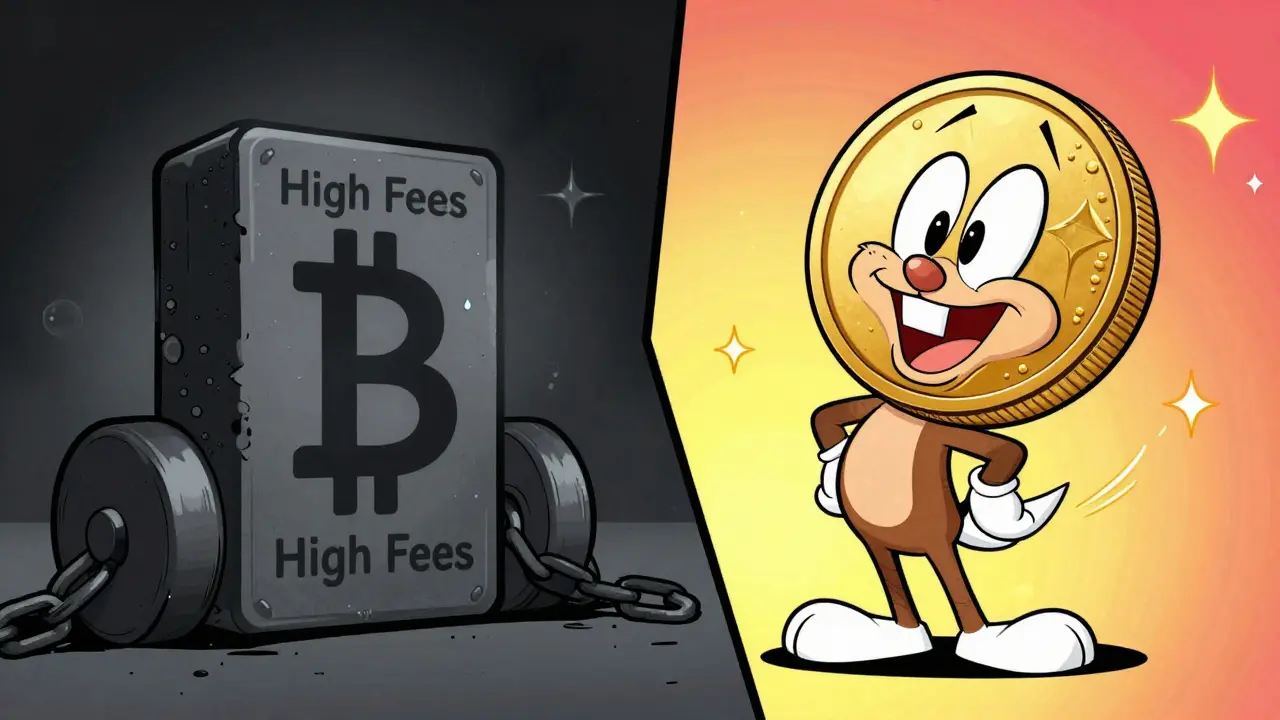
When the network gets busy, users bid up these fees to get their transactions processed faster. This creates a volatile cost structure. A simple payment might cost $1 one day and $50 the next, depending on network demand. This unpredictability makes small transactions-like buying a coffee or streaming a song-economically impossible. You wouldn't pay $5 in fees to buy a $3 cup of coffee. This friction is exactly what zero-fee cryptocurrencies aim to eliminate.
Nano: The Pioneer of Feeless Transfers
Nano is a decentralized cryptocurrency designed for instant, feeless transactions using a unique block-lattice architecture. Launched in 2017, Nano stands out because it is truly free. There is no hidden cost, no minimum fee, and no variable pricing based on network load.
Nano achieves this through a Directed Acyclic Graph (DAG) structure called a block-lattice. Unlike traditional blockchains where all accounts share one global ledger, each Nano account has its own individual blockchain. When you send money, you create a block in your outgoing chain, and the receiver creates a block in their incoming chain to confirm receipt. This parallel processing allows thousands of transactions to happen simultaneously without clogging a single main chain.
Since there are no miners competing for block space, there is no need for transaction fees. Security is maintained through Open Representative Voting (ORV), a delegated proof-of-stake mechanism where representatives vote on transactions. These representatives are incentivized by community support and reputation rather than direct transaction fees. For everyday users, this means sending any amount, from $0.0001 to $10,000, costs exactly nothing.
IOTA: Powering the Internet of Things
While Nano focuses on peer-to-peer payments, IOTA is a distributed ledger technology designed for the Internet of Things (IoT) that enables feeless microtransactions between devices. IOTA uses a different DAG structure known as the Tangle.
In the IOTA Tangle, there are no blocks and no miners. Instead, every user who wants to make a transaction must validate two previous transactions. This creates a self-sustaining network where activity strengthens security. As more people use the network, it becomes more secure and faster, unlike traditional blockchains which can slow down under heavy load.
This model is perfect for IoT applications. Imagine a smart car paying for its own charging station automatically, or sensors in a supply chain tracking goods with tiny data payments. With traditional crypto, these micro-transactions would be eaten alive by fees. With IOTA, they are free. However, IOTA’s complexity means it is less commonly used for simple person-to-person payments compared to Nano, serving instead as infrastructure for machine-to-machine economies.

Tron and Stellar: Near-Zero Fee Alternatives
Not all low-cost solutions are strictly zero-fee, but some come incredibly close, offering practical advantages for broader adoption. Tron is a blockchain platform focused on content sharing and entertainment that offers near-zero transaction fees through Delegated Proof-of-Stake. Tron uses a Delegated Proof-of-Stake (DPoS) consensus mechanism. Validators are elected by token holders, allowing the network to process up to 2,000 transactions per second with minimal latency.
Most Tron transactions cost fractions of a cent, often appearing free to the end-user because the cost is negligible. This makes Tron popular for DeFi applications, gaming, and NFT marketplaces where frequent interactions occur. Similarly, Stellar is an open-source network for currency exchange and money transfers that charges extremely low fees to prevent spam. Stellar charges a fixed fee of 0.00001 XLM per transaction. Given XLM's price, this amounts to roughly $0.000004-a cost so low it is effectively zero for most human purposes.
Stellar’s design prioritizes cross-border payments and financial inclusion. By keeping fees static and microscopic, it ensures that remittances remain affordable regardless of network congestion. Both Tron and Stellar offer a middle ground: they retain a tiny fee structure to discourage spam attacks while remaining economically viable for high-volume use cases.
| Cryptocurrency | Fee Structure | Consensus Mechanism | Best Use Case | Transaction Speed |
|---|---|---|---|---|
| Nano | $0.00 | Open Representative Voting (DAG) | Micropayments, P2P transfers | Instant |
| IOTA | $0.00 | Tangle (DAG) | IoT, Machine-to-Machine | Fast |
| Tron | <$0.01 | Delegated Proof-of-Stake | Gaming, DeFi, Content | ~3 seconds |
| Stellar | ~$0.000004 | Stellar Consensus Protocol | Cross-border payments | 3-5 seconds |
| Bitcoin | Variable ($1-$50+) | Proof-of-Work | Store of Value | 10 mins - hours |
How Do Zero-Fee Networks Stay Secure?
A common question is: if nobody pays fees, who secures the network? In Bitcoin, fees pay miners. In zero-fee networks, security models differ.
Nano relies on Open Representative Voting. Representatives run nodes and vote on transactions. They don't earn fees directly, but they gain status and influence within the community. Some third-party services may compensate top representatives, but the protocol itself does not mandate fee-based rewards. The security comes from the economic cost of attacking the network, which requires controlling a majority of voting power-a difficult feat in a decentralized representative system.
IOTA’s security grows with usage. Since every transaction validates two others, a high volume of transactions means high security. An attacker would need to control a massive portion of the network's computational power to rewrite history, which becomes exponentially harder as the network scales. This is the opposite of Bitcoin, where scaling can sometimes strain security margins if hash rate doesn't keep pace.
For DPoS networks like Tron, super-representatives are staked with large amounts of TRX tokens. If they act maliciously, their stake is slashed. This aligns their financial interest with network health, removing the need for per-transaction fees to incentivize honest behavior.

Practical Challenges and Adoption Barriers
Despite the technical brilliance, zero-fee cryptocurrencies face real-world hurdles. The biggest issue is liquidity and merchant adoption. Because Nano and IOTA are newer and less capitalized than Bitcoin or Ethereum, fewer exchanges list them, and fewer merchants accept them. You won't find many coffee shops with Nano QR codes yet.
Another challenge is user experience. Nano’s wallet interface can be confusing for beginners accustomed to centralized exchanges. Understanding concepts like "sending" vs "receiving" blocks requires a slight shift in mindset. IOTA’s Tangle is even more complex, primarily aimed at developers integrating IoT solutions rather than casual users.
Regulatory uncertainty also plays a role. Authorities are still figuring out how to classify these novel consensus mechanisms. Without clear regulatory frameworks, institutional investors hesitate to allocate funds, limiting growth. However, as platforms like Tron integrate seamlessly with existing DeFi ecosystems, they bypass some of these barriers by leveraging established infrastructure.
Getting Started with Zero-Fee Crypto
If you want to try these networks, here is how to begin:
- Choose Your Network: For simple personal transfers, start with Nano. For business or developer projects involving devices, look at IOTA. For trading and DeFi, consider Tron or Stellar.
- Select a Wallet: Use reputable wallets. For Nano, Nault or Kalium are popular choices. For Tron, TronLink is the standard. For Stellar, Lobstr or Freighter works well.
- Acquire Tokens: Buy Nano, TRX, or XLM on major exchanges like Binance or Kraken, then withdraw them to your private wallet. Note that exchange withdrawal fees may apply, but once in your wallet, transfers are free.
- Test Small Amounts: Send a tiny amount to yourself or a trusted friend to verify the process. Experience the speed and lack of fees firsthand.
Remember, while the transaction itself is free, converting fiat currency to crypto usually involves exchange fees. The savings come when moving value between crypto addresses frequently.
The Future of Feeless Transactions
As blockchain technology matures, the pressure to reduce costs will only increase. Layer-2 solutions on Ethereum, like Lightning Network or Arbitrum, aim to achieve similar results by offloading transactions from the main chain. However, native zero-fee designs like Nano and IOTA offer a cleaner, more integrated experience without the complexity of bridging assets between layers.
We are likely to see hybrid models emerge. Major networks may adopt DAG-like structures for micro-transactions while retaining traditional chains for high-value settlements. The goal is universal accessibility: a world where sending digital value is as frictionless as sending an email. Zero-fee cryptocurrencies are not just a niche experiment; they are a blueprint for the future of global finance.
Is Nano really completely free to use?
Yes, Nano transactions have zero fees built into the protocol. There is no cost to send or receive any amount of XNO. However, you may pay fees when buying Nano from an exchange or withdrawing it to your wallet.
Why don't all cryptocurrencies have zero fees?
Traditional blockchains like Bitcoin use fees to incentivize miners who secure the network through energy-intensive Proof-of-Work. Zero-fee networks use different consensus mechanisms like DAGs or Delegated Proof-of-Stake that do not require per-transaction payments for security.
Which is better: Nano or Tron for daily payments?
Nano is better for pure peer-to-peer payments because it is truly free and instant. Tron is better if you want to participate in DeFi, gaming, or smart contract applications, as it has a larger ecosystem and higher liquidity, though fees are technically non-zero (but negligible).
Are zero-fee cryptocurrencies safe?
They are secure, but they use different security models. Nano and IOTA rely on network participation and voting rather than mining. While they have never been hacked at the protocol level, they have lower market capitalization and liquidity than Bitcoin, which poses different risks regarding price volatility and exchange availability.
Can I use IOTA for regular money transfers?
Technically yes, but IOTA is optimized for IoT and machine-to-machine transactions. Its user interface and ecosystem are less developed for consumer payments compared to Nano or Stellar. It is best suited for developers building connected device networks.