AI and Blockchain Use Cases: Real-World Applications in 2026
 Aug, 24 2026
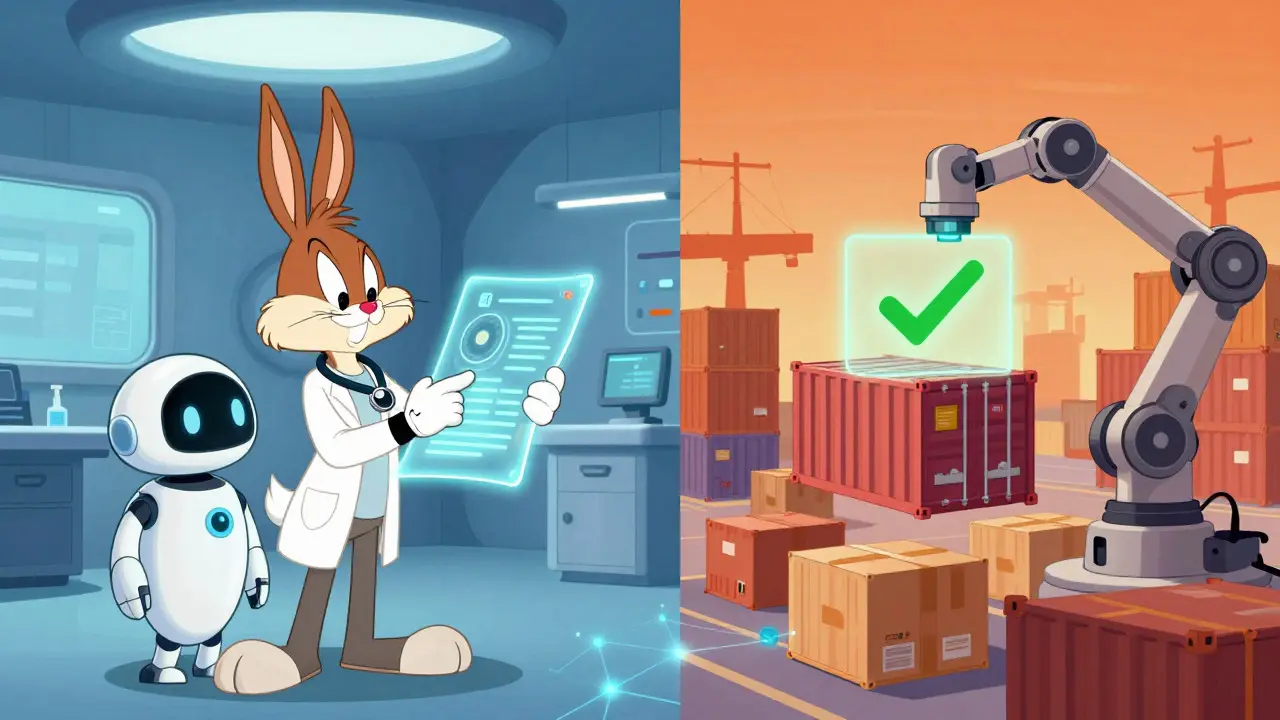
Imagine a world where your medical records are secure from hackers, yet an AI doctor can instantly analyze them to catch early signs of disease. Or picture a shipping container that proves its own authenticity while an algorithm predicts exactly when it will arrive at the port. This isn't science fiction; it's the reality of AI and blockchain use cases practical applications combining artificial intelligence with distributed ledger technology to solve complex real-world problems. For years, these two technologies developed in separate lanes. AI struggled with trust and data integrity, while blockchain suffered from inefficiency and lack of intelligence. Now, they are merging to create systems that are both smart and verifiable.
You might wonder why this combination matters to you or your business. The answer lies in reliability. Standalone AI is often a "black box"-it gives you an answer, but how do you know the data wasn't tampered with? Standalone blockchain is transparent but dumb-it records facts but doesn't interpret them. Together, they fix each other's biggest weaknesses. By 2026, this integration has moved past experimental phases into serious enterprise deployment, particularly in sectors where trust is expensive and errors are costly.
Why Combine AI with Blockchain?
To understand the value, you have to look at what each technology brings to the table. Artificial Intelligence a field of computer science focused on creating systems capable of performing tasks that typically require human intelligence excels at pattern recognition and prediction. However, if the training data is corrupted, the AI makes bad decisions. Blockchain a decentralized digital ledger that records transactions across many computers so that any record cannot be altered without network consensus provides an immutable history. It ensures that the data feeding into your AI model hasn't been quietly changed by a malicious actor.
Conversely, blockchain networks can become congested and inefficient. AI solves this by predicting network traffic and optimizing transaction routing. This symbiotic relationship creates a feedback loop: blockchain secures the data for AI, and AI makes the blockchain faster and cheaper to run. This isn't just theoretical. Recent industry analyses show that integrated systems process transactions up to 2.3 times faster than traditional implementations because machine learning algorithms anticipate bottlenecks before they happen.
Top Industry Applications in 2026
The theory is solid, but where is this actually being used? Let's look at the three sectors leading the charge: finance, healthcare, and supply chain management. These industries share a common trait: high stakes and heavy regulation.
- Finance: Banks use AI-blockchain integrations to detect fraud in real-time. Instead of reviewing transactions after the fact, AI scans patterns on the immutable ledger to flag anomalies instantly. Early adopters report a 68% reduction in data breaches compared to traditional systems.
- Healthcare: Hospitals need to share patient data for research without compromising privacy. Blockchain stores the data securely, while AI analyzes it for diagnostic insights. This allows doctors to access verified histories without worrying about unauthorized edits.
- Supply Chain: Retailers track goods from farm to shelf. Each step is recorded on a blockchain, ensuring authenticity. AI then uses this data to predict demand and optimize logistics. One supply chain manager reported a 52% drop in fraud incidents after implementing this verification method.
These examples highlight a key trend: the move from simple recording to intelligent action. It’s no longer just about keeping a diary of events; it’s about using those events to make better decisions automatically.
Ethereum vs. Hyperledger: Choosing Your Platform
If you're considering implementation, platform choice is critical. You generally have two main paths: public blockchains like Ethereum or private enterprise frameworks like Hyperledger Fabric. They serve different purposes and have distinct strengths.
| Feature | Ethereum | Hyperledger Fabric |
|---|---|---|
| Network Type | Public / Permissionless | Private / Permissioned |
| Best For | DeFi, Public dApps, Open Innovation | Enterprise Supply Chains, Healthcare, Banking |
| AI Integration Ease | Moderate (High community support) | Complex (Requires custom modules) |
| Transaction Speed | Variable (Depends on gas fees) | Consistent (Controlled environment) |
| Data Privacy | Lower (Public ledger) | Higher (Channel-based isolation) |
Ethereum the second-largest cryptocurrency platform by market cap, known for its smart contract functionality and vast developer ecosystem remains the pioneer for open-source AI projects. Its flexibility allows developers to deploy machine learning models directly within smart contracts. However, gas fee volatility can make costs unpredictable. On the other hand, Hyperledger Fabric an open-source project designed to provide a framework for developing permissioned blockchain networks offers control. It’s ideal for companies that need strict compliance and privacy, such as those dealing with HIPAA-regulated health data. While setup is more complex, the stability is worth it for large-scale enterprise operations.
Implementation Challenges and Costs
Let’s be honest: building these systems isn't cheap or easy. If you’re a startup, budget carefully. Enterprise solutions typically range from $250,000 to $500,000 for initial deployment. This cost covers not just software, but the specialized hardware needed to run AI computations alongside blockchain nodes.
Beyond money, there’s the talent gap. You need engineers who understand both Solidity (for blockchain) and Python or TensorFlow (for AI). Finding people with this dual expertise is tough. Most teams spend six to nine months just getting proficient in the combined architecture. A common pitfall is trying to run heavy AI calculations directly on-chain. Since blockchain space is limited and expensive, experts recommend a hybrid approach: store the results on-chain, but perform the heavy lifting off-chain.
Security is another concern. Combining two complex systems introduces new attack vectors. If your AI model is biased or hacked, and that output triggers a smart contract, you could have catastrophic automated consequences. Regular audits and robust testing protocols are non-negotiable here.

Future Trends: Zero-Knowledge Machine Learning
Where is this heading next? The most exciting development is Zero-Knowledge Machine Learning (zkML). This technology allows you to prove that an AI calculation was done correctly without revealing the underlying data or the model itself. Imagine proving to a bank that your credit score is above a certain threshold without showing them your entire financial history. Projects like Modulus Labs are working to bring zkML to production by late 2025 and 2026, which will unlock massive potential for privacy-focused AI applications.
We’re also seeing AI-driven oracles becoming standard. These are services that feed real-world data into the blockchain. With AI enhancement, they don’t just pass data; they validate it. If a weather sensor reports 100 degrees, the AI checks if that matches satellite data before writing it to the chain. This prevents "garbage in, garbage out" scenarios that have plagued traditional DeFi derivatives.
Frequently Asked Questions
Is AI blockchain integration only for large enterprises?
Not necessarily. While enterprise adoption is higher due to budget constraints, public platforms like Ethereum allow smaller developers to build lightweight AI-blockchain apps. However, the complexity means even small teams should seek expert guidance to avoid costly mistakes.
How does this improve data security compared to traditional databases?
Traditional databases have single points of failure. If a hacker accesses the server, they can alter data. In a blockchain-AI system, data is distributed across many nodes, making tampering nearly impossible. AI adds another layer by actively monitoring for anomalies that indicate a breach attempt.
What is the biggest barrier to adoption right now?
The skill gap is the primary hurdle. Companies struggle to find developers who are fluent in both machine learning and distributed systems. Additionally, the upfront cost of infrastructure and integration can be prohibitive for mid-sized businesses.
Will AI replace the need for blockchain verification?
No, they complement each other. AI can predict outcomes, but it doesn't inherently prove truth. Blockchain provides the cryptographic proof of state. Without blockchain, AI decisions remain subjective; without AI, blockchain data remains static. Together, they create a verifiable intelligence layer.
Which industry is seeing the fastest growth in these use cases?
Finance leads with 38% adoption among early implementers, followed closely by healthcare at 29%. Both sectors benefit significantly from the combination of regulatory compliance requirements and the need for rapid, accurate data analysis.