Qatar Institutional Crypto Ban: Why Financial Institutions Are Locked Out
 Oct, 6 2026
Imagine running a major bank in Doha. You have billions in liquidity, tech-savvy clients asking about Bitcoin, and global competitors offering digital asset custody. But you can’t touch it. Not a single satoshi. In Qatar, this isn’t hypothetical-it’s the law. Since 2018, Qatar has enforced one of the strictest institutional cryptocurrency bans in the world, effectively walling off its regulated financial sector from virtual assets.
This isn’t just a minor compliance hurdle; it’s a fundamental structural barrier. While neighbors like Dubai and Bahrain roll out red carpets for crypto exchanges, Qatar keeps the doors shut tight. If you’re an investor, a fintech founder, or a compliance officer operating in the Gulf Cooperation Council (GCC), understanding this ban is critical. It’s not just about what you can’t do-it’s about why the country chose this path and how it shapes the future of finance in the region.
The Core Prohibition: What Exactly Is Banned?
Let’s cut through the legal jargon. The Qatar Central Bank (QCB) issued Circular No. (6) in February 2018, which explicitly prohibited all licensed financial institutions from facilitating bitcoin transactions or any cryptocurrency-related activities. This wasn’t a suggestion. It was a hard stop.
Two years later, in December 2019, the Qatar Financial Centre Regulatory Authority (QFCRA) reinforced this stance with a strict alert banning virtual asset services within the Qatar Financial Centre (QFC). The definition used was broad: any digital substitute for currency used for trading, transfer, or payment purposes. Fiat currencies were excluded, but everything else-Bitcoin, Ethereum, stablecoins like USDT or USDC-fell under the hammer.
The ban covers three main areas:
- Exchange Services: Banks cannot swap fiat money for crypto or vice versa.
- Custody and Transfer: Institutions cannot hold, store, or move virtual assets on behalf of clients.
- Financial Services: Offering loans, derivatives, or investment products tied to crypto issuances is prohibited.
This comprehensive firewall means that if you walk into a Qatari bank today, you won’t find a crypto trading desk. You won’t get a quote on Ethereum. The traditional financial sector operates as if the blockchain revolution never happened-at least for native digital currencies.
Why Did Qatar Choose This Path?
You might wonder why a nation so eager to diversify its economy away from oil would block such a booming industry. The answer lies in risk management and monetary sovereignty. Qatar’s approach aligns with its Third Financial Sector Strategic Plan and Qatar National Vision 2030. These documents prioritize stability over speculative innovation.
For regulators, cryptocurrencies represent volatility and uncertainty. They are not legal tender. They lack central backing. In a small, open economy like Qatar’s, where capital flows are sensitive, allowing unregulated digital assets into the banking system could introduce systemic risks. By banning institutional participation, the government ensures that sovereign control over monetary policy remains intact.
It’s also a defensive play against money laundering and fraud. Without strict KYC (Know Your Customer) frameworks tailored for crypto, banks feared they’d become conduits for illicit funds. The ban simplifies compliance. There’s no gray area. Either it’s fiat, or it’s banned.
The Nuance: Tokenization vs. Cryptocurrency
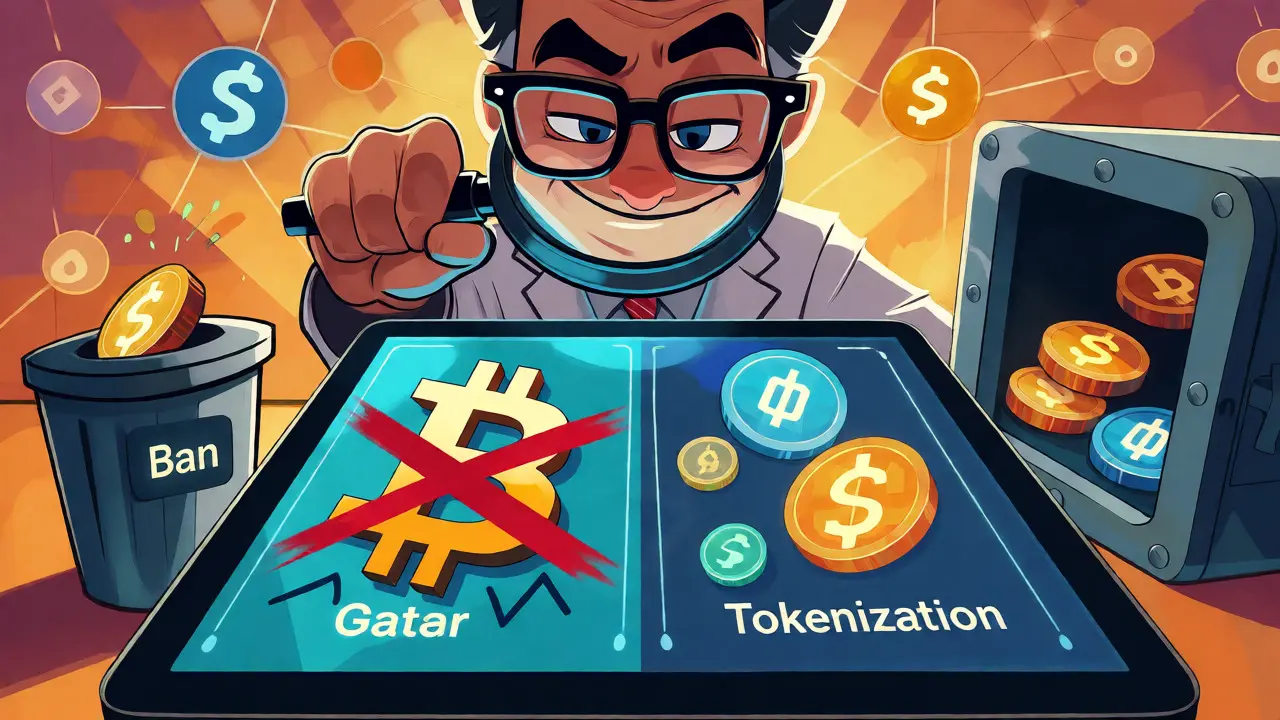
Here’s where it gets interesting. Just because Qatar hates Bitcoin doesn’t mean it hates blockchain. On September 1, 2024, the QFC introduced new Digital Assets Regulations designed to support tokenized securities.
This framework allows for the digitization of traditional assets. Think shares, bonds, sukuk (Islamic bonds), commodities, and real estate. These tokens can be validated, registered, and held in custody under strict regulatory oversight. But there’s a catch: these must be representations of existing, tangible value. They are not "virtual assets" in the sense of being currency substitutes.
The QFCRA clarified that anything classified as a "virtual asset" under the 2019 alert remains an "Excluded Token." So, while you can trade a tokenized share of a Qatari company, you still can’t trade Bitcoin. This distinction is crucial. Qatar is embracing blockchain technology for efficiency and transparency in traditional finance, but it rejects the decentralized, speculative nature of crypto.
How Qatar Compares to Its Neighbors
To understand the severity of Qatar’s stance, look at the map. The GCC countries have taken wildly different approaches to digital assets.
| Country | Institutional Stance | Key Features | Regulatory Body |
|---|---|---|---|
| Qatar | Strict Ban | No institutional crypto services; tokenization allowed for traditional assets only. | QCB, QFCRA |
| Kuwait | Strict Ban | Prohibits payments, investments, and mining; similar to Qatar. | Central Bank of Kuwait |
| Saudi Arabia | Restrictive/Middle Ground | Bans retail trading but explores wholesale CBDC for interbank settlements. | SAMA (Saudi Central Bank) |
| Bahrain | Permissive | Licensed exchanges; clear regulatory framework for virtual assets. | Central Bank of Bahrain |
| UAE | Highly Permissive | Dubai and Abu Dhabi offer free zones with specific crypto licensing. | DFSA, ADGM, VARA |
Bahrain and the UAE have positioned themselves as regional hubs for crypto innovation. They attract talent and capital by offering clarity and licenses. Qatar, conversely, sits at the conservative end of the spectrum, alongside Kuwait. Saudi Arabia occupies a middle ground, focusing on state-controlled digital infrastructure rather than market-driven crypto adoption.
Practical Implications for Businesses
If you run a fintech firm or a bank in Qatar, this ban creates operational headaches. International firms often operate across multiple GCC jurisdictions. A firm might offer crypto custody in Dubai but need to strip those services entirely when dealing with Qatari clients.
This requires separate operational frameworks. Compliance teams must build firewalls to ensure that no crypto-related activity leaks into Qatar-based operations. Penalties for violations are severe, including license revocation and heavy fines. The Qatar Central Bank maintains active oversight, requiring regular reporting and audits to prove adherence to the prohibition.
For investors, this limits exposure. Institutional capital from Qatar stays out of the global crypto markets. This reduces regional liquidity and may slow down the development of local blockchain startups that rely on crypto-native funding models. However, it also protects local savers from the wild swings of the crypto market, keeping household wealth more stable.
The Future: Will the Ban Ever Lift?
Experts suggest that the core ban will persist. Qatar’s preference for sovereign control over monetary policy is deeply ingrained. The recent QFC Digital Assets Regulations show a willingness to experiment, but only within tightly controlled boundaries.
We expect to see more approved tokenized assets in the coming years. Real estate tokenization, in particular, could gain traction given Qatar’s robust property market. But don’t hold your breath for Bitcoin ETFs traded on the Qatar Stock Exchange anytime soon. The line between "digital representation of value" and "speculative digital currency" remains firmly drawn.
Unless neighboring countries demonstrate overwhelming economic benefits from crypto adoption without compromising stability, Qatar is likely to maintain its status quo. For now, the message to the global financial community is clear: in Qatar, blockchain is welcome, but Bitcoin is not.
Can individuals in Qatar buy cryptocurrency?
Yes, individuals can technically own cryptocurrency, but they face significant hurdles. They cannot use local banks to buy or sell crypto directly due to the institutional ban. Most residents use international exchanges or peer-to-peer platforms, paying attention to tax implications and ensuring they don't violate anti-money laundering rules when moving funds in and out of the country.
Is Bitcoin legal tender in Qatar?
No, Bitcoin is not legal tender in Qatar. Only the Qatari Riyal is recognized as official currency. The Qatar Central Bank explicitly excludes cryptocurrencies from its definition of legal money, reinforcing the ban on their use for payments and financial services within the regulated sector.
What is the difference between the crypto ban and the new digital assets regulations?
The crypto ban prohibits native digital currencies like Bitcoin and Ethereum. The new digital assets regulations allow for tokenized versions of traditional assets, such as stocks, bonds, and real estate. Essentially, you can trade a digital certificate of ownership for a house, but you cannot trade a digital coin meant to act as money.
Which other GCC countries have similar bans to Qatar?
Kuwait has implemented similarly strict prohibitions on cryptocurrency payments, investments, and mining. Saudi Arabia restricts retail crypto activities but focuses on wholesale central bank digital currencies (CBDCs). In contrast, the UAE and Bahrain have adopted much more permissive frameworks that encourage institutional crypto adoption.
Can foreign banks offer crypto services to Qatari clients?
Foreign banks operating within Qatar's regulatory jurisdiction must comply with local laws. This means they cannot offer crypto services through their Qatar-based entities. However, Qatari residents can sometimes access services from foreign banks headquartered outside Qatar, though transferring funds back to local accounts can be complex due to banking scrutiny.