Challenges of Blockchain Voting Adoption in Modern Elections
 Dec, 17 2025
Blockchain voting sounds like a perfect fix for outdated election systems. Transparent, tamper-proof, and impossible to hack-right? But here’s the truth: blockchain voting hasn’t worked in any real, large-scale democratic election yet. Not because the idea is bad, but because the real-world problems are far messier than the tech demos suggest.
Security Isn’t Just About the Blockchain
People think blockchain is a magic shield. It’s not. It secures the vote once it’s recorded, but it does nothing to stop malware on your phone or laptop from changing your vote before it even leaves your device. Imagine this: you tap "Cast Vote" on your tablet. A hidden piece of malware intercepts that action, flips your choice from Candidate A to Candidate B, and sends the altered vote to the blockchain. The blockchain records it perfectly. It’s immutable. It’s transparent. And it’s completely wrong. No one can tell the difference. The U.S. Vote Foundation says it bluntly: blockchain doesn’t solve the biggest threat in online voting-infected devices. And there’s no reliable way to check if a million voters’ phones are clean. Foreign actors could deploy malware at scale. Botnets could flood servers during peak voting hours, blocking real votes. Blockchain can’t fix that. The system’s weakest link isn’t the ledger-it’s the voter’s phone.Regulators Don’t Know How to Handle It
Elections are governed by laws written decades ago. Those laws assume paper ballots, locked boxes, and poll workers watching over voters. Blockchain voting breaks every assumption. What happens if a vote needs to be corrected? Blockchain doesn’t allow changes. But what if someone accidentally votes twice? Or votes under a stolen identity? Or if a software bug miscounts 10,000 ballots? In Europe, GDPR requires strict data privacy. Voters must remain anonymous. But blockchain records everything. How do you prove a vote was counted correctly without revealing who voted? Some systems use zero-knowledge proofs to let voters verify their own ballot without exposing their identity. But those are complex, expensive, and rarely tested at national scale. Most governments avoid blockchain voting because there’s no legal framework for it. No court has ruled on whether a blockchain vote is legally binding. No election commission has clear rules for auditing it.Can It Even Handle Millions of Voters?
Blockchain networks like Bitcoin or Ethereum can handle maybe 10 to 50 transactions per second. A national election in the U.S. or India might see 100 million votes in 12 hours. That’s over 2,300 votes per second. Even if you optimize the blockchain for voting, you’re still pushing it far beyond its design limits. Some platforms try to fix this with layer-2 solutions-off-chain vote aggregation before final recording. But that adds complexity. Who verifies the off-chain data? If the off-chain system is centralized, you lose the whole point of blockchain. If it’s decentralized, you slow things down even more. And then there’s cost. Building a secure, scalable, auditable blockchain voting system requires top-tier cybersecurity teams, custom hardware, and constant monitoring. Most local governments can’t afford it. They’re still using old voting machines from the 2000s. Switching to blockchain isn’t an upgrade-it’s a full rebuild.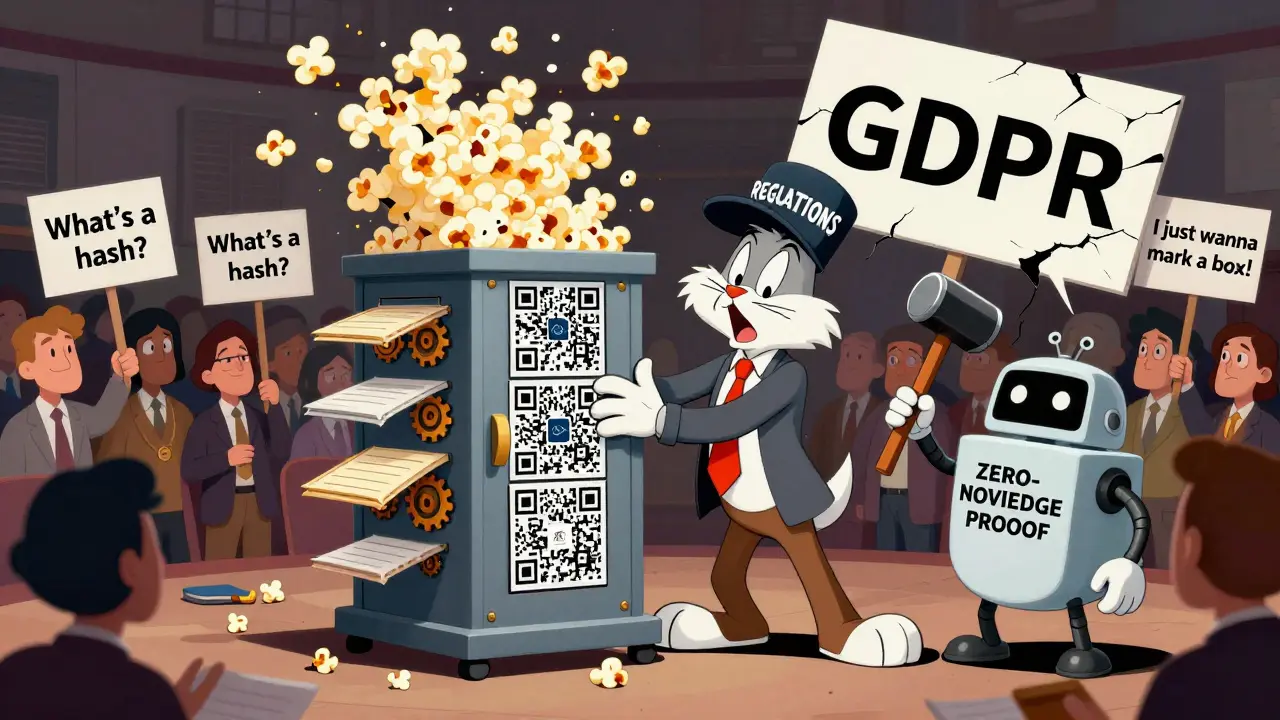
Most Voters Don’t Understand It
You can have the most secure system in the world, but if voters don’t trust it, it fails. A 2025 study found that 78% of people who used blockchain voting in pilot programs felt confident their vote was counted correctly. That sounds good. But here’s the catch: those were volunteers. People who already trusted tech. They were given training. They had help desks. They weren’t tired, confused, or skeptical. In a real election, voters show up at 7 a.m. or after work. They want to mark a box and leave. They don’t want to scan a QR code, log into a secure app, confirm their identity with a biometric, and then wait for a cryptographic receipt. They don’t know what a hash is. They don’t care. If they see a glitch, or if a neighbor says, "I heard they hacked the votes," they’ll lose faith. And once trust is gone, it doesn’t come back.Identity Fraud Is Still a Big Problem
How do you know the person voting is who they say they are? In person, you show a driver’s license. Online? You enter a username and password. That’s not enough. Even biometrics can be spoofed. Some systems link blockchain votes to government-issued digital IDs. But not everyone has one. Elderly voters, homeless people, rural communities-many don’t have access to the tech needed for digital verification. Smart contracts can prevent double voting by marking a voter’s token as used after one vote. But what if someone steals your phone? What if they clone your digital ID? What if a hacker gets access to the identity verification server? Blockchain can’t prevent identity theft. It can only record that a vote came from a verified identity. If the identity was stolen, the vote is still valid on the chain.Transparency vs. Privacy Is a Tightrope Walk
One of blockchain’s biggest selling points is transparency. Everyone can see the votes. But democracy also needs secrecy. You can’t let someone check if their boss voted the way they were told to. You can’t let a political party see how their donors voted. Some systems use mixnets or homomorphic encryption to hide voter identities while still allowing public verification. But these are advanced cryptography tools. They’re hard to build. Hard to audit. Hard to explain. And if you get them wrong, you expose voters. In pilot programs, systems that got this right saw a 67% increase in voter trust. But those pilots had small sample sizes and controlled environments. Scaling them to a national election? No one’s done it yet.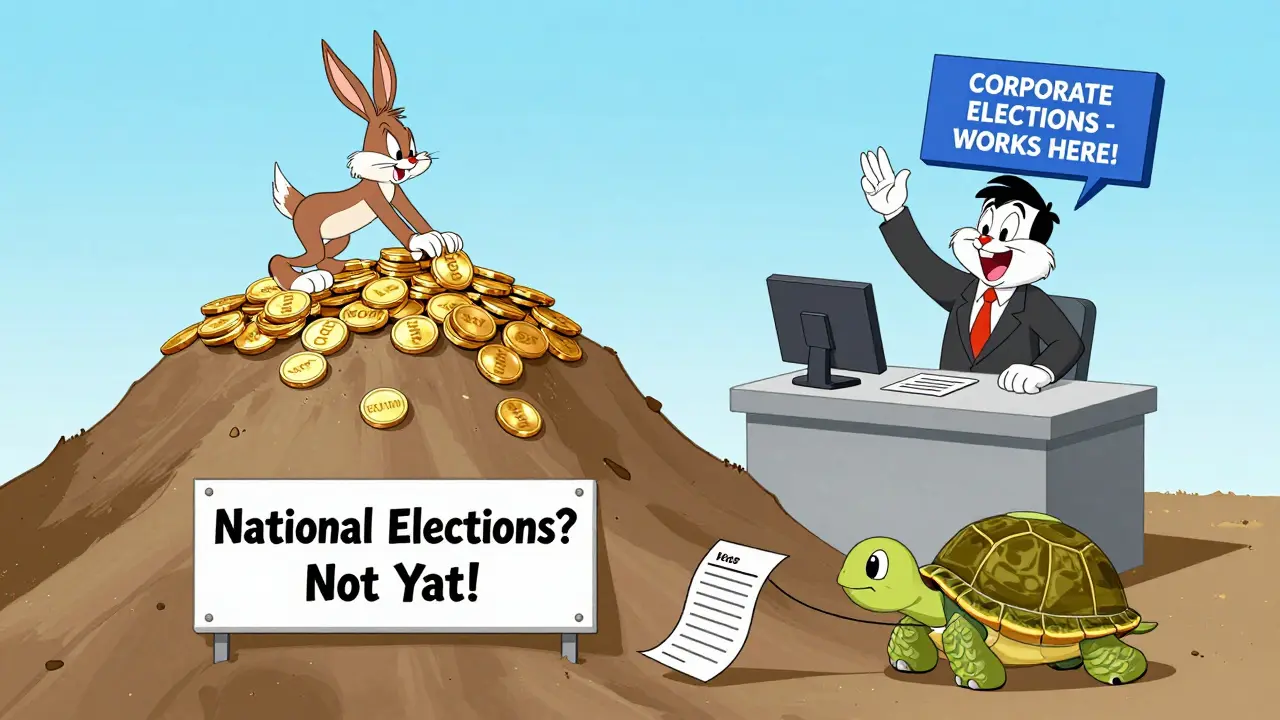
Bradley Cassidy
December 18, 2025 AT 16:34bro i just tried voting on that blockchain app last week and my phone died mid-vote. now i got a message saying "vote submitted" but i never saw the confirmation screen. what even is this tech? i just wanna mark a box and go eat tacos.
Emma Sherwood
December 20, 2025 AT 03:27Let’s be real - the real problem isn’t the blockchain. It’s that we’re trying to force a complex, high-stakes democratic process into a system designed for crypto bros and nerds who think ‘decentralized’ means ‘no rules.’ Most voters aren’t engineers. They’re moms, teachers, truck drivers. If your voting system needs a whitepaper to explain it, you’ve already lost.
And don’t get me started on the idea that ‘transparency’ means everyone can see who voted. That’s not transparency - that’s voter intimidation with a crypto twist. Privacy isn’t a bug. It’s the foundation of democracy.
SeTSUnA Kevin
December 20, 2025 AT 10:21Blockchain voting is a solution in search of a problem that doesn’t exist. Paper ballots have a 99.98% accuracy rate. They’re auditable, cheap, and don’t require quantum-resistant encryption. The real crisis is voter apathy - not cryptographic vulnerabilities.
Mark Cook
December 21, 2025 AT 23:00lol imagine trusting your vote to a blockchain while your phone has 37 malware apps running in the background. 🤡
Craig Nikonov
December 22, 2025 AT 12:51you think this is about tech? nah. this is a globalist plot to erase paper trails so they can manipulate votes without detection. the same people pushing blockchain voting are the ones who banned cash. they want total control. watch the news - they’re already testing facial recognition at polling stations. blockchain is just the next step.
Samantha West
December 23, 2025 AT 22:17It is imperative to recognize that the ontological framework of democratic participation is fundamentally incompatible with immutable digital ledgers. When the individual’s agency is subsumed by algorithmic determinism, the very essence of consent is eroded. We must ask: can a vote be free if it is recorded on a chain no human can fully audit?
And yet - the paradox remains. Without blockchain, how do we prevent fraud? The tension is not merely technical - it is existential.
Sammy Tam
December 24, 2025 AT 04:16My cousin works for a county election office. They still use machines from 2005 that beep when you press the wrong button. They can’t even afford to fix the touchscreens - let alone deploy a blockchain system that costs more than their entire annual budget. This isn’t tech failure. It’s funding failure. Fix the basics first.
Also, if you’re gonna spend $50M on blockchain voting, why not just hire 500 more poll workers? They’d fix lines, help seniors, and actually talk to voters. People trust humans more than code. Always have.
Kayla Murphy
December 24, 2025 AT 15:01Don’t give up on innovation just because it’s hard! We used to say computers were too complicated for seniors - now they’re FaceTiming grandkids. Blockchain voting can be the same. We just need patience, education, and real community outreach - not cynicism.
Start small. Test in college elections. Let people get comfortable. Then scale. Progress isn’t pretty - but it’s worth it.
Chevy Guy
December 26, 2025 AT 11:39blockchain voting? sure. next they'll make us vote via neural implant. 'hello mr. citizen your brainwave patterns indicate you're leaning liberal. please confirm your vote by blinking twice.' lol. we're one step away from the matrix
Tom Joyner
December 27, 2025 AT 05:20The entire premise rests on a fallacy: that decentralization implies security. It does not. It implies complexity. Complexity is the enemy of verifiability. A well-managed paper ballot system, overseen by trained observers, is more verifiable than any distributed ledger ever will be - especially when the ledger is maintained by private vendors with non-disclosure agreements.
Amy Copeland
December 28, 2025 AT 23:49Oh please. You think the average voter gives a damn about zero-knowledge proofs? They just want to know their vote counts. If your system needs a PhD to explain, it’s not democratic - it’s elitist. And the fact that only ‘tech-savvy volunteers’ trust it? That’s not progress. That’s exclusion.
Patricia Amarante
December 30, 2025 AT 09:10I voted in that pilot in Oregon. Felt weird at first, but after the tutorial, it was easy. I liked that I could check my vote was counted. No one told me what to think - I just got to know it worked. Maybe we just need better onboarding?
Cheyenne Cotter
December 30, 2025 AT 16:43Let’s not forget the elephant in the room - even if you solve the tech, you still have to get people to use it. Most Americans don’t even know what a blockchain is. And if you ask them to download an app, verify their identity with a selfie, scan a QR code, and wait for a cryptographic receipt… they’ll just stay home. Voting should be simple. Like checking a box. Not like setting up a crypto wallet. The more steps you add, the more people drop out. And that’s not innovation - that’s voter suppression dressed up as progress.
Also, who’s gonna pay for the help desk? The 70-year-old who can’t figure out how to turn on their tablet? The single mom working two jobs who doesn’t have time to watch a 10-minute tutorial? You think blockchain is gonna fix that? Nah. It’ll just make it worse.
And don’t even get me started on rural areas. My aunt in West Virginia still uses a flip phone. How’s she supposed to vote on a blockchain app? Do we send her a tablet? A cellular hotspot? A tech support rep? This isn’t about democracy - it’s about tech bros trying to solve problems they’ve never even seen.
And then there’s the audit problem. You say the blockchain is transparent? Great. But who’s gonna actually look at it? A team of 20 cryptographers? No. The public doesn’t care about hashes. They care if the winner looks legit. And if the system’s too complicated to audit visually? Then it’s not transparent - it’s obscurantist.
Bottom line: if you want to fix elections, fix the things that matter. More polling places. Longer hours. Better training for poll workers. More accessibility for disabled voters. That’s where the real impact is. Not in blockchain. Not in quantum encryption. Not in zero-knowledge proofs. In human effort. In community. In dignity. Not in code.
Heather Turnbow
January 1, 2026 AT 01:40The ethical implications of replacing physical ballot secrecy with digital traceability cannot be overstated. While the technical architecture may offer cryptographic assurances, the social contract of anonymous voting - a cornerstone of liberal democracy since the 19th century - is irreplaceable. The risk of coercion, retaliation, and social pressure increases exponentially when vote verification becomes possible outside the private voting booth.
Furthermore, the assumption that transparency equates to trust is empirically unfounded. Studies in behavioral psychology demonstrate that complexity breeds skepticism, not confidence. When voters perceive a system as opaque - even if it is technically transparent - they are more likely to distrust it. This is not a flaw of blockchain. It is a flaw of human cognition.
Jesse Messiah
January 2, 2026 AT 18:51Hey everyone - I get the skepticism. But let’s not throw the baby out with the bathwater. We didn’t stop using phones because some people got hacked. We got better at security. Same here. Let’s not pretend paper is perfect - ballot harvesting, miscounted boxes, lost ballots… it’s all real. Blockchain just needs time, testing, and real feedback from voters - not fear.
Start with student elections. Small towns. Then scale. We’ve done it with everything else. Why not voting?
Rebecca Kotnik
January 4, 2026 AT 08:59The notion that blockchain voting is inherently incompatible with democratic principles is a misreading of both technology and governance. The issue is not the ledger - it is the design of the interface, the accessibility of the infrastructure, and the failure of institutions to adapt their epistemological frameworks to digital realities. The solution lies not in rejecting innovation, but in reimagining civic participation through a lens of inclusive design, participatory governance, and iterative learning.
Historically, every major democratic advancement - from universal suffrage to absentee ballots - was met with fear, skepticism, and claims of irreparable harm. The response was not to retreat, but to refine. Blockchain voting is no different. It is not a panacea, but it is not a threat - it is a challenge. And challenges, when met with humility and rigor, become opportunities.
Let us not confuse familiarity with virtue. Paper ballots are not sacred. They are simply the technology of their time. Our time demands new tools - tools that are not merely efficient, but just, equitable, and inclusive. The question is not whether blockchain can be made to work - but whether we have the moral courage to try.
Sally Valdez
January 5, 2026 AT 01:03blockchain voting? yeah right. next they’ll let aliens vote too. this is how they’re gonna steal the election. they already hacked the 2020 vote with mail-in ballots. now they wanna make it digital so no one can prove it. america first. paper ballots or bust. if you want blockchain, move to canada
Jonny Cena
January 7, 2026 AT 00:22Look - I get why people are scared. But fear shouldn’t stop progress. Let’s take this step by step. Start with local elections. Let people try it. Train them. Fix the bugs. Build trust. It’s not magic - it’s just tech. And tech gets better with use.
Also, if you’re worried about malware? Build a dedicated voting device. Not a phone. Not a laptop. A simple, locked-down tablet with no internet except for the vote. No apps. No browser. Just vote. Done. That’s doable. And it’s way cheaper than blockchain.
George Cheetham
January 8, 2026 AT 22:38There’s a deeper truth here: we’re not debating technology. We’re debating our relationship with authority. Paper ballots represent a social compact - we trust the process because we can see it, touch it, witness it. Blockchain replaces that with trust in code, in corporations, in invisible algorithms. That’s not progress. That’s alienation.
Democracy isn’t about efficiency. It’s about presence. About shared ritual. About the weight of a ballot in your hand. You can’t digitize that. And if you try, you lose something essential.
Kelsey Stephens
January 9, 2026 AT 22:35I work with seniors who’ve never used a smartphone. One of them asked me if voting online means she’ll get a text like ‘your vote was received!’ - and then she cried because she thought it meant someone was watching her. That’s the real issue. Not the tech. The fear. And we need to meet people where they are - not drag them into a future they didn’t ask for.
Madhavi Shyam
January 11, 2026 AT 02:41Blockchain voting requires zero-knowledge proofs, homomorphic encryption, and distributed identity verification - all of which are computationally expensive and require quantum-safe cryptography. Current implementations lack formal verification. The attack surface includes side-channel leaks, firmware exploits, and identity spoofing via compromised biometric databases. Without formal methods, the system is not secure by design.
Jack Daniels
January 12, 2026 AT 03:56you ever notice how the people who push blockchain voting never use it themselves? they’re all sitting in their ivory towers typing on MacBooks while grandma in Ohio still uses a pencil and paper. this isn’t innovation. it’s elitism.
Donna Goines
January 12, 2026 AT 05:39they’re using blockchain to track who voted for who. you think the government can’t see it? they’re already building voter profiles. this is how they’ll target you with ads. next thing you know, your vote gets ‘adjusted’ based on your credit score. they’re not trying to make voting better - they’re trying to control you.
Timothy Slazyk
January 13, 2026 AT 03:34Let me cut through the noise. The real failure here isn’t the blockchain - it’s the assumption that technology alone can fix a broken system. We don’t need more encryption. We need more trust. More transparency in the process. More accountability for those running elections. More investment in civic education. Blockchain doesn’t fix voter suppression. It doesn’t fix gerrymandering. It doesn’t fix the fact that 30% of Americans don’t trust elections at all.
Fix the root causes. Stop chasing shiny tech. If you want to restore faith in democracy, you don’t need a ledger. You need leaders who show up, speak truth, and treat voters like citizens - not data points.
And if you’re still convinced blockchain is the answer? Then prove it. Run a national election with it. Let every voter see the chain. Let every auditor inspect it. Let the media follow it. And then - when the system collapses under load, or when someone’s vote gets flipped by malware, or when the public loses trust - come back and tell me it was worth it.
Until then, it’s just vaporware dressed up as salvation.
Tom Joyner
January 13, 2026 AT 16:56Timothy’s point is correct - but incomplete. The deeper issue is institutional inertia. Election commissions are underfunded, legally constrained, and risk-averse. They don’t fear blockchain. They fear liability. No court has ruled on blockchain votes. No law governs their audit. Until we fix the legal architecture, the tech is irrelevant.
Sammy Tam
January 14, 2026 AT 14:17Tom’s right. And that’s why I think the real path is hybrid. Use blockchain for the final tally - but keep paper ballots as the official record. Like a backup. That way, you get the audit trail, the transparency, and the safety net. No one’s doing that yet. But it’s the only way forward.