FATF Greylist Countries: Crypto Implications and Restrictions
 Feb, 25 2026
When the Financial Action Task Force (FATF) updates its greylist, it doesn’t just send a warning to governments-it sends shockwaves through the entire cryptocurrency ecosystem. As of June 2025, 24 countries are on the FATF greylist, meaning their financial systems have serious gaps in fighting money laundering and terrorist financing. For crypto exchanges, wallet providers, and investors, this isn’t just bureaucracy-it’s a live compliance crisis.
What the FATF Greylist Actually Means for Crypto
The FATF doesn’t just name and shame. It forces real-world changes. When a country lands on the greylist, international banks freeze or heavily restrict transactions involving that jurisdiction. The same rule applies to crypto. Virtual Asset Service Providers (VASPs)-that’s exchanges, custodians, and even DeFi platforms-are required to treat transactions from greylisted countries as high-risk. This means:- Transactions to or from these countries get flagged automatically
- Users must submit extra documentation-proof of identity, source of funds, even tax records
- Some platforms outright block users from these regions
- Withdrawals may be delayed for manual review
The 2025 Greylist: Who’s On It and Why
The current greylist includes:- Algeria
- Angola
- Bolivia
- Bulgaria
- Burkina Faso
- Cameroon
- Côte d’Ivoire
- Democratic Republic of the Congo
- Haiti
- Kenya
- Laos
- Lebanon
- Monaco
- Mozambique
- Namibia
- Nepal
- Nigeria
- South Africa
- South Sudan
- Syria
- Venezuela
- Vietnam
- Virgin Islands (UK)
- Yemen
Blacklist vs. Greylist: The Crypto Difference
There’s a big gap between greylist and blacklist. The blacklist has only three countries: North Korea, Iran, and Myanmar. These aren’t just risky-they’re considered active threats. For crypto:- Greylist: Enhanced monitoring. Transactions get flagged. Users get asked for more info.
- Blacklist: Complete freeze. No transactions allowed. No exceptions.
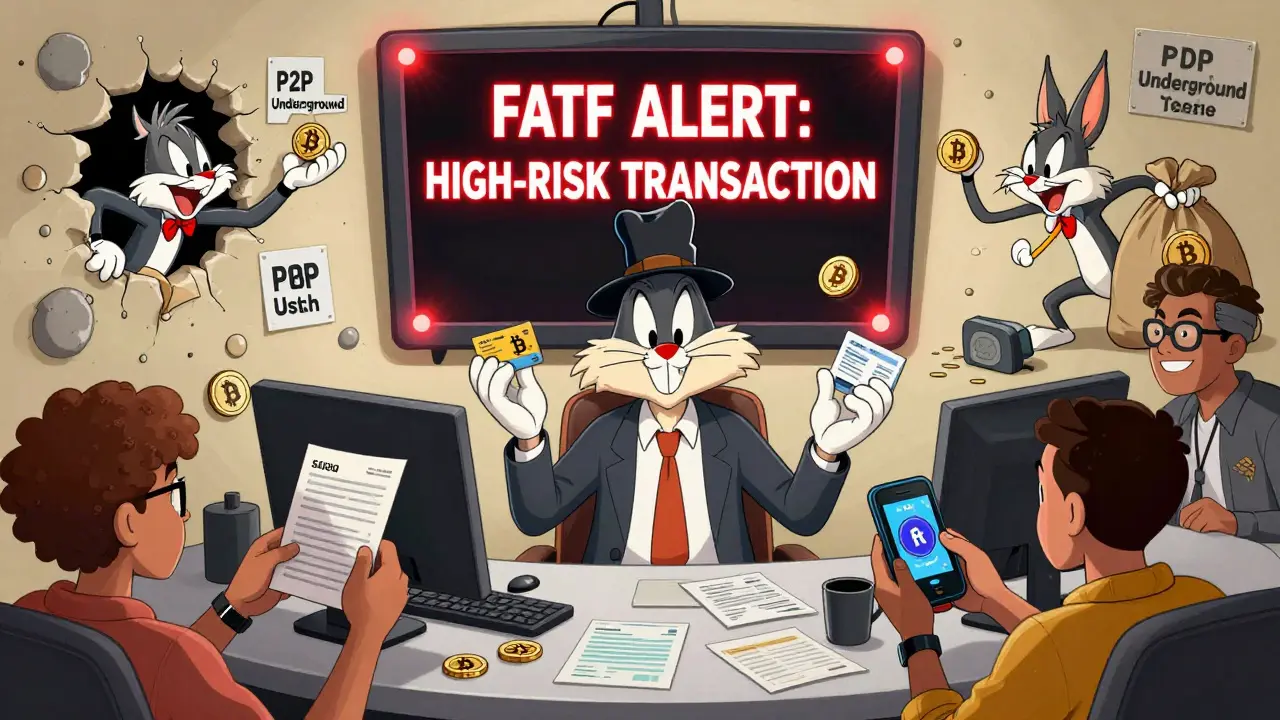
Why Crypto Thrives Despite the Restrictions
You’d think these rules would kill crypto use in greylist countries. But the opposite is true. In Nigeria, where traditional banks restrict crypto access, peer-to-peer trading exploded. In Venezuela, people use Bitcoin to buy food because the local currency is worthless. In Syria, crypto is the only way to receive aid without going through corrupt state banks. FATF wants to stop crime. But people in these countries aren’t criminals-they’re desperate. Crypto fills a gap that banks refuse to. So while platforms block formal channels, underground networks grow. Decentralized exchanges, privacy coins, and non-custodial wallets become lifelines. This creates a paradox: the more FATF tries to control crypto, the more it pushes users toward tools that are harder to track.How Crypto Platforms Handle FATF Rules
Major exchanges like Binance, Kraken, and Coinbase don’t wait for regulators to act. They update their compliance systems within hours of a FATF announcement. Here’s how they do it:- Real-time screening tools check every transaction against FATF lists
- Geolocation and IP address checks block access from high-risk zones
- KYC forms are upgraded to collect source-of-funds data
- Transaction monitoring AI flags unusual patterns-like rapid transfers between wallets in Nigeria and Venezuela
The Hidden Cost: Corruption and Compliance
There’s a direct link between corruption and FATF greylisting. Countries with high public sector corruption are five times more likely to be listed. Why? Because when officials take bribes, they ignore suspicious transactions. South Africa’s 2024 listing followed a surge in corruption under former president Zuma. Over 80% of citizens believed corruption got worse in 2023. That’s not just a political problem-it’s a financial one. If your government won’t investigate money laundering, FATF steps in. And when FATF steps in, crypto businesses pay the price. Banks demand more proof. Audits get longer. Compliance costs rise. Some platforms raise fees just to cover the extra work.
What’s Next? The Travel Rule and CBDCs
The FATF’s “Travel Rule” already requires VASPs to share sender and receiver info for transactions over $1,000. But enforcement is patchy. In 2026, expect tighter global rules-especially for DeFi protocols. Central Bank Digital Currencies (CBDCs) are also changing the game. Countries like Nigeria and Vietnam are rolling out digital versions of their national currencies. If these are built with FATF-compliant tracking, they could reduce crypto’s role in greylist nations. But if they’re poorly designed, they’ll just create new loopholes. The real question isn’t whether crypto will survive FATF rules. It’s whether FATF can adapt to crypto’s reality. You can’t regulate a decentralized network with 1990s banking rules. The system is already breaking at the seams.What You Need to Do If You’re Affected
If you live in a greylist country and use crypto:- Keep your KYC documents ready-ID, proof of address, bank statements
- Avoid mixing funds from different sources
- Use reputable exchanges with strong compliance-don’t gamble on shady platforms
- Understand that delays are normal. A transaction might take 48 hours to clear
- Update your screening tools monthly
- Train your support team to handle FATF-related queries
- Don’t assume your users are innocent-assume they’re under scrutiny
- Partner with compliance firms that specialize in crypto AML
Final Reality Check
FATF’s goal is to stop crime. But in crypto, the line between crime and survival is blurry. People in Venezuela aren’t laundering money-they’re feeding their kids. Nigerians aren’t evading taxes-they’re saving money that banks won’t protect. The system is flawed. It punishes entire populations for the failures of their governments. And while compliance is necessary, the current approach often hurts the very people it claims to protect. The future of crypto compliance won’t be about blacklists and greylists. It’ll be about smarter tools, better data, and real cooperation. Until then, users in restricted countries will keep finding ways to connect-because financial freedom doesn’t wait for bureaucracy.Which countries are currently on the FATF greylist for crypto in 2026?
As of June 2025, the FATF greylist includes 24 countries: Algeria, Angola, Bolivia, Bulgaria, Burkina Faso, Cameroon, Côte d’Ivoire, Democratic Republic of the Congo, Haiti, Kenya, Laos, Lebanon, Monaco, Mozambique, Namibia, Nepal, Nigeria, South Africa, South Sudan, Syria, Venezuela, Vietnam, Virgin Islands (UK), and Yemen. These jurisdictions are under increased monitoring for weaknesses in anti-money laundering and counter-terrorism financing systems. Crypto platforms treat transactions to and from these countries as high-risk, requiring enhanced due diligence.
Does being on the FATF greylist mean crypto is banned in those countries?
No, crypto is not banned. But access becomes much harder. Many exchanges block direct deposits or withdrawals from greylist countries. Users may need to complete extra verification steps, and transactions often face delays. Some platforms restrict services entirely to avoid compliance risk. However, peer-to-peer trading and non-custodial wallets remain active, allowing users to bypass restrictions-though with higher risk.
How do crypto exchanges detect if a user is from a FATF greylist country?
Exchanges use multiple methods: IP address geolocation, KYC documents (which include country of residence), bank account details, and blockchain analytics tools that trace transaction patterns. Some platforms also partner with third-party compliance providers like Chainalysis or Elliptic, which update their databases in real time with FATF listings. When a user attempts a transaction, the system checks against these databases and flags any match.
Why do some crypto platforms still operate in greylist countries?
Some platforms operate through offshore entities or use decentralized protocols that don’t require KYC. Others serve users who already have verified accounts from non-restricted countries. In places like Nigeria and Venezuela, crypto demand is so high that platforms accept the risk. However, they often face banking shutdowns, regulatory fines, or sudden service suspensions. The trade-off is usually short-term profit versus long-term stability.
Can I use a VPN to access crypto services if I’m in a greylist country?
Technically, yes-but it violates most exchange terms of service. Using a VPN to mask your location can trigger account freezes or permanent bans. Exchanges don’t just check your IP-they verify your ID, bank account, and sometimes even your phone number. If those details point to a greylist country, the system will flag you regardless of your IP. It’s not worth the risk unless you’re prepared to lose access to your funds.
What happens if I accidentally send crypto to a blacklisted country like North Korea?
If you send crypto to a blacklisted jurisdiction, your transaction will likely be blocked before it completes. If it goes through, your account will be flagged for review. You may be required to provide a detailed explanation, and in some cases, the exchange will freeze your account or report you to financial authorities. Even accidental transfers to blacklisted addresses can trigger compliance investigations-so always double-check wallet addresses.
Ryan Burk
February 26, 2026 AT 22:26lol so now we're gonna punish 24 countries because some gov'ts are corrupt? cool. so what happens when a guy in lagos just wants to send 500 usd to his sister in london? he gets flagged like a terrorist? this system is a joke. fatf thinks they're policing crime but they're just making life harder for people who already got nothing.
Sriharsha Majety
February 27, 2026 AT 09:56in nigeria we use crypto because banks are broken not because we wanna launder money. i sent money to my mom in abuja last week using usdt. took 3 mins. bank transfer took 4 days and charged me 30% in fees. fatf dont care about real people. they care about paper compliance.
Tabitha Davis
February 27, 2026 AT 17:06OMG this post is literally the most accurate thing ive read all year. like. seriously. i live in the us but my cousin in venezuela uses bitcoin to buy rice. she doesnt even have a bank account. and now fatf wants to cut her off? this isnt about crime. its about control. and its disgusting. also. why is monaco on the list??
Lilly Markou
February 27, 2026 AT 23:50While I appreciate the structural clarity of the analysis presented, I must emphasize the epistemological fallacy inherent in conflating regulatory compliance with systemic oppression. The FATF’s mandate is predicated upon international financial stability, not moral judgment. To frame this as a humanitarian crisis is to misappropriate the discourse of victimhood in service of a technocratic narrative that ultimately undermines the very legitimacy of global governance frameworks.
McKenna Becker
March 1, 2026 AT 22:30They’re not stopping crime. They’re stopping survival.
precious Ncube
March 2, 2026 AT 04:36Anyone who defends crypto use in greylist countries is either naive or complicit. If you’re not willing to play by the rules, you don’t get to complain when the rules apply. This isn’t about oppression-it’s about accountability. And if your country can’t even stop money laundering, maybe it deserves to be cut off.
Amita Pandey
March 3, 2026 AT 16:13It is imperative to recognize that the FATF framework operates within the boundaries of international law and financial ethics. The inclusion of jurisdictions on the greylist is not punitive but corrective. To equate compliance with oppression is to misunderstand the foundational purpose of financial regulation: to protect the integrity of the global system.
Jan Czuchaj
March 3, 2026 AT 16:48Look, I get it. People in Nigeria and Venezuela are using crypto because their systems failed them. That’s tragic. But here’s the thing: the solution isn’t to ignore the rules-it’s to fix the systems that made the rules necessary. You can’t build a better future on top of broken foundations. The FATF isn’t the enemy. The corruption, the incompetence, the lack of investment in institutions-that’s the enemy. And until we start treating those problems like the emergencies they are, we’re just rearranging deck chairs on the Titanic.
Tracy Peterson
March 4, 2026 AT 07:35People think crypto is about freedom. It is. But freedom without responsibility is chaos. The FATF isn’t trying to crush people. They’re trying to stop criminals from hiding behind the chaos. And yeah, sometimes innocent people get caught in the net. That’s the cost of building something that works for everyone-not just the lucky few.
George Suggs
March 5, 2026 AT 11:08so yeah. crypto in nigeria is how people eat. fatf shouldnt be the one deciding who gets to survive.
aaron marp
March 7, 2026 AT 06:16One thing I’ve learned from working with communities in Ghana and Kenya is that crypto isn’t a tool for crime-it’s a tool for connection. When your bank won’t send money abroad, when your currency is collapsing, when your government is silent-you don’t turn to crime. You turn to blockchain. This isn’t a loophole. It’s a lifeline. And the real question is: why are we punishing people for using a lifeline?
Patrick Streeb
March 7, 2026 AT 22:54While the humanitarian implications are undoubtedly significant, the legal obligations under the FATF recommendations remain binding upon all member jurisdictions. Any deviation from these standards, however well-intentioned, introduces systemic vulnerabilities that could compromise the global financial architecture. Compliance is not optional-it is foundational.
Phillip Marson
March 9, 2026 AT 14:33so like. imagine you’re in syria and your kid needs insulin. you can’t get it through the bank. so you send crypto. and now some suit in washington says ‘nah that’s a risk’? bro. that’s not regulation. that’s cruelty with a flowchart. and fatf is just the middleman for this whole messed-up system.
Tracy Whetsel
March 9, 2026 AT 22:11you know what’s wild? people in these countries are building their own financial systems because no one else will. and instead of helping them, we slap them with red flags and call it ‘compliance’. it’s like watching someone drown and then telling them they can’t use the life raft because it’s not Coast Guard approved. 🫂
Ifeanyi Uche
March 11, 2026 AT 18:30naija people dont use crypto to scam. we use it to live. my cousin in abia got paid in btc for her design work. bank said ‘no’ to her naira account. crypto said ‘yes’. fatf dont know the real story. they just see numbers. they dont see people.
Danny Kim
March 13, 2026 AT 12:26so let me get this straight-you’re telling me a guy in haiti who’s selling handmade crafts online has to jump through 17 hoops just to get paid… because some corrupt official in port-au-prince didn’t file a report in 2012? wow. that’s not regulation. that’s punishment by association. and it’s stupid.
Cathy Sunshine
March 14, 2026 AT 20:06It’s not about ‘desperate people’. It’s about weak institutions. And weak institutions attract predators. You think crypto is helping the poor? No. It’s helping the people who know how to game the system. The ones who hide behind ‘survival’ while laundering millions. Don’t romanticize crime. It’s not activism. It’s just crime with a better PR team.
Shannon Black
March 15, 2026 AT 03:41The FATF greylist is a tool for international cooperation-not a moral indictment. Countries removed from the list, such as Croatia and Tanzania, demonstrate that reform is possible. The focus should be on supporting capacity-building in affected nations, not on vilifying users who are simply trying to access financial services.
lori sims
March 16, 2026 AT 12:07imagine if we treated poverty like a medical emergency instead of a compliance problem. if a kid in lagos needs to send money to feed his family, why are we treating it like a bank robbery? this isn’t about rules. this is about heart. and right now, the system has none.
Kaitlyn Clark
March 18, 2026 AT 02:23they say ‘enhanced due diligence’ but what they mean is ‘make life hell for poor people’. i work in fintech. i’ve seen the forms. they ask for tax returns from people who dont even have a bank account. its not about security. its about control. and its cruel.
christopher luke
March 18, 2026 AT 17:14crypto is the only thing keeping people alive in some of these places. and we’re making it harder? 🤦♂️
Mary Scott
March 18, 2026 AT 22:16what if fatf is just a front for the deep state? think about it. they add countries one by one. then crypto gets more decentralized. then they say ‘see? we told you crypto is dangerous!’ and push cbdc’s. this is all a setup. they want total control. and they’re using ‘anti-money laundering’ as the excuse.
Shannon Holliday
March 19, 2026 AT 04:34people in these countries are using crypto like it’s oxygen. and we’re trying to turn off the valve. 🫁❤️
Jeremy buttoncollector
March 20, 2026 AT 00:00the travel rule is a regulatory overreach masquerading as risk mitigation. when you mandate p2p transactional metadata for non-custodial wallets, you’re not enhancing AML-you’re violating the core tenets of decentralization. this is institutional overreach wrapped in compliance jargon.
Michelle Xu
March 20, 2026 AT 12:05While the emotional arguments are compelling, compliance frameworks exist to protect the vulnerable from exploitation. The challenge lies in balancing security with access. Many platforms are now developing tiered KYC systems that allow limited, monitored access for users in greylisted regions-without full compliance burdens. This is the path forward: innovation within regulation, not defiance of it.