NFT Metadata Standards and Structure: A Complete Guide to ERC-721, IPFS, and On-Chain Data
 May, 20 2026
Imagine buying a digital painting that costs thousands of dollars, only to find out the image link is broken six months later. The token still exists on the blockchain, but the art? Gone. This isn't just a hypothetical nightmare; it's what happens when NFT metadata is poorly structured or stored on fragile servers. Metadata is the DNA of your non-fungible token. It tells wallets, marketplaces, and users what they are looking at. Without it, an NFT is just a number on a ledger.
If you are building, buying, or selling NFTs in 2026, understanding the technical skeleton behind these assets is no longer optional-it’s survival. We will break down how this data works, why most projects fail due to bad implementation, and how to future-proof your collection against 'metadata decay.'
What Is NFT Metadata?
At its core, NFT metadata is structured data that describes the essential properties of a non-fungible token. Think of it as the label on a wine bottle. The token ID is the serial number stamped on the bottom, but the metadata is the label telling you the vintage, the region, the grape variety, and the tasting notes. In the digital world, this includes the name, description, image URL, and specific traits like 'Rare' or 'Golden.'
This concept took shape with the ERC-721 standard, proposed by Dieter Shirley in January 2018 and accepted as an Ethereum standard in June 2018. Before this, tokens were fungible-meaning one was identical to another, like Bitcoin. ERC-721 introduced uniqueness. However, the standard itself doesn't dictate exactly what goes into the metadata file; it only mandates that a method called `tokenURI` returns a Uniform Resource Identifier (URI). That URI points to the actual data.
The primary purpose of this data is threefold: establishing provenance (who made it and when), enabling rich attribute systems for gaming and collectibles, and ensuring interoperability across different platforms. According to OpenSea’s 2023 platform analytics, properly structured metadata increases NFT discoverability by 47%. If your metadata is messy, algorithms ignore your asset.
The Anatomy of NFT JSON Structure
Almost all major blockchain platforms use JSON (JavaScript Object Notation) as the de facto format for storing metadata. It’s lightweight, readable by humans, and easily parsed by machines. While the ERC-721 standard leaves the internal structure open-ended, industry leaders like OpenSea have created a 'best practice' schema that has become the unofficial rulebook.
A robust NFT metadata file typically contains the following fields:
- Name: A string limited to 50 characters per OpenSea specs. This is what appears in wallet interfaces.
- Description: A text field supporting Markdown formatting. Use this for lore, utility details, or artist statements.
- Image: The URL pointing to the primary visual asset. Minimum resolution should be 350x350px, though high-res art often uses 5,200x5,200px.
- external_url: A link to the creator’s website or a landing page for more context.
- Attributes: An array of trait objects. This is where the magic happens for rarity tools.
The attributes array is critical for collectors. Each trait object contains a `trait_type` (e.g., 'Background', 'Eyes') and a `value` (e.g., 'Blue', 'Laser'). You can also add a `display_type` to specify how numbers render, such as 'number' or 'boost_percentage'. Tableland’s 2023 analysis of 2.1 million NFTs showed that 92.7% of Ethereum-based NFTs implement at least three attributes. Gaming NFTs average 5.8 attributes, while art NFTs stick to around 3.2. More attributes mean more granularity for filtering and trading.
| Field | Data Type | Purpose | Best Practice |
|---|---|---|---|
| name | String | Token title | Keep under 50 chars; avoid special symbols |
| image | String (URL) | Visual representation | Use absolute URLs; prefer IPFS over HTTP |
| attributes | Array | Rarity traits | Consistent casing; define display_type for numbers |
| external_url | String (URL) | External resource | Link to project site or whitepaper |
On-Chain vs. Off-Chain Storage: The Great Debate
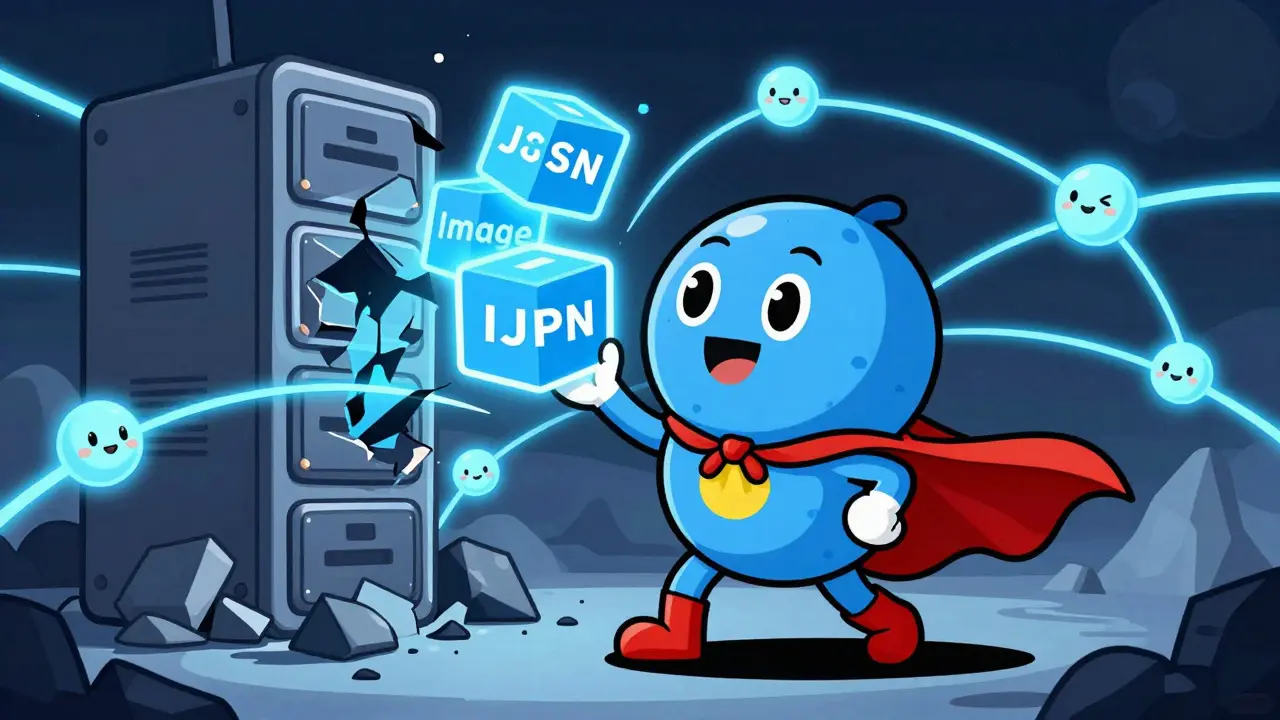
Here is the biggest trap in the NFT space: where do you store the JSON file? Most developers put the heavy data off-chain and store only the pointer (the URI) on-chain. This keeps transaction fees low. However, this creates a centralization risk known as 'link rot.'
According to DappRadar’s Q2 2024 report, 38.2% of NFTs point to standard HTTP endpoints (like AWS S3 or private servers), while 59.1% use IPFS (InterPlanetary File System). Arweave accounts for the remaining 2.7%. The problem with HTTP is simple: if the server shuts down, the metadata disappears. Blockchain researcher Hasu noted in a January 2024 Bankless article that 63% of NFT metadata relies on HTTP endpoints vulnerable to takedowns.
IPFS solves this by using content-addressing. Instead of finding a file by its location (server.com/file.jpg), you find it by its cryptographic hash. As long as one node in the network hosts the file, it remains accessible. However, IPFS requires 'pinning' services to ensure long-term availability. Pinata charges approximately $0.004 per GB for the first 10TB per month (as of May 2024). For enterprise-grade permanence, Arweave offers permanent storage for a one-time fee, making it ideal for high-value art collections.
Solana takes a different approach. Through Metaplex, Solana stores more metadata directly on-chain via the Metadata program. This results in faster retrieval and eliminates reliance on external URIs for basic info, though complex files still point off-chain. Solana transactions for metadata creation average $0.00025, compared to Ethereum’s $1.20-$5.00 range during congestion, according to QuickNode’s April 2024 benchmarks.
Cross-Chain Standards: ERC-721, ERC-1155, and Beyond
Not all blockchains speak the same language. Understanding the differences between standards is crucial for cross-chain compatibility.
ERC-721 is the original standard for unique items. It supports only non-fungible tokens. Its metadata requirements are optional but strongly recommended. If you are launching a generative art collection or a unique real-world asset token, this is your go-to.
ERC-1155, proposed by Enjin in June 2018, allows a single contract to hold both fungible and non-fungible tokens. This is massive for gaming. Imagine a game where players own gold coins (fungible) and unique swords (non-fungible). ERC-1155 handles both efficiently, reducing gas costs significantly. Enjin reports 78% adoption among blockchain games as of Q1 2024. The metadata structure here uses the `uri` method instead of `tokenURI`, but the JSON payload remains similar.
On other chains, variations exist. Binance Smart Chain’s BEP-721 and BEP-1155 are near-identical to Ethereum’s counterparts but optimized for BNB Chain’s lower gas fees (average $0.03 per transaction). Solana’s Metaplex standard (v2.0, released Jan 2022) adds fields like `animation_url` for dynamic content and a `uses` field to track utility consumption-a feature increasingly popular for event tickets and access passes.
The Danger of Metadata Decay
We need to talk about failure. 'Metadata decay' is the phenomenon where off-chain metadata becomes inaccessible over time. Stephen Hess, CTO of Metaplex Foundation, stated in a January 2024 blog post that this affected 18.3% of Ethereum NFT projects in 2023. Why does this happen?
- Server Shutdowns: The developer runs out of money or loses interest, killing the hosting service.
- Broken Links: Incorrectly formatted URIs or relative paths that don’t resolve.
- Format Obsolescence: Using outdated JSON structures that new marketplaces can’t read.
A stark example is the 'DigitalDreams' project, which lost 92% of its value after launch when their HTTP metadata server went offline in November 2023, affecting 4,382 tokens. Conversely, the Bored Ape Yacht Club maintained value partly because they implemented comprehensive, pinned metadata with consistent attribute structures. Consensys noted in their 2023 NFT Developer Guide that improper metadata implementation is the cause of 42.7% of reported NFT issues.
Implementation Best Practices for 2026
If you are deploying an NFT collection today, follow these steps to ensure longevity and usability:
1. Validate Your JSON: Use tools like OpenSea’s Metadata Validator or the IPFS Metadata Checker. GitHub issues show that 38.2% of metadata-related bugs stem from invalid JSON formatting. Common errors include missing commas, unescaped quotes, or incorrect data types.
2. Pin Everything: Never rely solely on a personal web server. Upload your images and JSON files to IPFS and pin them with a reputable service like Pinata or nft.storage. Then, construct your URI to point to the IPFS gateway (e.g., `ipfs://Qm...`).
3. Standardize Attributes: Ensure your `trait_type` values are consistent. Don't mix 'Color' and 'color'. Rarity calculators fail when casing is inconsistent. Aim for at least 3-5 attributes for collectibles to provide enough variance for secondary market trading.
4. Consider On-Chain Embedding: For smaller projects, consider embedding minimal metadata directly in the smart contract bytecode. EIP-5169, announced by ENS in April 2024, promotes decentralized metadata profiles embedded in contracts to prevent URI failures entirely.
5. Test Across Wallets: What looks good in MetaMask might break in Phantom or Rainbow. Test your metadata rendering on multiple frontends before launch. CORS headers are a common culprit for HTTP-hosted metadata failing to load in browsers.
Future Trends: Self-Healing and Cross-Chain Specs
The landscape is evolving rapidly. The newly formed NFT Metadata Alliance (announced May 7, 2024), comprising OpenSea, Coinbase, and Rarible, aims to create cross-chain metadata specifications by Q4 2024. This could finally solve the fragmentation issue where an NFT looks different on Ethereum than it does on Polygon.
We are also seeing proposals for 'self-healing' metadata systems, like EIP-6453 currently in review, which would allow contracts to automatically update their URI pointers if the original host fails. Additionally, integration with decentralized identity protocols (DID) is gaining traction for verifying creator provenance without relying on centralized social media links.
As regulatory frameworks like the EU’s MiCA (effective Dec 2024) begin requiring specific metadata fields for digital tokens-including creator identification-the line between technical implementation and legal compliance is blurring. Proper metadata is no longer just about aesthetics; it’s about accountability.
What is the difference between ERC-721 and ERC-1155 metadata?
The main difference lies in the underlying token standard, not necessarily the JSON structure. ERC-721 is for unique, non-fungible items and uses the `tokenURI` function to retrieve metadata. ERC-1155 supports both fungible and non-fungible tokens within a single contract and uses the `uri` function. Both typically point to a JSON file, but ERC-1155 is more efficient for batch operations, making it preferred for gaming assets.
Why is IPFS better than HTTP for NFT storage?
HTTP relies on a specific server address. If that server goes offline, changes hands, or gets hacked, the metadata is lost. IPFS uses content-addressing, meaning the file is identified by its cryptographic hash. As long as any node in the network hosts the file, it remains accessible. This decentralization prevents 'link rot' and ensures the longevity of your NFT's data.
What causes metadata decay?
Metadata decay occurs when the off-chain data linked to an NFT becomes inaccessible. Common causes include the shutdown of the hosting server, broken hyperlinks, incorrect JSON formatting that prevents parsing, or the deprecation of the API endpoint used to serve the data. Approximately 18.3% of older Ethereum NFTs suffer from this issue.
How many attributes should an NFT have?
There is no strict rule, but best practices suggest at least 3-5 attributes for collectibles to enable meaningful rarity differentiation. Gaming NFTs often average 5.8 attributes to support gameplay mechanics, while art-focused NFTs may use fewer, focusing on aesthetic traits. Consistency in naming and structure is more important than quantity.
Can I store all NFT metadata on-chain?
Yes, but it is expensive on networks like Ethereum due to high gas fees. Storing large images or detailed descriptions directly on-chain is impractical. However, you can store minimal metadata (like name and symbol) on-chain using techniques like EIP-5169. Solana’s Metaplex standard allows for more substantial on-chain metadata storage at a fraction of the cost, making it a viable option for Solana-based projects.
Jesse Alston
May 20, 2026 AT 13:08Hey everyone! 👋 This is such a crucial topic for anyone serious about Web3. I've seen too many projects fail just because they didn't pin their metadata properly. The part about IPFS vs HTTP really hit home for me. It's wild how many people still use centralized servers for something that's supposed to be decentralized 🤔
Ashley Rodriguez
May 22, 2026 AT 05:02i think this article is super helpful but honestly i feel like it could have gone deeper into the actual coding part of things like how you actually write the json file and all that stuff because knowing the theory is one thing but doing it is another and i know a lot of us are just trying to figure out the practical side of things without getting overwhelmed by all the technical jargon that gets thrown around in these spaces
Bridget Coogle
May 22, 2026 AT 07:06You're right Ashley, the practical side is key. But honestly, if you can't read the basics here, the code will confuse you more. Start small. Pin your files. That's step one.
Zara Zaman
May 22, 2026 AT 20:46This whole guide is just fluff for people who don't understand real security. American developers need to stop relying on foreign standards and build our own infrastructure. Why are we using Ethereum when we have better options? Stop being weak.
Larry Port
May 23, 2026 AT 05:45I wonder if the standardization efforts mentioned at the end will actually stick or if it's just another cycle of hype and then abandonment. It seems like every year we get a new 'best practice' that contradicts the last one. Maybe the industry needs to slow down and focus on stability rather than speed?
Jocelyn Garcia
May 24, 2026 AT 21:28The latency issues with IPFS gateways are often overlooked in these guides. While content-addressing is great for permanence, the retrieval speed can be a bottleneck for high-frequency trading bots or dynamic NFTs that need real-time updates. You gotta balance decentralization with UX.
Amit Varpe
May 26, 2026 AT 15:53India is leading in blockchain adoption and we should be proud of that. This guide is good but lacks perspective from emerging markets where gas fees matter more. Solana is the way forward for sure. 🇮🇳
Bronwen Butler
May 28, 2026 AT 13:26Everyone thinks IPFS is magic. It's not. Nodes go offline. Pinning services charge money. If you don't pay Pinata your files disappear just like any other server. The only true storage is on-chain and everyone knows it but they hate paying for it.
Pauline Larocco71
May 30, 2026 AT 00:05oh my gosh this is so true about the broken links i had an nft once and it just vanished after a month it was so sad i cant believe people still do this its like digital vandalism almost and i hope they fix it soon because art is precious and we need to protect it form decay
beti macedo
May 31, 2026 AT 03:04It is indeed a very important subject for the preservation of digital assets. One must ensure that the JSON structure is valid and follows the OpenSea specifications meticulously. Failure to do so results in poor discoverability which is unfortunate for the creator. We must strive for excellence in our metadata implementation.
Michelle Bonahoom
May 31, 2026 AT 08:48Boring. Another tech bro guide. Nobody cares about ERC-721 anymore. Just buy the dip and hold. Metadata is for nerds.
Matt Davis
June 1, 2026 AT 23:14Absolutely pathetic advice. You call this a complete guide? It's barely a scratch on the surface. The fact that you suggest using HTTP endpoints as a primary example shows how out of touch you are. Disgraceful. Do better.
Albert Lee
June 2, 2026 AT 18:44Wow, Matt, take a breath! 😲 Jesse did a great job explaining the basics. Not everyone is a senior engineer. We all start somewhere. Let's keep the conversation constructive please!
Ankush Pokarana
June 3, 2026 AT 20:49the philosophical implication of metadata decay is profound it suggests that our digital memories are ephemeral and fragile much like human memory itself when we lose the link we lose the context and without context the token is just a number floating in the void of the blockchain devoid of meaning or history which raises questions about the nature of ownership in a digital age
Bianca Vilas Boas Lourenço
June 4, 2026 AT 16:16Ugh, reading this gave me a headache. 🙄 So basically, if you don't spend thousands on Arweave, your NFT is worthless? Thanks for the scare tactic. I'm going back to sleep. 💤
Yash Lodha
June 5, 2026 AT 17:15The 'NFT Metadata Alliance' is clearly a front for Coinbase to control what data is visible. They want to centralize the narrative under the guise of 'standards'. Don't fall for it. The real truth is hidden in the private keys, not the public JSON.
Sarah C
June 5, 2026 AT 18:37I appreciate the detailed breakdown here. It helps clarify why some collections look broken in wallets while others render perfectly. Consistency really does matter.
Kimberly Herbstritt
June 7, 2026 AT 08:34I disagree that IPFS is the only solution. Arweave is better for permanent storage even if it costs more upfront. Paying monthly fees for pinning is just renting your own data. Buy it once.
Sharada Vakkund
June 7, 2026 AT 17:30Great discussion everyone! Let's make sure we include those from different backgrounds in this tech space. Blockchain should be for everyone, not just the elite devs.
Sudarshan Anbazhagan
June 8, 2026 AT 14:49it is imperative that one understands the nuances of the ERC-1155 standard as it offers significant gas savings for batch operations which is particularly relevant for gaming applications where multiple items are transferred simultaneously thus reducing the overall transaction cost for the user base
John Gonzalez Bentham
June 9, 2026 AT 17:38this guide is trash u didnt mention EIP-5169 enough its the future and ur focusing on old stuff. also ur spelling is bad lol. get better.
Ellie Riddell
June 10, 2026 AT 05:45Sarcasm aside, the point about CORS headers breaking wallet rendering is spot on. I spent three days debugging that issue. It's always the little things that kill you.
Destiny Kilby
June 11, 2026 AT 12:57The distinction between on-chain and off-chain storage is critical. Many users fail to grasp that the token ID is merely a pointer. Without reliable hosting, the asset is effectively non-existent despite its presence on the ledger.
Jerry CUNNINGHAM SR
June 11, 2026 AT 13:01Excellent summary. We must respect the boundaries of technical standards while fostering innovation. The community benefits when we adhere to best practices like pinning and validation. Let us continue this dialogue with professionalism.