P2P Network Vulnerabilities in Blockchain: Eclipse Attacks, Mitigation & 2026 Security Guide
 Aug, 11 2026
Imagine sending a transaction that hangs forever, not because the network is busy, but because your device is being lied to. This isn't a glitch; it's a targeted attack on the foundation of blockchain technology. The Peer-to-Peer (P2P) network layer, often overlooked by users focused on wallet balances and gas fees, is currently the most underestimated threat vector in digital asset security. While cryptography protects the data, the P2P layer controls who sees that data-and if an attacker can isolate you from the honest majority, they control your reality.
In 2026, as blockchain adoption matures, the battle for network integrity has shifted from code exploits to network topology manipulation. Understanding these vulnerabilities is no longer optional for developers or serious investors; it is essential for preserving the decentralization that makes blockchain valuable in the first place.
The Hidden Weakness of Decentralized Communication
To understand the risk, we must look at how blockchains actually talk. Unlike traditional internet services that rely on central servers, blockchains use a distributed network where nodes communicate directly. P2P Network is a decentralized communication architecture where each participant acts as both client and server, enabling direct exchange of data without intermediaries. In Bitcoin, this uses a random graph topology over TCP/IP port 8333, while Ethereum employs a more complex Kademlia-based Distributed Hash Table (DHT) on port 30303.
This design eliminates single points of failure, which is its greatest strength. However, it also creates unique attack surfaces. As documented by the Cloud Security Alliance in October 2020, this same decentralization allows malicious actors to exploit connection limits and routing protocols. The core issue? Trust. Nodes must trust their peers to provide valid blocks and transactions. If those peers are compromised, the node’s view of the network becomes skewed.
Dr. Emin Gün Sirer, Professor of Computer Science at Cornell University, highlighted this critical gap in his 2024 IEEE Security & Privacy keynote, stating that 'P2P layer vulnerabilities represent the most underestimated threat vector in blockchain security today, with 78% of consensus failures originating from network layer issues rather than cryptographic flaws.' This statistic shifts the focus from hashing power to network connectivity.
Eclipse Attacks: Isolating the Node
The most notorious P2P vulnerability is the Eclipse Attack is a network-level attack where an adversary monopolizes all incoming and outgoing connections of a target node, effectively isolating it from the rest of the honest network. Originally described by Heilman et al. at USENIX Security '15, this attack doesn't require breaking encryption; it requires controlling bandwidth and IP addresses.
Here is how it works in practice:
- Reconnaissance: An attacker monitors the target node's IP address and identifies its current peer connections.
- Displacement: Using a large pool of controlled IPs (often via cloud providers), the attacker floods the target with connection requests, filling up its limited connection slots.
- Isolation: Once all slots are filled with attacker-controlled nodes, the victim can no longer connect to honest peers. It only sees blocks and transactions broadcast by the attacker.
The consequences are severe. For a miner, this means they might mine on a stale chain, wasting electricity and losing rewards. For a user, it can mean double-spending attacks where the attacker convinces the victim that a transaction was confirmed when it wasn't. In January 2019, Monero experienced a real-world eclipse attack involving approximately 130 IP addresses, delaying user transactions for 8-12 minutes and disrupting market confidence.
Bitcoin Core nodes historically had an 8-connection slot limit, making them highly susceptible. Although newer versions have increased this limit, the fundamental vulnerability remains if an attacker can predict the target's IP before it connects to new peers. Ethereum’s Geth client faced similar issues, prompting a hotfix in version 1.11.0 released on March 15, 2023, after the NDSS '23 paper demonstrated the "Gethlighting Attack," showing that DoS conditions could be achieved without full eclipse.
Beyond Eclipse: Bandwidth and Routing Exploits
Eclipse attacks are just the tip of the iceberg. The P2P layer faces a variety of sophisticated threats that exploit the resource-intensive nature of maintaining network connections.
| Attack Type | Mechanism | Impact | Mitigation Difficulty |
|---|---|---|---|
| Eclipse Attack | Monopolizing connection slots | Node isolation, double-spending risk | High |
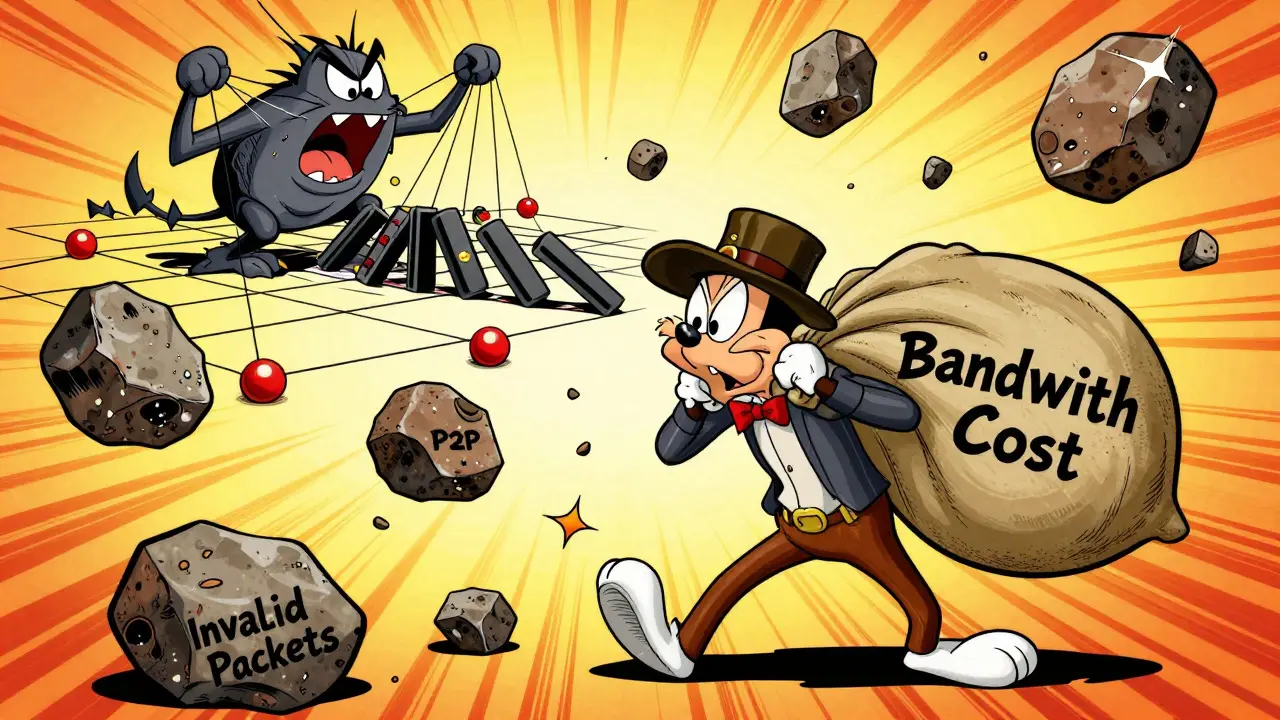
| Bandwidth Exhaustion | Flooding with invalid packets | Service denial, high costs for miners | Medium |
| DHT Manipulation | Corrupting routing tables in structured networks | Data unavailability, slow discovery | Very High |
| Network Partitioning | Blocking communication between regions | Chain splits, consensus failure | Extreme |
Structured P2P networks, like those using DHTs, face additional risks. A 2022 paper from the Georgia Tech DISL project demonstrated how malicious nodes could manipulate routing tables to isolate specific data items. This is particularly dangerous for privacy-focused chains where revealing your location in the DHT can deanonymize you.
Furthermore, the resource cost of defense is significant. CFTE's 2022 analysis revealed that maintaining secure P2P connections consumes 15-20% of a node's processing resources. Bitcoin nodes alone require approximately 50GB of monthly upload bandwidth just to stay synced. This economic pressure pushes smaller operators offline, inadvertently increasing centralization among well-funded entities who can afford robust infrastructure.
Real-World Impact: From Delays to Theft
These aren't theoretical risks. Users have felt the pain of P2P vulnerabilities firsthand. During the Gethlighting Attack period in early 2023, Reddit discussions in r/ethereum were flooded with complaints. User u/EthereumUser4567 reported: 'My swap transactions failed for 47 minutes during the attack window despite normal gas prices.' This delay wasn't due to congestion; it was due to the node failing to propagate the transaction correctly across the fractured network.
Exchanges are not immune either. Binance's transparency report documented 2,341 affected transactions across 1,872 user accounts during the Monero eclipse attack in 2019. These delays erode trust and create arbitrage opportunities for attackers who can see pending transactions before others.
More alarmingly, Chainalysis reported that 12.7% of cryptocurrency thefts in 2023 originated from P2P layer exploits targeting wallet applications. When a wallet app runs a lightweight node or relies on a single provider, it becomes a prime target for eclipse-style isolation, allowing attackers to trick the wallet into accepting fraudulent confirmations.
Mitigation Strategies for 2026
Securing the P2P layer requires a multi-layered approach. There is no silver bullet, as Vitalik Buterin acknowledged in Ethereum's All Core Devs meeting #157 (February 8, 2024): 'Complete elimination of P2P layer vulnerabilities is theoretically impossible without compromising decentralization principles.'
However, several effective strategies have emerged:
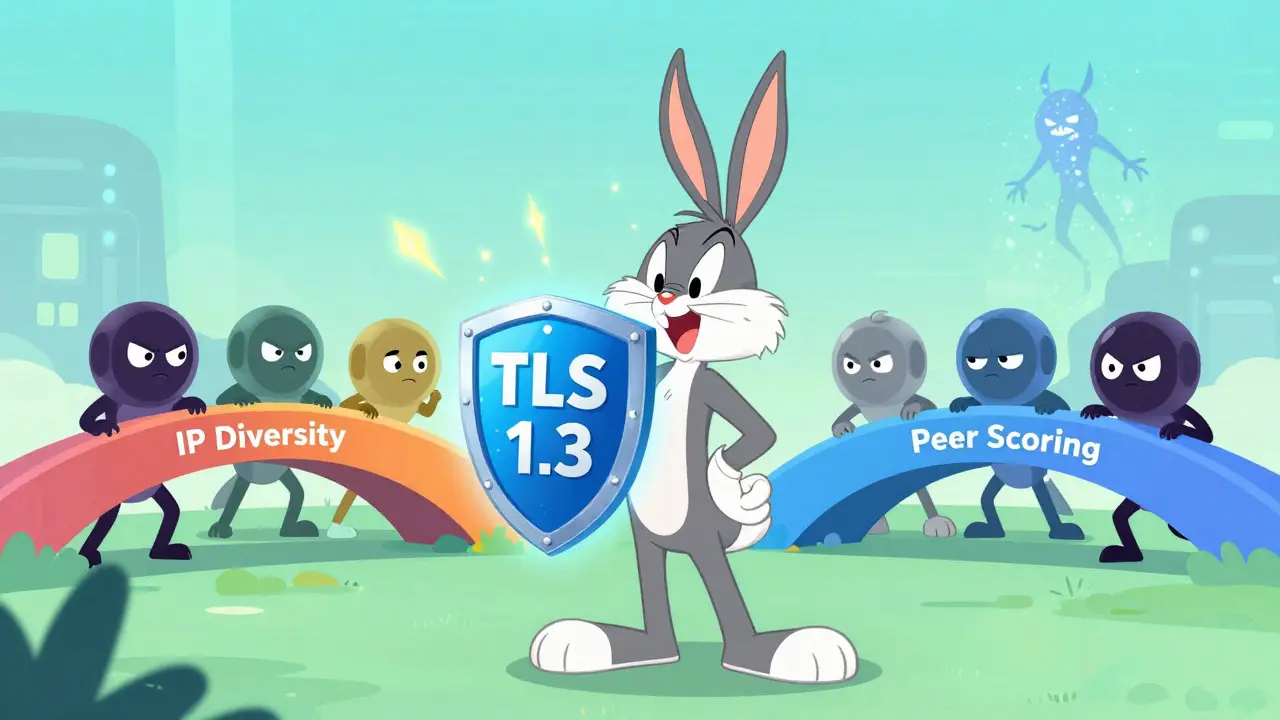
- Peer Scoring Systems: Ethereum implemented EIP-5845, which scores peers based on their behavior. Nodes that consistently provide invalid data or fail to respond are disconnected and penalized. This reduces the effectiveness of low-quality botnets.
- Connection Diversity: Bitcoin Core merged PR #27891 in July 2024, introducing requirements for IP diversity. Nodes now prioritize connecting to peers from different /24 subnets, making it harder for an attacker to fill slots with multiple IPs from the same cloud provider.
- TLS 1.3 Enforcement: The Blockchain Security Alliance recommended mandatory TLS 1.3 for all new implementations in February 2025. This encrypts the control plane, preventing attackers from easily sniffing out target IPs and peer lists.
- DNS Seed Rotation: Diversifying initial connection sources prevents attackers from poisoning the bootstrapping process. Regularly updating DNS seeds ensures nodes discover fresh, honest peers.
For individual node operators, the advice is simple: run a full node, keep software updated, and consider using a VPN or Tor for initial connections to obscure your true IP. However, note that Qualysec's 2023 scan found that 68% of public nodes still have incorrectly implemented firewall rules, leaving them exposed despite good intentions.
The Future: Quantum Threats and Hybrid Architectures
As we move through 2026, the landscape is evolving rapidly. Ethereum's planned 'DevP2P 2.0' upgrade, scheduled for Q2 2026, aims to reduce the P2P attack surface by 70% through structured topology improvements. This shift toward a more organized network model promises better resilience against eclipse attacks but raises concerns about increased complexity.
Looking further ahead, Dr. Ari Juels, Professor at Cornell Tech, warned in his 2025 Black Hat keynote that 'quantum networking advancements could fundamentally undermine current P2P security models within 5-7 years.' Current cryptographic assumptions may hold, but the latency and synchronization mechanisms of P2P networks could be disrupted by quantum-enabled timing attacks.
Deloitte predicts that P2P layer security will become a primary differentiator among blockchain platforms by 2027. Networks implementing advanced countermeasures are expected to gain a 25-30% market share advantage. This suggests that security is no longer just a technical feature; it is a competitive moat.
The arms race continues. Attackers adapt, defenders patch, and the underlying tension between decentralization and security persists. For anyone relying on blockchain technology, understanding these P2P vulnerabilities is the first step toward protecting their assets and preserving the integrity of the network.
What is an Eclipse Attack in blockchain?
An Eclipse Attack occurs when an attacker monopolizes all incoming and outgoing connections of a target node. By filling the node's limited connection slots with attacker-controlled peers, the victim is isolated from the rest of the honest network. This allows the attacker to feed the victim false information, such as missing blocks or fake transactions, potentially leading to double-spending or mining inefficiencies.
How do I protect my node from P2P vulnerabilities?
To protect your node, ensure you are running the latest version of your client (e.g., Bitcoin Core v25.0+ or Geth v1.13.5+) which includes recent patches like connection diversity requirements. Configure your firewall correctly to allow only necessary ports. Consider using a VPN or Tor for initial connections to hide your true IP address. Additionally, monitor your peer list regularly for anomalies and ensure you have sufficient bandwidth to handle legitimate traffic spikes.
Why are P2P networks vulnerable despite being decentralized?
Decentralization removes single points of failure but introduces complexity in trust and connectivity. P2P networks rely on nodes trusting their immediate peers to relay accurate data. If an attacker can control who a node talks to, they can manipulate that node's view of the network. Limitations like connection slots and reliance on IP addresses create exploitable weaknesses that centralized systems avoid through strict access controls.
What is the difference between Bitcoin and Ethereum P2P topologies?
Bitcoin uses a random graph topology, where nodes connect to peers somewhat randomly, making it resilient to targeted data manipulation but susceptible to general network partitioning. Ethereum uses a Kademlia-based Distributed Hash Table (DHT), which is more structured and efficient for finding specific data. However, this structure makes Ethereum more vulnerable to routing anomalies and ID mapping attacks if the DHT is manipulated.
Can quantum computing affect P2P network security?
Yes, experts warn that quantum networking advancements could undermine current P2P security models within 5-7 years. While quantum computers primarily threaten cryptographic signatures, quantum-enabled timing attacks could disrupt the synchronization and latency assumptions that P2P networks rely on for consensus. This may require a complete architectural redesign of blockchain communication layers.
Don Fizy
August 12, 2026 AT 06:33hey guys! just wanted to say this is super helpful info for anyone running nodes at home. i always forget about the connection limits until my wallet acts weird :)
Candice Cornett
August 13, 2026 AT 18:02everyone panicking over nothing. decentralization is a myth anyway. you are still trusting code written by dudes in basements who probably hate women. stop pretending your ip address matters when the whole system is rigged by venture capitalists and elitist devs who think they are gods. it’s all a scam wrapped in tech jargon to make you feel smart while they take your money.
Lance Jantz
August 15, 2026 AT 04:27ah, but Candice, you miss the poetic tragedy of it all! the eclipse attack is not merely a technical flaw; it is a metaphor for the human condition. we are all isolated nodes in a vast, indifferent universe, screaming into the void hoping someone honest hears us. the attacker is simply the shadow self, the id that seeks to consume the ego. beautiful, isn't it? terrifyingly so. one must embrace the chaos to find the order within the entropy.
Candice Cornett
August 15, 2026 AT 21:00shut up lance. nobody asked for your pretentious nonsense. you sound like a bot trying to pass a turing test with a thesaurus. get a life instead of writing bad poetry about blockchain bugs.
Dominic Greco
August 17, 2026 AT 13:59it’s not a bug it’s a feature 🕵️♂️ the deep state wants you disconnected from the truth. they use these ‘eclipse attacks’ to hide the real transactions. look at the dates. 2026 guide? fake news. they want you to install their spyware under the guise of security. wake up sheeple! 👁️👄👁️
Sus Sawyer
August 19, 2026 AT 00:35yo dom calm down lol. but seriously this article dropped some hard facts. i was running a node on an old laptop and thought everything was fine until my txns started failing. turns out my firewall was wide open and i got eclipsed for like 2 hours. scary stuff. gotta keep that software updated folks!
Sean Rowland
August 19, 2026 AT 14:02The aforementioned anecdote by Mr. Sawyer is trivial compared to the existential dread of network partitioning. You see, Sus, when we speak of DHT manipulation, we are speaking of the very fabric of reality being torn asunder. The Kademlia protocol is not just code; it is a social contract enforced by mathematics. When that contract is broken, society collapses. We are all complicit in our own isolation. Do you even know what a /24 subnet is? Probably not. You likely rely on centralized cloud providers, thereby validating the hegemony of Big Tech. Pathetic.
Sus Sawyer
August 20, 2026 AT 15:35whoa sean easy there big guy. no need to be rude. i just meant its good to learn. yeah i dont know much about subnets but im learning. thanks for the lesson i guess?
Aryan MISHRA
August 20, 2026 AT 17:24Incorrect assumptions prevalent in this discourse. P2P latency is negligible compared to consensus overhead. Focus on ZK-Rollups instead. This is outdated information. Read more papers. Less opinion.
Ethan Yuwono
August 21, 2026 AT 12:10aryan you’re missing the point. it’s not about the tech stack alone. it’s about trust. if you can’t trust your neighbors (nodes) how can you trust the chain? it’s a philosophical problem disguised as a networking issue. interesting perspective though.
Aryan MISHRA
August 23, 2026 AT 06:38Philosophy does not secure packets. Code does. Your sentimentality is a vulnerability. Patch it.
Jack Delasquez
August 24, 2026 AT 23:20i had a simular experince last year with my eth node. took me forever to figger out why my blocks were stale. turned out i was connected to only 3 peers and they were all bots. fixed it by changing my dns seeds. hope this helps anyon else having issuses
Harman Singh
August 26, 2026 AT 18:15why is everyone so obsessed with fixing things that arent broken? my node works fine. maybe you guys are just looking for problems because you are bored. let people live their lives without worrying about every little packet loss. it’s exhausting reading all this doom and gloom. i just want to hodl and chill. why cant we just enjoy the ride?
Joy Kwant
August 27, 2026 AT 08:30harman you are so naive. ignorance is bliss until you lose everything. then you cry. typical male behavior. ignore the warnings and then blame the messenger. pathetic. do your research or stay poor.
amy miranda
August 27, 2026 AT 08:57This entire post is a masterclass in fear-mongering designed to sell consulting services. The author clearly has an agenda to push proprietary solutions rather than addressing the fundamental flaws in blockchain architecture. It is disingenuous to present basic networking concepts as novel discoveries. Furthermore, the reliance on anecdotal evidence from Reddit users undermines the credibility of the statistical claims. One must question the motives behind such alarmist rhetoric. Is it truly about security, or is it about control? The distinction is crucial for anyone seeking genuine knowledge in this field.
Qolbina Islami
August 28, 2026 AT 01:15AMERICA FIRST!! Why are we using foreign servers for our blockchain?? Get off AWS and Azure!!! Build American Nodes!!!! Patriotism is the key to security!!! 🇺🇸🇺🇸🇺🇸 Stop letting China control the internet cables!!!