RBI Banking Ban Reversal: How the Supreme Court Changed Crypto in India
 May, 27 2026
Imagine you run a small business. You wake up one morning to find your bank account frozen. Your customers can’t pay you. Your suppliers won’t wait for you. You haven’t broken any laws, but the rules have changed overnight. This wasn’t just a hypothetical nightmare for many Indian entrepreneurs; it was reality between 2018 and 2020.
The Reserve Bank of India (RBI) is the central banking institution of India responsible for issuing currency and formulating monetary policy issued a circular in April 2018 that effectively cut off all regulated banks from doing business with cryptocurrency exchanges. It didn’t explicitly ban owning Bitcoin, but it made trading it nearly impossible by removing the banking infrastructure needed to move money. For two years, the Indian crypto market operated in a legal gray zone, forced underground or onto offshore platforms.
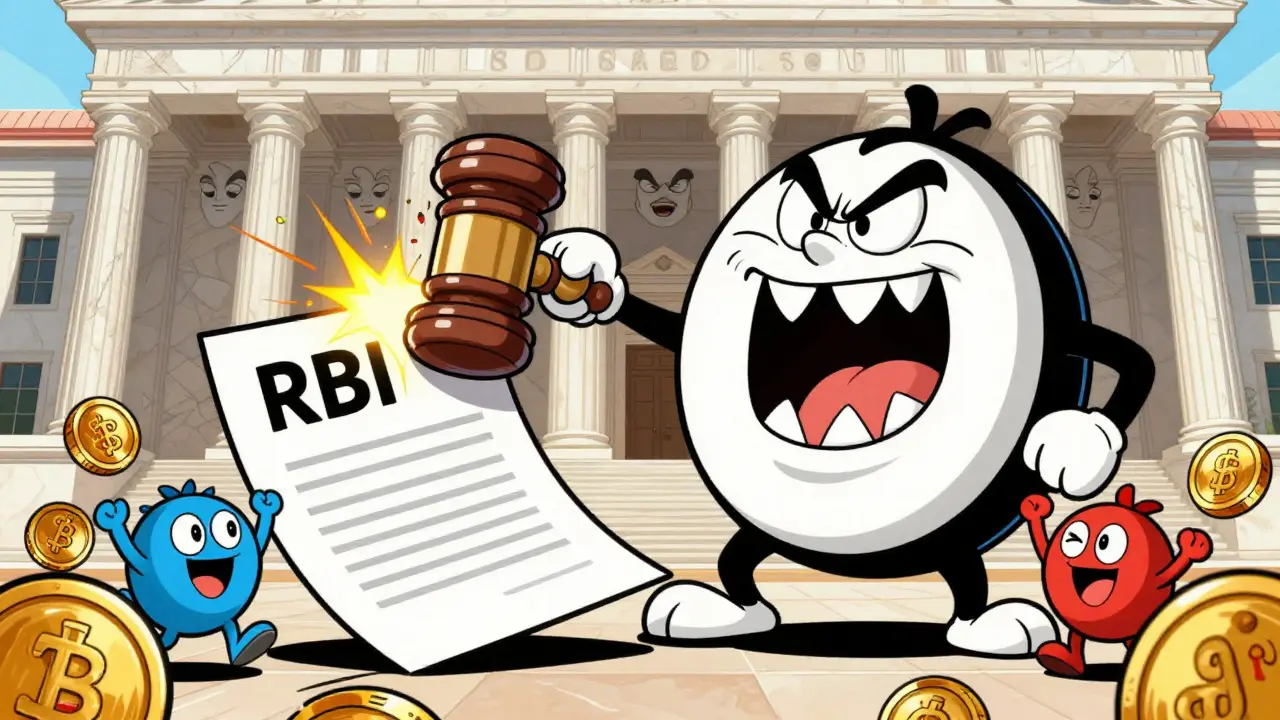
Then, on March 4, 2020, everything changed. The Supreme Court of India struck down the RBI’s ban. This decision didn’t just restore banking services; it fundamentally reshaped how we understand the relationship between financial regulators, constitutional rights, and emerging technologies like blockchain. If you are trying to understand where Indian crypto stands today, you need to look back at this pivotal moment. Here is what actually happened, why it matters, and what it means for traders and businesses now.
The 2018 Circular: A Blanket Ban on Banking Services
To understand the reversal, you first have to understand the severity of the original ban. On April 6, 2018, the RBI issued a circular under Section 35A of the Banking Regulation Act, 1949. This directive prohibited all entities regulated by the RBI-including scheduled commercial banks, cooperative banks, non-banking financial companies (NBFCs), and payment system operators-from providing any services to persons or entities dealing in virtual currencies.
Virtual currencies, such as Bitcoin and Ethereum, are digital assets that use cryptography for security and operate on decentralized networks called blockchains. The RBI’s concern was rooted in risk management. They argued that cryptocurrencies were highly volatile, lacked intrinsic value, and posed significant risks to the financial system, including potential capital flight and exposure to money laundering.
However, the method chosen was drastic. By cutting off banking channels, the RBI didn’t just discourage trading; it paralyzed the ecosystem. Local exchanges like ZebPay and Unocoin had to shut down their domestic operations. Users who wanted to buy crypto had to rely on peer-to-peer transactions, which were risky and inefficient, or turn to international exchanges that often blocked Indian users due to compliance pressures. The ban also inadvertently hurt legitimate fintech startups exploring blockchain technology for supply chain management or identity verification, as they too found themselves unable to open bank accounts.
The Legal Battle: Constitutionality vs. Regulatory Power
The industry didn’t accept the ban quietly. The Internet and Mobile Association of India (IMAI) filed a petition in the Supreme Court, arguing that the RBI’s circular violated fundamental rights guaranteed by the Constitution of India. Specifically, they pointed to Article 19(1)(g), which protects the right to practice any profession, carry on any occupation, trade, or business.
The core of the legal argument revolved around the concept of proportionality. In constitutional law, a restriction on a fundamental right must be reasonable and proportional to the objective it seeks to achieve. The Supreme Court agreed with the IMAI. Justice Rohinton Fali Nariman, writing for the bench, stated that while the RBI was entitled to protect its regulated entities from risk, it failed to demonstrate that the measures taken were the least intrusive possible.
The Court noted that the RBI had not shown concrete evidence that any bank had suffered actual damage from servicing crypto exchanges. Instead of imposing a blanket ban, the regulator could have required stricter compliance measures, enhanced monitoring, or higher capital reserves. By choosing an outright prohibition, the RBI acted disproportionately. This judgment established a critical precedent: regulatory bodies cannot simply shut down industries without proving that less restrictive measures would fail.
Immediate Aftermath: The Resurgence of Indian Crypto
The impact of the March 2020 verdict was immediate and profound. Within days of the ruling, major Indian exchanges resumed operations. WazirX, CoinDCX, and Bitbns saw massive spikes in user registrations and trading volumes. The fear that had gripped the community evaporated, replaced by a surge of optimism.
Banking access was restored, allowing users to deposit and withdraw funds through standard banking channels again. This normalization brought transparency to the market. Before the ban, much of the trading volume was opaque, occurring on offshore platforms. Post-ruling, domestic exchanges grew rapidly, contributing to increased tax visibility and regulatory engagement. The Indian cryptocurrency market cap grew significantly in the following years, reflecting both global trends and local adoption driven by this legal clarity.
However, the celebration was tempered by caution. The Supreme Court did not declare cryptocurrencies legal tender. It only ruled that the RBI’s specific circular was unconstitutional. This distinction is crucial. Owning and trading crypto remained legal, but it did not become recognized as official currency. Businesses could not accept Bitcoin for goods and services in the same way they accept Rupees, because crypto lacks the status of legal tender.
Regulatory Uncertainty: The Years Following the Ruling
If you thought the 2020 ruling settled everything, you’d be mistaken. The period between 2020 and 2025 was characterized by intense regulatory debate. The government sought to introduce comprehensive legislation to govern Virtual Digital Assets (VDAs). The proposed Cryptocurrency and Regulation of Official Digital Currency Bill, drafted in 2021, aimed to ban private cryptocurrencies while paving the way for a Central Bank Digital Currency (CBDC).
Central Bank Digital Currency (CBDC) is a digital form of fiat currency issued and backed by a country's central bank. The Reserve Bank of India has been actively developing its own CBDC, known as the e-Rupee. Unlike private cryptocurrencies, the e-Rupee is centralized, stable, and fully backed by the state. The government’s stance has consistently been that private cryptos pose systemic risks, while a state-issued digital currency offers the benefits of digital payments without the volatility.
Despite these efforts, no comprehensive law banning private crypto was passed during this period. Instead, the government opted for a taxation framework. In the 2022 budget, Finance Minister Nirmala Sitharaman announced a 30% tax on income from virtual digital assets and a 1% Tax Deducted at Source (TDS) on transactions above a certain threshold. This approach signaled a shift from prohibition to regulation. By taxing crypto gains, the government implicitly acknowledged the legality of the activity while ensuring revenue collection.

Current Landscape in 2026: What Has Changed?
As we stand in May 2026, the landscape is clearer than it was in 2020, but complexities remain. Cryptocurrency trading is legal, banking access is restored, and tax obligations are defined. However, the RBI maintains a cautious stance. Former Governor Shaktikanta Das has repeatedly expressed concerns about the speculative nature of crypto and its potential impact on monetary stability.
For investors, this means operating in a regulated but restricted environment. You can buy, sell, and hold crypto, but you must report your gains and pay taxes. Banks are more willing to service crypto-related businesses now, provided they adhere to strict Know Your Customer (KYC) and Anti-Money Laundering (AML) norms. The collateral damage to blockchain innovation has largely healed, with Indian startups leading in areas like decentralized finance (DeFi) protocols and Web3 development.
The Supreme Court’s 2020 ruling remains the bedrock of this ecosystem. It prevented a complete shutdown and forced regulators to engage with the technology rather than ignore it. While the RBI still views crypto with skepticism, the legal framework ensures that businesses cannot be arbitrarily banned without due process. This balance between innovation and regulation is delicate, but it allows the Indian crypto market to grow steadily.
Key Takeaways for Traders and Businesses
If you are navigating the Indian crypto space today, keep these points in mind:
- Legality: Trading and holding crypto is legal. The Supreme Court overturned the RBI’s banking ban.
- Taxation: Income from crypto is taxed at 30%, plus surcharge and cess. A 1% TDS applies to most transactions.
- Banking: Major banks will service your accounts if you comply with KYC norms. Avoid using informal channels.
- Legal Tender: Crypto is not legal tender. You cannot force merchants to accept it for payments.
- Future Outlook: Watch for updates on the e-Rupee and potential amendments to VDA regulations. The government may introduce stricter reporting requirements in the future.
The reversal of the RBI banking ban was not just a legal victory; it was a necessary correction that allowed India’s digital asset ecosystem to survive and thrive. It reminded us that regulation should guide, not stifle, innovation. As the technology evolves, so too will the rules, but the foundation laid in 2020 ensures that the door remains open for responsible participation in the global crypto economy.
Is cryptocurrency legal in India in 2026?
Yes, cryptocurrency is legal to own, trade, and invest in India. The Supreme Court overturned the RBI's 2018 banking ban in 2020, restoring banking access to crypto exchanges. However, crypto is not recognized as legal tender, meaning it cannot be used as official currency for payments.
Why did the Supreme Court strike down the RBI's crypto ban?
The Supreme Court ruled that the RBI's 2018 circular violated Article 19(1)(g) of the Constitution, which guarantees the right to practice any profession or trade. The Court found that the ban was disproportionate because the RBI failed to show that less intrusive measures, such as stricter compliance, would have been ineffective.
Can I use my regular bank account for crypto transactions?
Yes, since the 2020 Supreme Court ruling, regulated banks in India are allowed to provide services to cryptocurrency exchanges and businesses. However, banks must enforce strict KYC (Know Your Customer) and AML (Anti-Money Laundering) procedures. Ensure your exchange is registered with the Financial Intelligence Unit (FIU) to avoid issues.
What are the tax implications of trading crypto in India?
Income from the transfer of Virtual Digital Assets (VDAs) is taxed at a flat rate of 30%, plus applicable surcharge and cess. Additionally, a 1% Tax Deducted at Source (TDS) is levied on transactions exceeding specified thresholds. Losses from crypto trades cannot be set off against other income sources.
Will the government ban cryptocurrency in the future?
While the government has expressed concerns about private cryptocurrencies, there are no current plans for a total ban. Instead, the focus is on regulation through taxation and the development of the e-Rupee, the RBI's Central Bank Digital Currency. Future legislation may impose stricter reporting requirements, but the legal framework established by the Supreme Court provides protection against arbitrary bans.