CARBON crypto: What It Is, Who Uses It, and Why It Matters in 2025
When you hear CARBON crypto, a digital token designed to represent real carbon offsets or environmental credits on a blockchain. Also known as carbon credit token, it's meant to turn climate action into something tradable, trackable, and transparent. But here’s the catch: most CARBON crypto projects don’t actually reduce emissions. They just add a blockchain layer to existing carbon credit systems — often without real oversight.
Some projects try to link tokens to verified carbon removal, like reforestation or direct air capture. Others are just marketing gimmicks with no physical backing. The blockchain environmental projects, initiatives that use distributed ledgers to track sustainability efforts like carbon sequestration or renewable energy generation that actually work usually partner with third-party auditors like Verra or Gold Standard. Without those checks, you’re buying a digital promise — not a real reduction in CO2.
The ESG crypto, crypto assets marketed as environmentally, socially, or governance-aligned investments space exploded in 2021, but by 2025, the market has cleared out the noise. Real projects now focus on measurable outcomes: how many tons of CO2 were actually removed? Who verified it? Where’s the proof on-chain? Many tokens still trade with zero volume because no one trusts them. And if a CARBON crypto claims to be "green" but doesn’t link to a public registry or third-party audit, treat it like a meme coin with a fancy name.
Then there’s the carbon offset crypto, a tokenized version of a carbon credit that can be bought, sold, or retired on a blockchain. These aren’t new — companies like Toucan and KlimaDAO built them years ago. But even the best ones struggle with liquidity and adoption. Most traders don’t care about offsets. They care about price pumps. And that’s why so many CARBON crypto projects collapse after their initial hype. The ones that survive? They’re not trying to make money from trading. They’re trying to fund actual climate work — and they’re transparent about it.
If you’re looking at CARBON crypto, ask: Is this token backed by real, verified carbon removal? Is there a public ledger showing every credit issued and retired? Is there a team with a track record in environmental science, not just crypto marketing? The answers will tell you if it’s a tool for change — or just another speculative asset.
Below, you’ll find real reviews and breakdowns of crypto projects that actually tie into environmental impact — and the ones that don’t. No fluff. No greenwashing. Just what’s working, what’s fake, and what you should avoid in 2025.
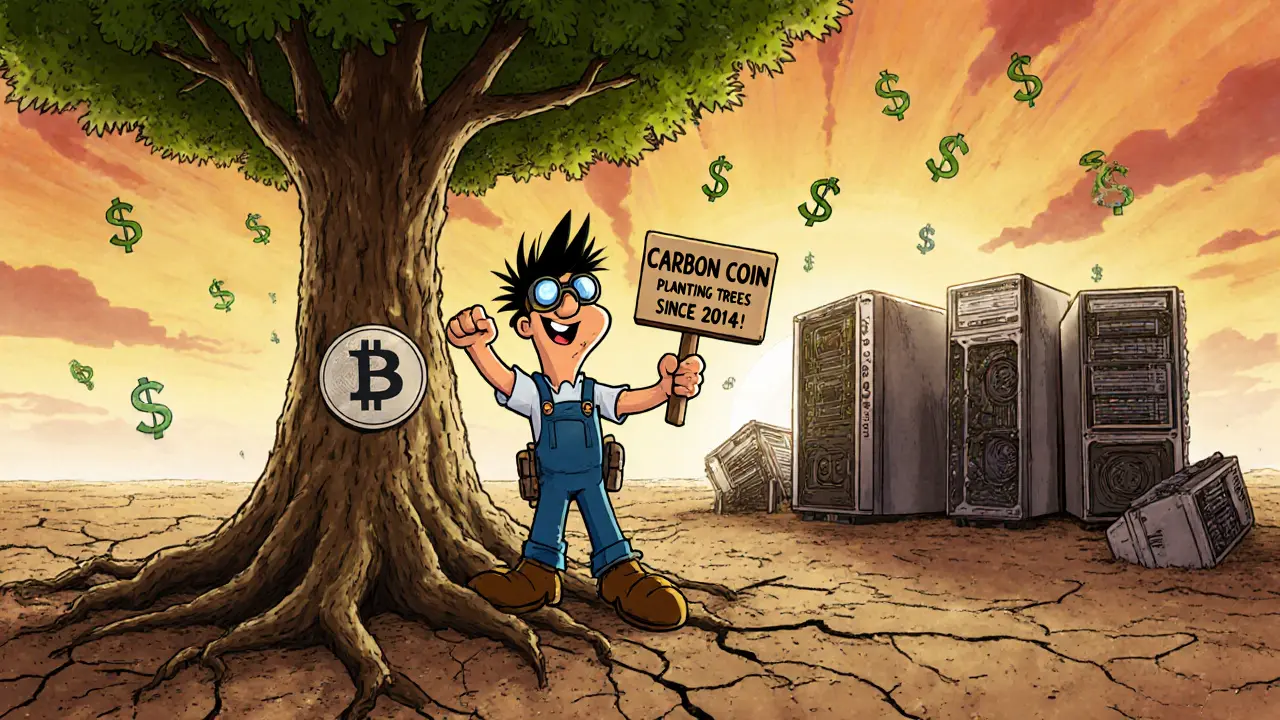
What is Carboncoin (CARBON) Crypto Coin? Facts, Claims, and Reality
Carboncoin (CARBON) claims to be an eco-friendly crypto that plants trees, but has zero trading volume, no community, and no proof of environmental impact. Here's what really happened to it.