ETCH Airdrop 2025: What It Is, Who’s Involved, and Why It Might Be a Scam
When you hear about an ETCH airdrop 2025, a claimed token distribution event tied to a little-known blockchain project, your first question should be: Is this real? Most airdrops you see online in 2025 are either dead projects, copycats, or outright scams. Unlike legitimate airdrops like DeFiChain (DFI), a Bitcoin-backed DeFi protocol that has distributed real tokens to early adopters or MoMo KEY (KEY), a verified token with a clear roadmap and active community, the ETCH airdrop shows zero public data—no whitepaper, no team, no blockchain explorer trace, and no exchange listings. That’s not a feature. That’s a red flag.
Airdrops are supposed to reward users for early support, but scammers use them to harvest wallets, steal private keys, or pump fake tokens before vanishing. In 2025, fake airdrop pages are more convincing than ever—they copy real logos, use fake Twitter accounts with thousands of followers, and even create fake Telegram groups with bots pretending to be users. If you’re being asked to connect your wallet, pay a gas fee, or enter your seed phrase to claim ETCH, you’re already in danger. Real airdrops don’t ask for money upfront. They don’t need your private keys. And they definitely don’t disappear after the hype.
Compare this to the MMS airdrop, a project with $0 market cap and zero trading volume that was exposed as a ghost in early 2025. Or the SynFutures ($F), a real decentralized derivatives exchange with transparent tokenomics and live trading volume. One is a ghost. The other is a working product. The difference isn’t in the name—it’s in the proof. If a project can’t show you where its tokens live on-chain, who’s behind it, or how many people are actually using it, then it’s not a project. It’s a trap.
There’s no such thing as a guaranteed free crypto. If it sounds too easy, it’s designed to be taken. The only way to protect yourself is to check the basics: Does the token have a contract address? Is it listed on CoinGecko or CoinMarketCap? Are there real transactions on the blockchain? Is there a public GitHub repo or a team with verifiable LinkedIn profiles? If the answer to any of these is no, walk away. The ETCH airdrop 2025 doesn’t pass any of these tests. And that’s not an oversight—it’s the pattern.
Below, you’ll find real reviews of airdrops that actually paid out, exchanges that are still running, and scams that got exposed. You’ll learn how to spot the difference before you lose your wallet. No fluff. No hype. Just what works—and what doesn’t—in 2025’s crowded, chaotic crypto landscape.
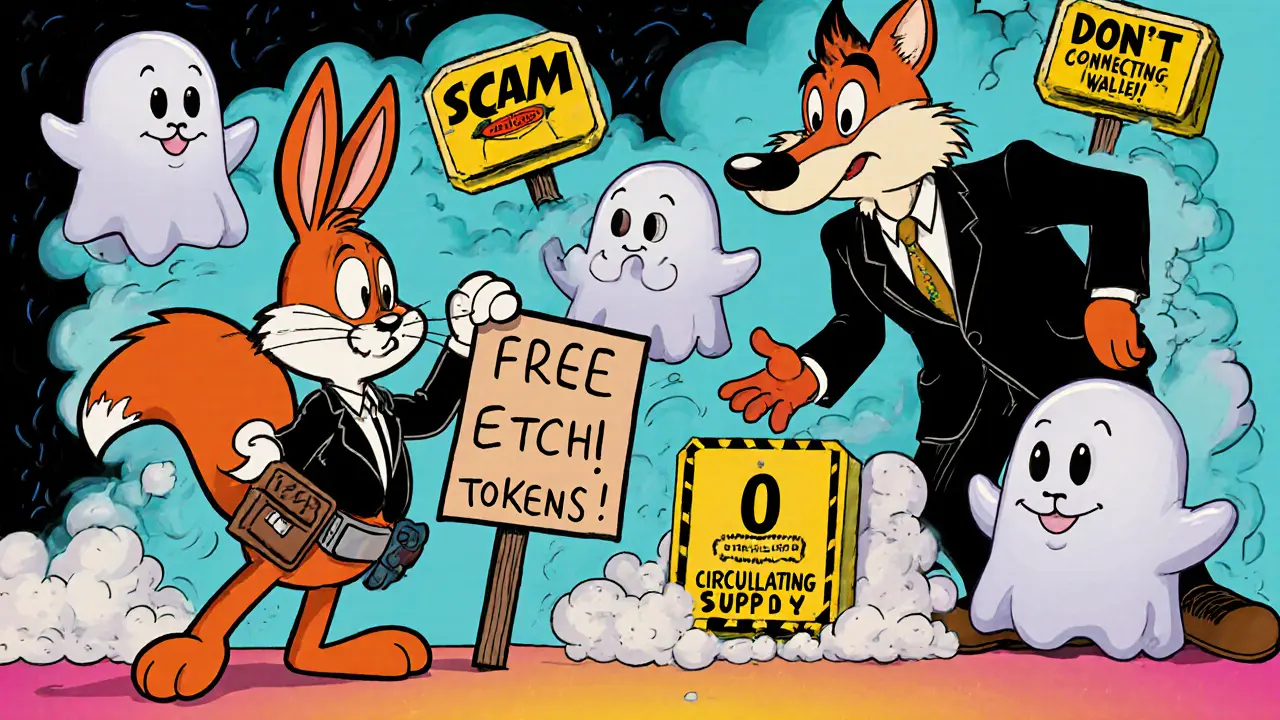
ElonTech (ETCH) Airdrop: What’s Real, What’s Not in 2025
No active ElonTech (ETCH) airdrop exists in 2025. The project has been inactive since 2022 with zero circulating supply. Avoid fake airdrop scams and focus on real opportunities like Monad or OpenLoop.