Vesting and Token Unlock Schedules Explained for Crypto Investors
 Dec, 27 2025
Imagine buying into a new crypto project, only to watch the price crash a week later because the founders sold all their tokens the second they could. This happened - a lot - in the early days of crypto. That’s why vesting and token unlock schedules exist. They’re not just technical jargon. They’re the invisible rules that keep projects alive, prices stable, and investors from getting wiped out.
What Exactly Is a Vesting Schedule?
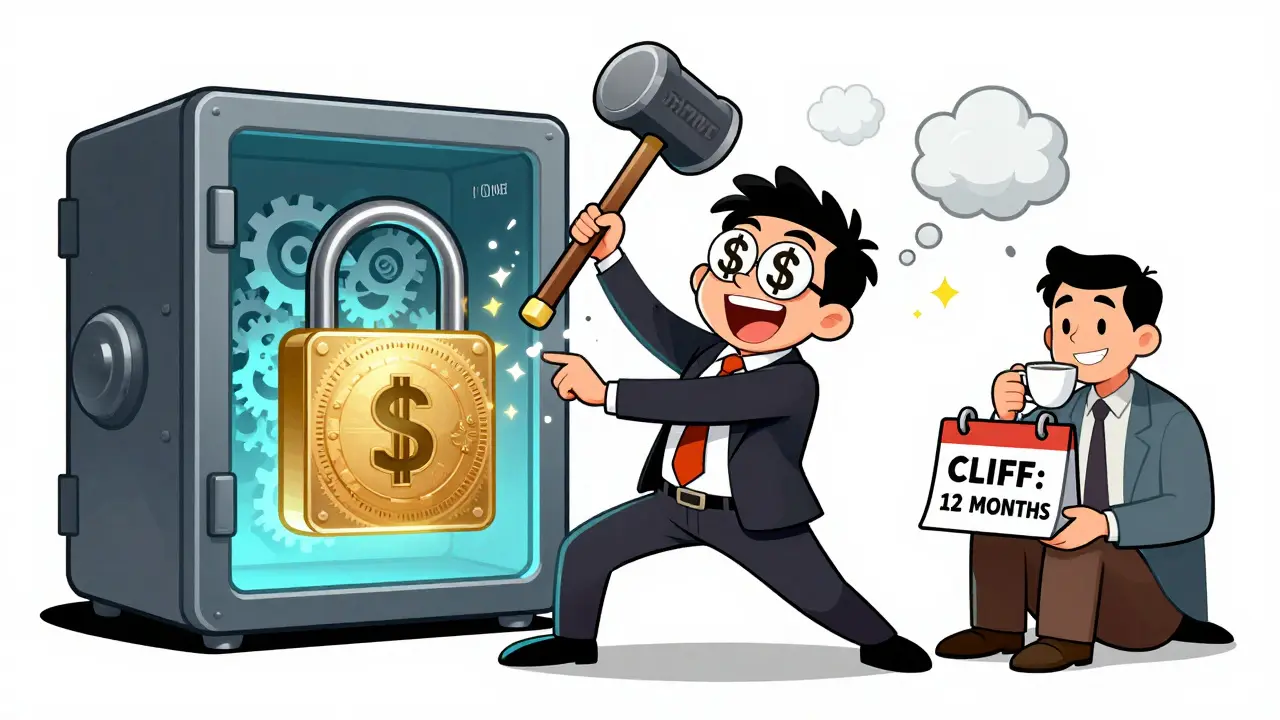
A vesting schedule is a timer built into a smart contract that controls when you can actually use or sell your crypto tokens. It doesn’t mean you don’t own them. It means you can’t touch them yet. Think of it like a bank account with a lock on it - you have the key, but the lock won’t open until a certain date or condition is met. Most token allocations - whether you’re a founder, employee, investor, or advisor - come with strings attached. These strings are the vesting rules. Without them, someone could get 10% of a project’s total supply on day one and dump it all on the open market. That kind of sell-off can kill a project before it even starts. The magic happens through smart contracts. These are self-executing programs on the blockchain. Once the vesting rules are coded in, no one can change them. No CEO can fast-track a release. No team member can sneak out early. It’s automatic, transparent, and tamper-proof.The Three Core Parts of Every Vesting Schedule
Every vesting schedule has three moving parts. If you understand these, you can read any token distribution plan and know what to expect.- Duration: How long until all tokens are fully released? Most projects use 1 to 4 years. A 2-year vesting period is common for team members. Investors often get 12 to 18 months.
- Cliff: This is the waiting period before any tokens unlock at all. It’s usually 3 to 12 months. If you leave the project before the cliff ends, you get nothing. That’s intentional. It forces people to stick around during the risky early phase.
- Frequency: After the cliff, how often do tokens unlock? Monthly is most common. Quarterly works for investors. Annual releases are rare and usually only for early backers.
For example: A team member gets 100,000 tokens. 25% vest after a 12-month cliff. Then, 1/36th of the remaining 75,000 unlocks every month for the next 3 years. That’s a 4-year total vesting period with a 1-year cliff and monthly unlocks.
Types of Vesting Schedules You’ll See
Not all vesting is the same. Projects pick different styles based on who’s getting tokens and what they want to achieve.- Linear Vesting: The simplest kind. Tokens unlock evenly over time. If you get 120,000 tokens over 2 years, you get 5,000 per month. Predictable. Easy to track. Used for employees and advisors.
- Graded Vesting: Tokens unlock in chunks tied to milestones. For example: 20% after 6 months, 30% after 12 months, 50% after 24 months. This rewards progress. Common in early-stage startups where funding rounds or product launches act as triggers.
- Cliff Vesting: Nothing for a year, then 50% unlocks all at once, followed by monthly releases. This is brutal but effective. It ensures that even if someone leaves after 11 months, they walk away with nothing. It’s a strong signal of long-term commitment.
Some advanced projects mix these. A founder might have a 1-year cliff, then 25% unlocked at launch, another 25% after 12 months of active development, and the rest monthly after that. The more complex the schedule, the more it’s designed to align incentives with real project milestones - not just time.

Why Vesting Protects Everyone - Even You
Vesting isn’t just about protecting the project. It protects you, the investor. Without vesting, here’s what happens: A team raises $10 million in a token sale. They keep 20% for themselves - that’s $2 million worth of tokens. They dump it all on day one. Price crashes 60%. You lose half your investment. The team walks away with cash. The project dies. With vesting, that same team can’t sell their $2 million until after 2 years. They have to wait. They have to make the project succeed. Their money is tied to its success. That’s alignment. Investors benefit too. Instead of facing a flood of tokens hitting the market all at once, the supply is spread out. That prevents price crashes. It gives the market time to absorb the tokens. It lets the project build real value before tokens start flowing freely. And let’s not forget employees. If a dev gets 50,000 tokens with no vesting, they might quit after 3 months and sell everything. With a 2-year vesting schedule, they’re more likely to stay, learn, and help ship the product. Their compensation grows with the project.What Happens When Tokens Unlock?
When a token unlocks, it doesn’t mean it automatically sells. It just means you can. That’s a big difference. Many team members and early investors choose not to sell right away. Why? Because they believe in the project. They’ve seen it grow. They know dumping tokens could hurt the price - and their own remaining holdings. But sometimes, they do sell. That’s normal. And that’s why you need to track unlock schedules. If 10% of the total supply unlocks next week, and the market is already weak, expect pressure on the price. Smart investors watch unlock calendars like weather reports. Most crypto tracking sites now show token unlock schedules publicly. You can see exactly when large holders will be able to sell. That’s transparency. Use it. Don’t buy into a project without checking its unlock calendar.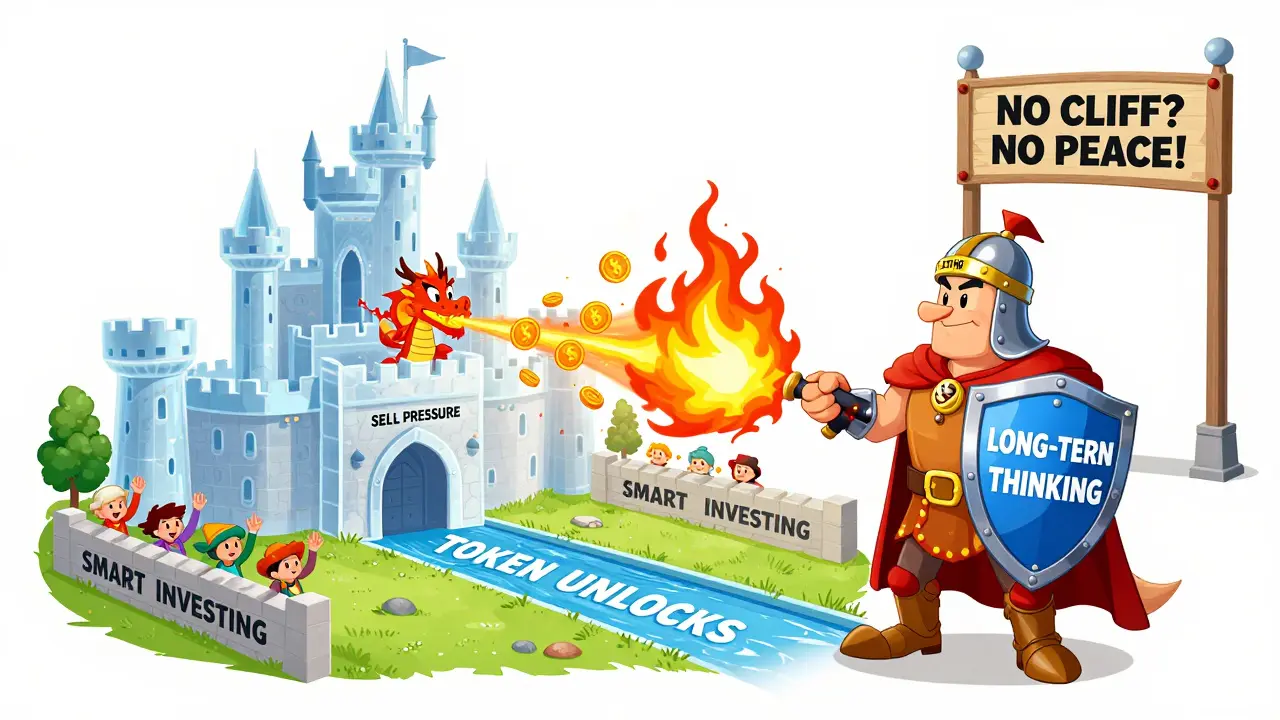
Common Mistakes and Red Flags
Not all vesting schedules are fair. Some are designed to trick you.- No cliff: If founders get tokens unlocked immediately, that’s a red flag. They’re not committed.
- Too short a duration: A 6-month vesting period for team members? That’s not long-term commitment - that’s a quick exit plan.
- Large unlocks after short cliffs: A 3-month cliff followed by 40% of tokens unlocking? That’s a dump waiting to happen.
- Hidden vesting: Some projects don’t disclose vesting details. If they won’t show you the schedule, walk away.
Also, watch out for “reverse vesting.” That’s when a team gets tokens upfront but must earn them back over time by staying. If they leave, they forfeit unearned tokens. This is rare but fairer than traditional models.
How to Use Vesting Schedules to Make Better Decisions
Here’s how to turn vesting info into investment insight:- Check the unlock calendar before buying. If a major unlock is coming in 2 weeks, wait. Don’t buy right before a flood of tokens hits the market.
- Compare vesting schedules across similar projects. If one has a 1-year cliff and another has none, the first is more trustworthy.
- Look at who holds the tokens. If 80% of tokens are held by a single investor with no cliff, that’s a risk. If they’re spread across 10 team members with 2-year vests, that’s a sign of balance.
- Track what happens after unlocks. Did the price hold? Did the team keep building? That tells you if the schedule worked.
Some investors even use unlock schedules to time their buys. If a big unlock just passed and the price dropped, but the project is still active, that could be a buying opportunity. The selling pressure is gone. The real holders are still in.
The Future of Vesting: More Flexibility, More Control
Vesting isn’t stuck in the past. New tools are making it smarter. Platforms like Streamflow Finance and Magna now let projects build custom vesting logic. You can tie unlocks to:- Product milestones (e.g., “10% unlocks when mainnet launches”)
- Community votes (DAOs can vote to adjust vesting)
- Price thresholds (e.g., “Tokens unlock only if price stays above $0.50 for 30 days”)
This is the next evolution. Vesting isn’t just about time anymore. It’s about performance. It’s about making sure tokens go to people who actually build value - not just show up.
Traditional companies are starting to adopt this too. If you’re working for a Web3 startup, your salary might be 50% crypto with a 3-year vesting schedule. That’s becoming normal.
The message is clear: Long-term thinking is the only sustainable model in crypto. Vesting schedules are the tool that makes it possible.
What happens if I sell my tokens before they vest?
You can’t. Tokens that haven’t vested are locked in a smart contract. You don’t have control over them yet. Even if you try to transfer them, the blockchain will reject the transaction. Vesting is enforced by code, not trust.
Are vesting schedules only for team members?
No. Vesting applies to founders, investors, advisors, early backers, and employees. Every group usually has its own schedule. Investors might have a 12-month cliff, while employees get a 24-month vest with monthly unlocks. The structure depends on risk, contribution, and alignment goals.
Can vesting schedules be changed after launch?
If they’re built into a smart contract with no upgrade function, then no. That’s the point - they’re immutable. Some projects allow changes through DAO votes, but that’s rare and usually requires a supermajority. Always assume the schedule is fixed unless proven otherwise.
Why do some projects have longer vesting periods than others?
Longer vesting (3-4 years) is common for early-stage, high-risk projects that need deep commitment. Established projects with strong revenue or user bases might use shorter vests (1-2 years). It’s about risk. The riskier the project, the longer the lock-up.
Is it normal for token prices to drop after an unlock?
Yes, it’s very common. When large amounts of tokens unlock, some holders sell. That increases supply, which can push prices down. Smart investors expect this and often wait a few weeks after an unlock to buy, once the selling pressure fades. It’s not a sign the project is failing - it’s just market mechanics.
christopher charles
December 27, 2025 AT 15:09Okay, so I just checked my portfolio and realized I bought into a project with a 3-month cliff and 40% unlocking right after? 🤦♂️. I’m lucky I didn’t lose my shirt. This post literally saved me. Always check the unlock schedule now. No exceptions.
Johnny Delirious
December 28, 2025 AT 03:59It is imperative to underscore the critical importance of vesting schedules as a foundational mechanism for ensuring the integrity and long-term viability of blockchain-based ventures. Without such structural safeguards, market manipulation and systemic collapse become inevitable.
Bianca Martins
December 28, 2025 AT 19:59Yessss this is why I always check token unlock calendars before buying 😌 I had a project crash on me last year because I didn’t. Now I treat it like a weather forecast - if there’s a storm of unlocks coming, I wait it out. Also, no cliff = red flag. Always. 🚩
alvin mislang
December 29, 2025 AT 14:16People still don’t get it. If your team has no cliff, you’re not investing in a project - you’re funding a robbery. I’ve seen 100+ projects die because founders got their tokens and vanished. Don’t be the sucker who buys into a ‘team’ that’s already cashed out. Wake up.
Monty Burn
December 30, 2025 AT 04:31Vesting is just time made visible. The real question isn't when tokens unlock but why we believe in anything lasting at all. If a token is meant to represent value, why must we lock it to prove sincerity? Isn't trust the original currency? The blockchain just mirrors our fear
Kenneth Mclaren
December 30, 2025 AT 19:25EVERY SINGLE PROJECT has a backdoor. The 'smart contract' isn't immutable - it's just waiting for the right exploit. I've seen DAOs vote to change vesting after a dump. The 'no changes' thing? Total lie. They want you to think it's safe so you buy in. Then they pull the rug. The real insiders always know when the unlock is coming - and they sold weeks before.
Jack and Christine Smith
December 31, 2025 AT 22:18omg i just realized my last buy had a 6 month vesting and i thought it was fine?? lol my bad. but seriously, i never knew about cliffs before this. now i’m like a detective checking every project’s schedule. also, why do people spell ‘vesting’ like ‘vestingg’? 😅
Michelle Slayden
January 2, 2026 AT 03:39The structural integrity of decentralized ecosystems is contingent upon the enforcement of time-based incentive alignment. The absence of vesting protocols introduces moral hazard, thereby undermining the very premise of trustless collaboration. One must therefore regard vesting not as a constraint, but as a covenant.
Alison Hall
January 3, 2026 AT 20:59Always check the unlock calendar. Seriously. It’s the #1 thing I do before investing. 🙌
Amy Garrett
January 5, 2026 AT 18:40i never knew what a cliff was until i read this 😳 now i’m obsessed with checking every project’s vesting. also, why do people say ‘vesting’ like it’s a bad word? it’s just smart money stuff lol
Haritha Kusal
January 6, 2026 AT 08:10so true! i am from india and here many people think crypto is get rich quick. but vesting teach us patience. slow and steady win the race 💪❤️
Mike Reynolds
January 6, 2026 AT 16:45I used to ignore vesting schedules. Thought it was just boring finance stuff. Then I lost money on a project where the team dumped right after launch. Now I read them like a novel. If the cliff is short or there’s no cliff? I scroll past. Simple.
dayna prest
January 8, 2026 AT 07:10Let’s be real - vesting is just capitalism in a turtleneck. You're not protecting the project. You're protecting the rich from the poor getting too greedy. It’s a velvet rope at a club where the bouncer is a smart contract. The real power move? Not having to vest at all.
Brooklyn Servin
January 9, 2026 AT 20:39Guys, I’ve been tracking unlocks for 3 years and I’ve seen patterns no one talks about. When a big unlock hits and the price drops but the devs are still pushing updates? That’s your golden window. I bought $20k worth of $X after their 15% unlock dropped the price 30% - now it’s up 200%. Don’t fear the unlock. Study it. 📈🧠
Phil McGinnis
January 10, 2026 AT 19:15This is why America is falling behind. We allow these chaotic, unregulated token schemes to flourish. In my country, we have real laws. Real oversight. Not some code written by teenagers in a basement. Vesting? A band-aid on a bullet wound.
Ian Koerich Maciel
January 11, 2026 AT 01:36I appreciate the clarity of this breakdown. The distinction between linear, graded, and cliff vesting is particularly illuminating. I now cross-reference every token distribution document with this framework - it has significantly improved my due diligence. Thank you for the meticulous structure.
Andy Reynolds
January 12, 2026 AT 03:17Hey, if you're new to crypto and reading this - welcome. You’re already ahead of 90% of people who just buy because a meme looks cool. Vesting isn’t boring, it’s your armor. Keep asking questions. Keep checking calendars. You’re gonna be okay.
Alex Strachan
January 13, 2026 AT 10:31So… you’re telling me the only thing keeping these crypto bros from being total scammers… is a timer? 😂 I mean, I guess it’s cute. Like locking your dog in the yard so it doesn’t run away… while you’re on vacation.