What is Zypher Network (POP)? The Crypto Behind AI Agent Trust
 Jun, 6 2026
Imagine hiring an AI assistant to manage your finances. It looks at your bank account, decides to move money, and executes a trade. Sounds efficient, right? But what if you couldn't see *why* it made that decision? What if the AI hallucinated, got hacked, or simply followed a corrupted instruction? Right now, most AI systems are black boxes. You give them input, they spit out output, and you have to hope for the best.
This opacity is a massive problem as we move toward an economy run by autonomous software agents. Enter Zypher Network, which uses its native token, POP. Think of Zypher not just as another cryptocurrency, but as the 'SSL certificate' for the AI web. It provides a cryptographic layer that proves an AI agent did exactly what it was told to do, without revealing sensitive private data. If you've been hearing about the intersection of blockchain and artificial intelligence, POP is one of the specific projects trying to solve the trust crisis in this sector.
The Core Problem: Why AI Needs Blockchain Verification
To understand why Zypher exists, you first need to understand the risk of modern AI agents. Today's Large Language Models (LLMs) are powerful, but they are also probabilistic. They guess the next word based on patterns. This works great for writing poetry, but it’s dangerous for executing financial transactions or legal contracts. An AI might confidently make up a fact (hallucinate) or be manipulated by a malicious prompt injection attack.
Currently, there is no standard way to verify that an AI agent executed a task correctly. If an AI bot buys stock for you, how do you prove to an auditor-or to yourself-that it didn't deviate from your instructions? Traditional cloud logs can be altered. Centralized servers can be hacked. This lack of verifiable truth creates a barrier to letting AI handle high-stakes tasks autonomously.
Zypher Network addresses this by creating a decentralized protocol for trust infrastructure. It doesn't build the AI; it builds the security layer around it. By using blockchain technology, specifically built on top of the BNB Chain, Zypher ensures that once an AI action is verified, that record is immutable and transparent. This turns opaque AI processes into auditable events.
Proof of Prompt (PoP): How It Actually Works
The heart of Zypher’s technology is a mechanism called Proof of Prompt (PoP). This isn't just marketing jargon; it’s a specific cryptographic method. Here is the simple breakdown of what happens:
- Input Linking: When you send a command (prompt) to an AI agent, PoP cryptographically links that specific input to the resulting output.
- Proxy Signing: The system generates a digital signature that proves the output matches the input constraints.
- Distributed Validation: Instead of one central server checking this, a network of validators verifies the proof.
The magic here is privacy. Using Zero-Knowledge Proofs (ZKPs), Zypher can prove that the AI followed the rules without actually showing the sensitive data inside the prompt or the response. For example, a healthcare AI could process patient records. Zypher would generate a proof that says, "This analysis followed HIPAA-compliant protocols," without ever exposing the patient’s name or medical history to the public ledger.
This makes PoP distinct from other consensus mechanisms like Proof of Work or Proof of Stake. While those secure the blockchain itself, Proof of Prompt secures the *logic* of the AI execution. It answers the question: "Did the agent do what I asked, and nothing else?"
The Role of the POP Token
In any blockchain ecosystem, the native token serves as the fuel. For Zypher Network, the POP token is a BEP-20 token operating on the BNB Chain. Its primary functions are economic incentives and access control.
First, POP is used to pay for verification services. Developers who want to embed trust into their AI applications will spend POP tokens to submit proofs to the network. Second, it rewards the people keeping the network honest. Through a system called "Proof Mining," community members can validate agent outputs. If you participate in verifying that an AI acted correctly, you earn POP tokens and potentially NFTs as a reward.
The tokenomics are designed to be deflationary. With a maximum supply capped at 10 billion POP tokens, the project aims to reduce circulating supply over time through burning mechanisms tied to usage. As of mid-2026, only about 15% of these tokens are in circulation, meaning significant distribution is still planned. This scarcity model is common in newer crypto projects aiming to align long-term holder interests with network growth.
| Feature | Detail |
|---|---|
| Token Symbol | POP |
| Blockchain | BNB Chain (BEP-20) |
| Max Supply | 10,000,000,000 POP |
| Core Technology | Proof of Prompt (PoP) & Zero-Knowledge Proofs |
| Execution Layer | Zytron (AI-optimized) |
| Primary Use Case | Verifying AI Agent Integrity |

Zytron: The Execution Layer
You might wonder how fast all this verification happens. AI agents often need real-time responses. If verification takes minutes, the utility drops significantly. This is where Zytron comes in. Zytron is the execution layer built specifically for AI workloads.
Unlike traditional blockchains that prioritize transaction throughput above all else, Zytron prioritizes *proof generation latency*. It uses a "Proof of Verifiable Work" model to coordinate validation tasks across a decentralized community of provers. These provers use heterogeneous compute resources-meaning they don't all need identical supercomputers-to process verification requests quickly.
The goal is low-latency proof generation suitable for millions of daily verifications. For a developer building a customer service chatbot, this means every interaction can be instantly verified for compliance and accuracy, adding a layer of trust without slowing down the conversation.
How to Use Zypher Network
If you are a regular user, you likely won't interact with the blockchain directly. Your entry point is the AI Security Browser extension. This tool sits between you and the AI services you use online. It monitors interactions and provides visual indicators of trustworthiness based on Zypher’s verification data.
For developers, the path is more technical. Zypher offers a RESTful API and an SDK (Software Development Kit). This allows you to embed integrity verification directly into your applications. You can set up your AI agent to automatically submit proofs to the Zypher network after every major action. This is particularly useful for enterprise applications where auditing trails are legally required.
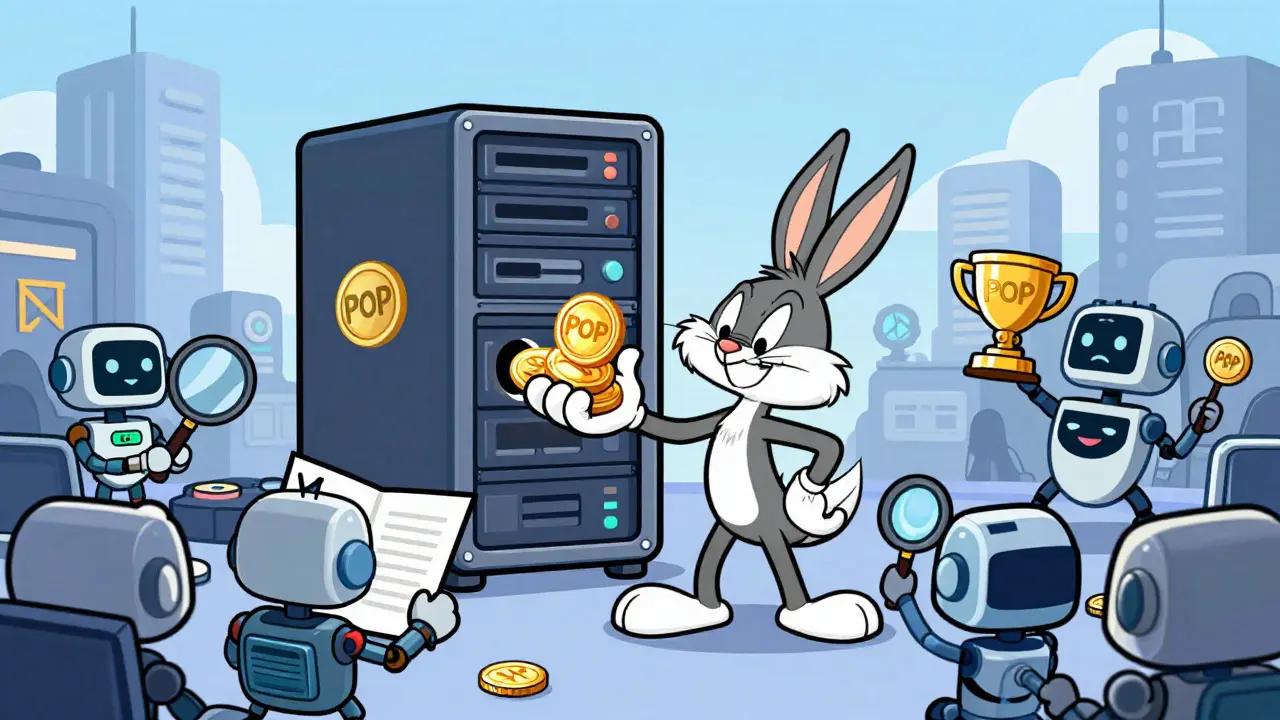
Participating in "Proof Mining" requires a bit more effort. You would need to set up a node or join the validator community via Discord. Validators review agent outputs against twelve safety and usability dimensions. It’s a crowdsourced quality control system, similar to how Wikipedia editors maintain article quality, but powered by cryptographic incentives rather than volunteer altruism.
Market Position and Competition
Zypher operates in a niche but rapidly growing sector: AI infrastructure. It is not competing directly with AI model builders like OpenAI or Google. Instead, it competes with other blockchain projects trying to solve AI trust issues, such as Bittensor (TAO), Fetch.ai (FET), and Render Network (RNDR).
Here is the key difference: Render focuses on GPU rendering power. Fetch.ai focuses on agent connectivity and automation. Bittensor focuses on decentralized machine learning training. Zypher is hyper-specialized in *verification*. It is the auditor, not the builder or the runner. This specialization is both its strength and its risk. If the industry adopts a different standard for AI verification, Zypher’s value proposition weakens. However, if regulatory bodies begin demanding auditable AI logs (which many experts predict for finance and healthcare sectors), Zypher’s position becomes much stronger.
Price-wise, POP has shown high volatility, typical for early-stage altcoins. Trading volumes are moderate, indicating a dedicated but still small community. The token’s value is heavily tied to the broader adoption of AI agents. As more companies deploy autonomous bots, the demand for verifying those bots should theoretically rise.
Risks and Challenges
No crypto project is without risks. For Zypher, the biggest hurdle is adoption. Building a new protocol is hard; getting the entire AI industry to adopt it is harder. Developers are busy building features, not necessarily integrating third-party verification layers unless forced to by regulation.
There is also the technological complexity. Zero-Knowledge Proofs are computationally expensive and difficult to implement correctly. Any bug in the PoP protocol could undermine the entire trust model. Furthermore, the regulatory landscape for AI is shifting daily. A framework that is compliant today might change tomorrow, requiring rapid updates to the verification standards.
Finally, the tokenomics include a large amount of tokens yet to be released. With only ~15% in circulation, future unlocks could create selling pressure if demand doesn't keep pace with supply increases. Investors should always check the vesting schedule and inflation rate before committing capital.
Is Zypher Network Worth Your Attention?
If you are a developer building AI agents that handle sensitive data or financial transactions, Zypher Network offers a compelling solution. The ability to cryptographically prove that your AI followed instructions without leaking data is a powerful feature. The SDK and browser extension make it accessible enough to test.
If you are an investor, POP represents a bet on the "trust layer" of the AI economy. It is a high-risk, high-reward play. It relies entirely on the assumption that AI agents will become ubiquitous and that their actions will require independent verification. Given the current trajectory of AI integration in business, that assumption seems plausible, but it is not guaranteed.
Zypher Network isn't trying to replace AI. It’s trying to make AI safe enough for the real world. Whether that vision becomes the industry standard remains to be seen, but the problem it solves is real, urgent, and critical for the next decade of tech development.
What is the main purpose of Zypher Network (POP)?
The main purpose of Zypher Network is to provide a decentralized trust infrastructure for AI agents. It uses a cryptographic protocol called Proof of Prompt (PoP) to verify that AI agents execute tasks exactly as instructed, ensuring transparency and security without compromising data privacy.
How does Proof of Prompt (PoP) differ from other blockchain consensus mechanisms?
While mechanisms like Proof of Work or Proof of Stake secure the blockchain ledger itself, Proof of Prompt secures the logic of AI execution. It cryptographically links an AI's input prompt to its output, proving that the agent followed specific instructions without hallucinating or being manipulated, all while keeping the actual data private using Zero-Knowledge Proofs.
Which blockchain does Zypher Network operate on?
Zypher Network operates on the BNB Chain. The POP token is a BEP-20 token, which allows it to leverage the speed and low transaction costs of the Binance Smart Chain ecosystem while utilizing Zytron as its specialized AI-optimized execution layer.
Can I use Zypher Network if I am not a developer?
Yes. End-users can install the AI Security Browser extension. This tool helps monitor and verify the interactions between you and various AI services, providing visual cues about the trustworthiness and integrity of the AI responses you receive.
What is Proof Mining in the Zypher ecosystem?
Proof Mining is a community-driven validation system where participants help verify AI agent outputs. Validators assess results across twelve safety and usability dimensions. In return for their work, they earn POP tokens and NFTs, creating a decentralized quality control network similar to a crowdsourced audit system.
What is the total supply of POP tokens?
The maximum supply of POP tokens is capped at 10 billion. As of mid-2026, approximately 14-15% of these tokens are in circulation, with the rest scheduled for future distribution through mining rewards, partnerships, and ecosystem growth initiatives.
How does Zypher protect user privacy during verification?
Zypher uses Zero-Knowledge Proofs (ZKPs). This cryptographic technique allows the network to prove that an AI followed the correct rules and instructions without ever revealing the actual content of the prompt or the response. This ensures data integrity and auditability without exposing sensitive private information.