1-10 Million Pound Fines for Crypto Trading in Egypt: What You Need to Know
 Jan, 28 2026
It’s illegal to trade cryptocurrency in Egypt. Not just discouraged. Not just risky. Crypto trading is a crime that can land you in jail or cost you up to 10 million Egyptian pounds-roughly half a million U.S. dollars. That’s not a warning. That’s the law.
What the Law Actually Says
Law No. 194 of 2020 is Egypt’s official hammer against cryptocurrency. Article 206 makes it a criminal offense to issue, trade, promote, or operate any crypto exchange without government approval. The penalties aren’t optional. They’re mandatory: either imprisonment, or a fine between 1 million and 10 million Egyptian pounds. Some people get both.The Central Bank of Egypt (CBE) didn’t just make this up. They’ve been warning people since 2018. Back then, they singled out Bitcoin, saying it had no real value, no backing, and no oversight. By 2020, they turned those warnings into prison sentences. The Egyptian Financial Regulatory Authority (FRA) backed them up, warning citizens not to fall for social media scams promising crypto returns. They said these schemes are often fronts for fraud, money laundering, and cyber theft.
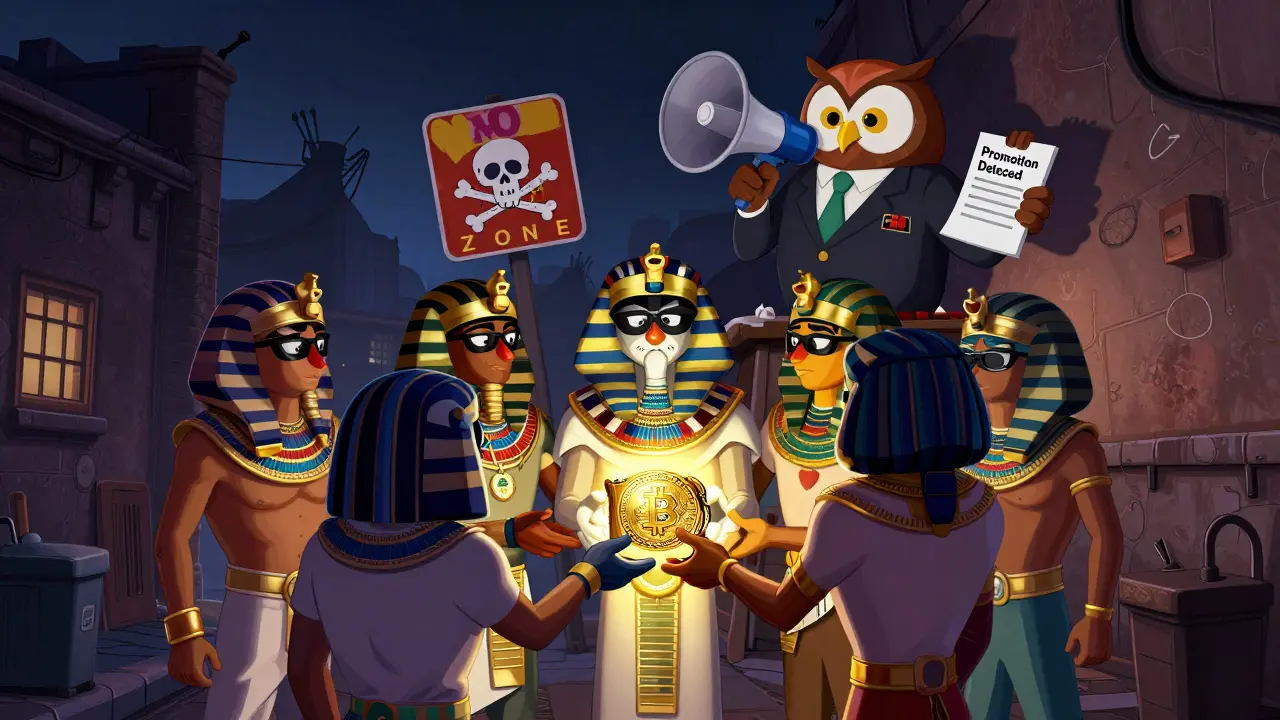
It’s not just about buying Bitcoin on Binance. Even promoting crypto on Instagram, running a Telegram group that shares trading tips, or helping someone set up a wallet can be considered illegal promotion under this law. The government doesn’t care if you’re a student, a freelancer, or a small business owner. If you’re involved in any part of the crypto chain without permission, you’re breaking the law.
Why Egypt Banned Crypto-And Why It Still Doesn’t Work
The government’s reasoning is clear: crypto is dangerous. It’s volatile. It’s used for crime. And since it’s not controlled by the state, it threatens financial stability. That’s the official line.But here’s the contradiction: Egypt has one of the highest crypto adoption rates in Africa and the Middle East. A 2022 report found over 1.7 million Egyptians owned cryptocurrency-about 1.75% of the population. That’s more than in countries like Nigeria and South Africa, despite their more open policies. People aren’t ignoring the law because they’re unaware. They’re ignoring it because they need to.
Why? Because the banking system in Egypt is slow, expensive, and often inaccessible for international transactions. Freelancers working for clients abroad get stuck waiting weeks for wire transfers, paying high fees just to get paid. Crypto offers a faster, cheaper alternative. For many, it’s not a speculative investment-it’s a survival tool.
The government hasn’t cracked down on every single user. Enforcement is selective. Most people who trade privately aren’t targeted. But if you’re running a business, advertising crypto services, or handling large volumes, you’re on the radar. The FRA has been publishing lists of unlicensed crypto platforms and asking citizens to report them. They’re watching.
What Happens If You Get Caught?
There’s no gray area in the law. If you’re caught trading crypto, the penalties are severe:- Minimum fine: 1 million EGP ($51,634 USD)
- Maximum fine: 10 million EGP ($516,340 USD)
- Imprisonment (length not specified, but typically for serious financial crimes)
- Both fine and jail time can be applied
These aren’t small numbers. The average monthly salary in Egypt is around 8,000 EGP. A 10 million EGP fine is over 1,200 times that. For most people, paying that fine isn’t an option-it’s impossible. That’s why many who get caught end up in jail instead.
And it’s not just individuals. Businesses are targeted too. Any company that accepts crypto as payment, even accidentally, risks being labeled a violator. Foreign companies working with Egyptian partners have been warned: if your contract includes crypto payments, you could be held liable under Egyptian law.
How This Affects Everyday Life
The ban doesn’t just affect traders. It affects freelancers, remittance senders, small businesses, and even tourists.Imagine you’re an Egyptian designer working for a client in the U.S. You invoice them in USD. They want to pay you via crypto because it’s faster and cheaper. You say no-because you know the risk. So you wait weeks for a bank transfer, pay $50 in fees, and still get less than expected because of exchange rate swings.
Or you’re a tourist in Cairo trying to pay for a tour with Bitcoin. The guide says no. Not because they don’t want to-but because they could go to jail if they do.
Even crypto education is risky. YouTube channels teaching how to use wallets or trade on exchanges have been taken down. Instagram influencers promoting crypto have been investigated. The government doesn’t want people learning about it. They want it erased.
The Bigger Picture: Egypt vs. the World
Egypt’s stance is extreme. Most countries are trying to regulate crypto, not ban it. The U.S., EU, Japan, and even India have frameworks that allow trading under oversight. China banned it outright, but that’s because they’re building their own digital currency. Egypt has no such plan.The result? Egypt is cutting itself off from global finance. Businesses avoid operating there because of the legal uncertainty. Investors stay away. Blockchain startups can’t set up shop. Innovation dies before it starts.
Meanwhile, crypto use keeps growing underground. The more the government cracks down, the more people turn to decentralized tools-mixers, peer-to-peer platforms, cash-based trades. Enforcement becomes harder. The law is strict, but the system is porous.

What Should You Do?
If you’re in Egypt: don’t trade. Don’t promote. Don’t even tell people how to do it. The risk isn’t worth it. The fines are too high. The jail time is real.If you’re outside Egypt and doing business with Egyptians: don’t accept crypto payments. Don’t offer crypto services. Don’t assume they know the risks. Many don’t. And if they get caught, you could be dragged in.
There’s no legal workaround. No licensed exchange exists in Egypt. No government-approved wallet. No safe path. The law is absolute.
For now, the only way to stay safe is to avoid crypto entirely. Not because it’s evil. Not because it’s useless. But because in Egypt, it’s a crime.
What’s Next?
The government hasn’t signaled any softening. In fact, they’ve doubled down. The FRA is preparing a public list of banned crypto platforms. They’re training banks to flag suspicious transactions. They’re working with international agencies to track cross-border crypto flows.One day, they might change their mind. But for now, Egypt is one of the few countries where owning crypto isn’t just risky-it’s illegal.
Is it illegal to own cryptocurrency in Egypt?
Owning cryptocurrency isn’t explicitly illegal, but any activity around it-buying, selling, trading, promoting, or using it as payment-is banned under Law No. 194 of 2020. Simply holding crypto in a wallet isn’t prosecuted, but if you’re caught trading it, you face heavy fines or jail.
How much is the fine for crypto trading in Egypt?
Fines range from 1 million to 10 million Egyptian pounds (EGP), which is about $51,634 to $516,340 USD. The court decides the amount based on the severity of the violation. Some offenders get jail time instead, or both.
Can I use crypto to pay for goods or services in Egypt?
No. Accepting cryptocurrency as payment is considered operating an unlicensed financial service under Egyptian law. This applies to businesses, freelancers, and even individuals. Doing so can result in criminal charges.
Are there any licensed crypto exchanges in Egypt?
No. There are no government-approved cryptocurrency exchanges or platforms operating legally in Egypt. All exchanges, whether local or foreign, are banned under Law No. 194 of 2020.
Why do so many Egyptians still use crypto despite the ban?
Many Egyptians use crypto because the traditional banking system is slow, expensive, and unreliable for international transactions. Freelancers, small businesses, and families sending remittances rely on crypto to get paid faster and cheaper. The need outweighs the risk for many.
Can I get in trouble for just learning about crypto in Egypt?
No, learning about crypto isn’t illegal. Reading articles, watching videos, or studying blockchain technology is fine. The law targets active participation-trading, promoting, or operating services. Knowledge itself isn’t a crime.
What happens if a foreign company accepts crypto from an Egyptian client?
The foreign company itself won’t be prosecuted under Egyptian law. But if the Egyptian client is caught using crypto to pay, they could face legal action. The foreign company could also be blacklisted or blocked from future business with Egyptian entities due to compliance concerns.
Has anyone actually been jailed for crypto trading in Egypt?
Public records of jail sentences are limited, but enforcement actions have been confirmed. In 2023, the FRA announced the arrest of individuals running unlicensed crypto promotion campaigns on social media. While exact numbers aren’t published, authorities confirm criminal cases are active.
Is Bitcoin treated differently from other cryptocurrencies in Egypt?
No. The law applies to all cryptocurrencies equally. Bitcoin, Ethereum, Solana, or any other digital asset-none are exempt. The Central Bank’s 2018 warning focused on Bitcoin, but the 2020 law covers all digital currencies without distinction.
Can I open a crypto wallet in Egypt without breaking the law?
Technically, yes-owning a wallet isn’t illegal. But if you use it to send, receive, or trade crypto, you’re violating the law. The government doesn’t monitor wallets, but they track transactions. If your wallet activity is detected and linked to trading or promotion, you’re at risk.
Richard Kemp
January 28, 2026 AT 15:58Aaron Poole
January 30, 2026 AT 08:24William Hanson
January 31, 2026 AT 13:40Lori Quarles
January 31, 2026 AT 23:20Jeremy Dayde
February 2, 2026 AT 23:11Freddy Wiryadi
February 4, 2026 AT 02:34christal Rodriguez
February 5, 2026 AT 08:28Gustavo Gonzalez
February 5, 2026 AT 18:03Gavin Francis
February 6, 2026 AT 04:42Rob Duber
February 7, 2026 AT 20:36Joshua Clark
February 9, 2026 AT 10:44Brandon Vaidyanathan
February 10, 2026 AT 18:39Dahlia Nurcahya
February 10, 2026 AT 23:30Dylan Morrison
February 12, 2026 AT 06:44Ramona Langthaler
February 13, 2026 AT 21:59