Centralized vs Decentralized Exchanges: Complete Comparison Guide
 May, 17 2026
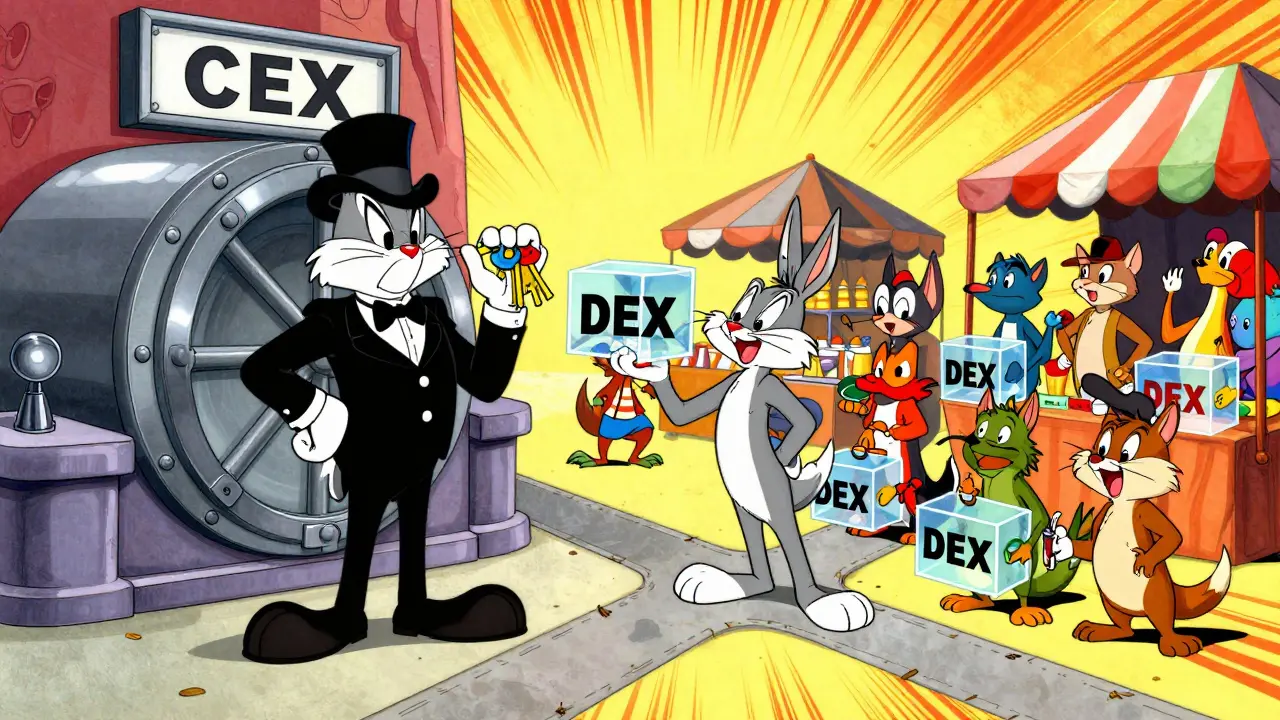
Imagine standing at a crossroads. On one side is a familiar bank lobby with tellers, security guards, and a clear line of sight to your money. On the other is a bustling open market where you trade directly with strangers using locked boxes that only you can open. This isn't just a metaphor; it's the exact choice every cryptocurrency trader faces today. The decision between Centralized Exchanges (CEXs) and Decentralized Exchanges (DEXs) defines how you interact with digital assets, who controls your funds, and what risks you accept.
As of 2025, the total crypto exchange market is valued at $71.35 billion. Centralized exchanges dominate this landscape, holding an impressive 87.4% market share according to CoinLaw.IO's 2025 statistics report. Yet, despite their dominance, decentralized exchanges are growing rapidly, with over 1,097 tracked platforms processing millions of transactions monthly. Understanding the differences between these two models isn't just academic-it's essential for protecting your capital and maximizing your trading potential.
The Core Difference: Custody and Control
The fundamental divide between CEXs and DEXs comes down to one word: custody. When you use a centralized exchange like Binance or Coinbase, you are essentially renting space in their digital vault. You deposit your cryptocurrency into wallets controlled by the exchange entity. They hold the private keys, meaning they have ultimate authority over your assets. If the exchange freezes your account, hacks occur, or the company goes bankrupt-as seen with FTX in 2022-you may lose access to your funds permanently.
In contrast, Decentralized Exchanges operate through blockchain-based smart contracts. These platforms enable peer-to-peer trading directly from your non-custodial wallet, such as MetaMask or Trust Wallet. No intermediary holds your funds. You maintain full sovereignty over your assets at all times. This eliminates counterparty risk but shifts the burden of security entirely onto you. If you lose your seed phrase, there is no customer support team to call. Your money is gone forever.
This philosophical difference shapes everything else about the user experience. CEXs prioritize convenience and familiarity, mimicking traditional stock brokerages. DEXs prioritize financial sovereignty and censorship resistance, aligning with the original cypherpunk vision of Bitcoin creator Satoshi Nakamoto.
Liquidity and Trading Volume: Who Has the Depth?
Liquidity refers to how easily you can buy or sell an asset without causing significant price changes. High liquidity means tight spreads and faster execution. In this dimension, centralized exchanges currently hold a massive advantage.
Binance reported $79.28 billion in 24-hour spot volume as of Q1 2025, according to CoinGecko data. By comparison, Uniswap-the largest decentralized exchange-recorded $3.72 billion during the same period. That’s a staggering disparity. For large institutional traders moving millions of dollars, CEXs offer deeper order books that absorb big orders without slippage. DEXs rely on Automated Market Maker (AMM) models, like Uniswap’s Constant Product Formula (x*y=k), which can suffer from high slippage when trading illiquid tokens or executing large swaps.
However, liquidity is not static. Layer-2 scaling solutions including Optimism, Arbitrum, and zkSync have improved DEX performance significantly. These networks enable sub-second settlement times and reduce gas costs by up to 90% compared to Ethereum mainnet, as documented by BlockchainX in 2025. While CEXs still win on raw volume, DEXs are catching up in usability and cost efficiency for smaller trades.
| Feature | Centralized Exchange (CEX) | Decentralized Exchange (DEX) |
|---|---|---|
| Custody | Exchange holds your funds | You hold your funds |
| Liquidity | High (deep order books) | Variable (depends on pools) |
| Fiat Support | Direct USD/EUR/JPY pairs | Rare (mostly crypto-to-crypto) |
| KYC Requirement | Mandatory identity verification | Not required |
| Security Risk | Hacks, insolvency, frozen accounts | Smart contract bugs, phishing |
| Transaction Speed | Near-instantaneous | Depends on blockchain congestion |
Security: Hacks, Bugs, and Human Error
Security is often cited as the primary reason users choose one model over the other, but the reality is more nuanced. Both CEXs and DEXs face serious threats, just different kinds.
Centralized exchanges have suffered 56 major hacks totaling $4.7 billion since 2011, according to a CipherTrace 2024 report. Platforms mitigate this by storing 95-98% of assets in cold wallets (offline storage) and implementing AES-256 encryption and mandatory two-factor authentication. However, centralized control creates single points of failure. The collapse of FTX demonstrated how internal fraud could wipe out $8 billion in user funds overnight. Additionally, regulatory pressure forces CEXs to comply with Know Your Customer (KYC) rules, which expose personal data to breaches.
Decentralized exchanges avoid custodial risks but introduce smart contract vulnerabilities. The 2022 Wormhole bridge exploit resulted in a loss of $320 million due to code flaws. Unlike CEXs, there is no central authority to reverse transactions or freeze malicious activity. Users must trust audited code rather than a company’s reputation. The Blockchain Transparency Institute’s 2025 audit found that 78% of top DEXs had undergone third-party smart contract audits, compared to 100% of top 10 CEXs having proof-of-reserves certifications.
User error remains the biggest threat in both ecosystems. A WalletConnect survey found that 63% of new DEX users abandoned their first trade due to slippage errors or gas miscalculations. Meanwhile, Coinbase users frequently cite slow customer support during volatility as a pain point. Ultimately, security depends less on the platform type and more on user diligence.
Costs and Fees: What Are You Really Paying?
Trading fees vary widely depending on the platform, fee structure, and network conditions. Understanding these costs is crucial for long-term profitability.
Centralized exchanges typically charge tiered trading fees based on volume. Coinbase charges from 0.00% to 0.60% per trade, plus a 1% fee for fiat deposits, according to its January 2025 fee schedule. High-volume traders can negotiate lower rates. Hidden costs include withdrawal fees and spread markups on certain pairs.
Decentralized exchanges charge protocol fees plus blockchain network fees (gas). Uniswap v3 charges pool fees ranging from 0.01% to 1.0%, depending on the asset pair. Gas costs fluctuate dramatically based on network congestion. In Q2 2025, average transaction costs on Arbitrum were $1.27 per swap, while Ethereum mainnet fees often exceeded $10 during peak hours. Layer-2 solutions have reduced DEX transaction costs by 45% in 2025, making them increasingly competitive for frequent traders.
For small trades under $100, DEX gas fees can eat into profits quickly. For large institutional moves, CEX maker-taker fees become negligible compared to slippage savings. There is no universal winner-cost efficiency depends on your trading size and frequency.
Regulation and Compliance: Legal Gray Areas
Regulatory compliance creates a stark divergence between CEXs and DEXs. Centralized exchanges operate within established legal frameworks, obtaining licenses in multiple jurisdictions. Kraken maintains over 40 jurisdictional licenses globally, ensuring adherence to anti-money laundering (AML) and KYC regulations. This provides users with legal recourse in case of disputes but also subjects their funds to government oversight.
Decentralized exchanges operate in legal gray areas. Because they lack a central operator, regulators struggle to assign liability. The SEC’s 2024 lawsuit against Uniswap Labs highlighted this tension, arguing that many DEXs function as unregistered securities exchanges. Chairman Gary Gensler stated in February 2025 congressional testimony that “many DEXs operate as unregistered securities exchanges.” As of 2025, 18 countries have banned smart contract interactions, forcing some DEXs to geo-block users.
This regulatory uncertainty poses risks for DEX users. If a platform is deemed illegal in your country, you may face tax complications or inability to withdraw funds. Conversely, CEX users benefit from consumer protections but sacrifice privacy and autonomy. The MiCA implementation in Europe forced 37% of previously unregulated CEXs to exit the market, reshaping the competitive landscape.

User Experience: Ease of Use vs. Learning Curve
If you’ve never traded cryptocurrency before, the user experience gap between CEXs and DEXs feels enormous. Centralized exchanges offer intuitive interfaces, email recovery options, and dedicated customer support. MintLayer’s 2025 guide estimates 2-3 hours for basic CEX proficiency. Coinbase’s knowledge base scores 87/100 on Technical Communication Society metrics, reflecting high documentation quality.
Decentralized exchanges demand prior technical knowledge. MetaMask’s 2025 user survey revealed that 62% of new Web3 users required three or more attempts to successfully complete their first DEX swap. Seed phrase management represents the largest failure point, cited by 78% of support tickets. Competent DEX navigation-including gas optimization and slippage configuration-requires 15-20 hours of learning time.
Community support structures differ fundamentally. CEXs offer ticket-based customer service, with Kraken averaging an 18-minute response time per Q1 2025 reports. DEX users rely on Discord communities; Uniswap’s server has 142,000 members but averages 72 hours for question resolution. For beginners, CEXs provide a smoother entry point. For experienced users seeking control, DEXs offer unparalleled flexibility.
Which Should You Choose?
Your choice depends on your goals, risk tolerance, and technical comfort level. Here’s a quick decision framework:
- Choose a CEX if: You’re new to crypto, want to buy with fiat currency, need customer support, prefer simplicity, or trade large volumes requiring deep liquidity.
- Choose a DEX if: You value self-custody, want to avoid KYC requirements, trade niche tokens unavailable on CEXs, seek censorship resistance, or participate in DeFi protocols.
Many advanced users adopt a hybrid approach. They use CEXs for onboarding and large trades, then transfer assets to self-custody wallets for DEX interactions. Hybrid exchange models combining CEX liquidity with DEX custody controls now represent 12% of new platforms, exemplified by Coinbase’s Base integration that processed $427 million in DEX volume during Q2 2025.
Gartner predicts a bifurcated market where CEXs serve 80% of retail volume but DEXs process 65% of institutional DeFi interactions by 2027. Rather than choosing one forever, adapt your strategy as your needs evolve. Start simple, learn gradually, and always prioritize security.
Can I use a DEX without owning cryptocurrency first?
No, most DEXs require you to already hold cryptocurrency (like ETH or MATIC) to pay for transaction fees and execute trades. You typically need to buy crypto on a CEX first, transfer it to a self-custody wallet, then connect that wallet to the DEX. Some newer DEX aggregators are experimenting with fiat gateways, but widespread adoption remains limited.
Are DEXs safer than CEXs?
It depends on what you mean by safe. DEXs eliminate custodial risk-you won’t lose funds if the platform gets hacked because you never deposit assets there. However, DEXs carry higher risks from smart contract bugs, phishing attacks, and user error. CEXs protect against individual mistakes but introduce counterparty risk. Neither is universally safer; they shift risk differently.
Why do DEXs have higher slippage than CEXs?
Slippage occurs when your trade executes at a worse price than expected due to low liquidity. DEXs use automated market makers (AMMs) with finite liquidity pools. Large orders deplete these pools quickly, causing price impact. CEXs maintain deep order books with thousands of buyers and sellers, allowing larger trades with minimal slippage. Using limit orders or splitting trades can reduce slippage on DEXs.
Do I need to worry about taxes when using DEXs?
Yes, tax obligations apply regardless of platform type. Every swap, yield farming reward, or NFT purchase on a DEX is considered a taxable event in most jurisdictions. Since DEXs don’t report transactions to authorities, you’re solely responsible for tracking and reporting them. Use portfolio trackers like Koinly or CoinTracker to automate record-keeping.
What happens if a DEX smart contract is exploited?
If a vulnerability is discovered, developers may pause the contract to prevent further losses, but stolen funds are usually unrecoverable. Unlike CEXs, there’s no insurance fund or customer support to reimburse victims. Always verify audit reports from reputable firms like CertiK or OpenZeppelin before interacting with new DEXs. Never approve unlimited token allowances unless necessary.
Can I trade leverage or futures on DEXs?
Yes, several DEXs offer perpetual futures and leveraged trading, such as dYdX, GMX, and Hyperliquid. However, these products are complex and carry higher liquidation risks. Regulatory scrutiny is intensifying around decentralized derivatives, so availability may change. Beginners should stick to spot trading until fully comfortable with margin mechanics.
How do Layer-2 solutions improve DEX performance?
Layer-2 networks like Arbitrum, Optimism, and zkSync process transactions off the main Ethereum chain, then settle batches back on-chain. This reduces congestion and lowers gas fees by up to 90%. Traders enjoy faster confirmations (sub-second) and cheaper swaps, making DEXs viable for daily trading. Most major DEXs now support multiple L2 networks simultaneously.
Is it possible to switch from CEX to DEX seamlessly?
Yes, but preparation is key. First, set up a secure hardware wallet (like Ledger or Trezor) or software wallet (MetaMask). Transfer a small amount of crypto from your CEX to test the process. Familiarize yourself with gas estimation, slippage settings, and token approvals. Once comfortable, gradually migrate larger holdings. Never rush-mistakes cost real money.