DeFi Tax Reporting Requirements: What You Need to Know in 2026
 Feb, 17 2026
When you trade ETH for USDC on a decentralized exchange, or stake your ADA to earn rewards, or add liquidity to a pool on Uniswap - you’re not just participating in DeFi. You’re also creating a taxable event. And as of 2026, the IRS doesn’t care whether you used a centralized exchange or a smart contract. If you made a profit, you owe taxes.
The rules changed dramatically in 2025. What was supposed to be a sweeping new system for tracking DeFi transactions? Gone. What remains? A confusing patchwork of obligations that puts the entire burden on you - the user. No more automatic reports from DeFi platforms. No more broker filings. Just you, your wallet history, and a mountain of records you probably haven’t kept.
DeFi Brokers Are No Longer Required to Report
In December 2025, the IRS and Treasury rolled out final rules that would have forced DeFi platforms - like Uniswap, Curve, or Aave - to act like brokers. That meant collecting user data, tracking every trade, and filing Form 1099-DA for every digital asset sale or exchange. It was meant to close a loophole. But by April 2025, Congress passed a law that wiped those rules off the books.
So right now, DeFi platforms do not file Form 1099-DA. They don’t report your swaps, staking rewards, or liquidity provision to the IRS. That’s not because these activities are tax-free. It’s because the government decided not to force decentralized systems to comply.
This doesn’t mean you’re off the hook. It means you’re now the sole record-keeper. If you don’t track your own transactions, the IRS won’t have a record - but that doesn’t stop them from auditing you later.
What Still Gets Reported? Centralized Exchanges
While DeFi is quiet, centralized platforms like Coinbase, Kraken, and Gemini are still busy filing. For trades made in 2025, they sent Form 1099-DA to users and the IRS in early 2026. That form shows the total gross proceeds from sales and exchanges - but not your original cost.
For 2026, those same platforms will start reporting cost basis too. That’s the price you paid when you bought the asset. But again, this only applies to trades done through their platform. If you bought BTC on Coinbase, sold it on Uniswap, and bought ETH on Binance - only the Coinbase and Binance parts get reported. The Uniswap trade? Invisible to the IRS.
This creates a dangerous blind spot. You could have made $50,000 in profit on DeFi and never seen it on a 1099. The IRS will only see the $5,000 you made on Coinbase. That mismatch is a red flag.
Every DeFi Transaction Is Taxable - Even If It’s Not Reported
Just because a DeFi platform doesn’t report doesn’t mean the IRS ignores it. The IRS has always treated digital assets as property. That means every swap, every staking reward, every liquidity pool deposit or withdrawal - it’s all taxable.
- Swaps: Exchanging one crypto for another is a taxable event. Selling ETH for DAI? You owe capital gains tax on the difference between what you paid for ETH and what it was worth when you swapped it.
- Staking rewards: Every time you earn ETH or SOL from staking, that’s ordinary income at the fair market value the day you received it. If you later sell those rewards, you owe capital gains on the increase.
- Liquidity provision: Adding ETH and USDC to a pool isn’t a gift - it’s a trade. Removing your share later? That’s another trade. If the value of your assets changed between deposit and withdrawal, you have a taxable gain or loss.
- Lending: If you lend crypto through Aave or Compound and earn interest, that’s income. If you get repaid in a different asset, that’s a swap.
- NFTs: Buying an NFT with ETH? Taxable. Selling it for DAI? Taxable. Trading it for another NFT? Also taxable.
There’s no exemption. No “de minimis” rule for DeFi. Even if you only swapped $200 worth of tokens, you still have to report it. The $10,000 de minimis threshold only applies to brokers - not to you.

Your Responsibility: Tracking Cost Basis
The IRS doesn’t care how messy your records are. They only care that you report correctly. And that means knowing your cost basis - the original price you paid for each unit of crypto.
For centralized exchanges, you’ll get that data. For DeFi? You’re on your own. You need to track:
- When you bought each coin
- How much you paid
- What wallet it was sent to
- When you used it (for a swap, staking, etc.)
There are three methods to calculate gains:
- FIFO (First In, First Out): The default. The first coins you bought are the first ones sold. Simple, but not always optimal.
- Specific Identification: You can pick exactly which coins you’re selling - but only if you document it before the transaction. You need a timestamp, wallet address, and cost basis for each unit.
- Average Cost: Not allowed. The IRS doesn’t let you average your crypto purchases like you can with stocks.
If you don’t identify specific units, FIFO applies. That means if you bought BTC in 2020 for $10,000 and sold it in 2025 for $60,000, you owe tax on $50,000 - even if you bought more BTC later at $40,000.
What’s Not Reported - But Still Taxable
There are six major DeFi activities that brokers are temporarily exempt from reporting - but they’re still taxable:
- Wrapping/unwrapping (e.g., wETH ↔ ETH)
- Liquidity provision and removal
- Staking rewards
- Lending and borrowing
- Short sales
- NFT trades
Even if your wallet shows $15,000 in staking rewards over the year, and your 1099-DA says $0 - you still owe income tax on that $15,000. The IRS knows how blockchain works. They can see your wallet activity. They just don’t have a broker to ask.
That’s why audits are rising. Taxpayers who report only what’s on their 1099-DA are getting flagged. The IRS uses blockchain analytics firms like Chainalysis to trace transactions across wallets. If you have $200,000 in DeFi activity and only report $20,000 - you’re asking for trouble.
How to Stay Compliant
Here’s what you need to do right now:
- Track every transaction. Use a crypto tax tool like Koinly, CoinTracker, or ZenLedger. Connect your wallets (MetaMask, Trust Wallet, etc.) and let them pull on-chain data. Don’t rely on exchange reports alone.
- Classify each event. Was it a swap? A reward? A transfer? Each has different tax treatment.
- Document specific identification. If you want to use specific unit tracking, write down the exact transaction IDs and cost basis before you spend.
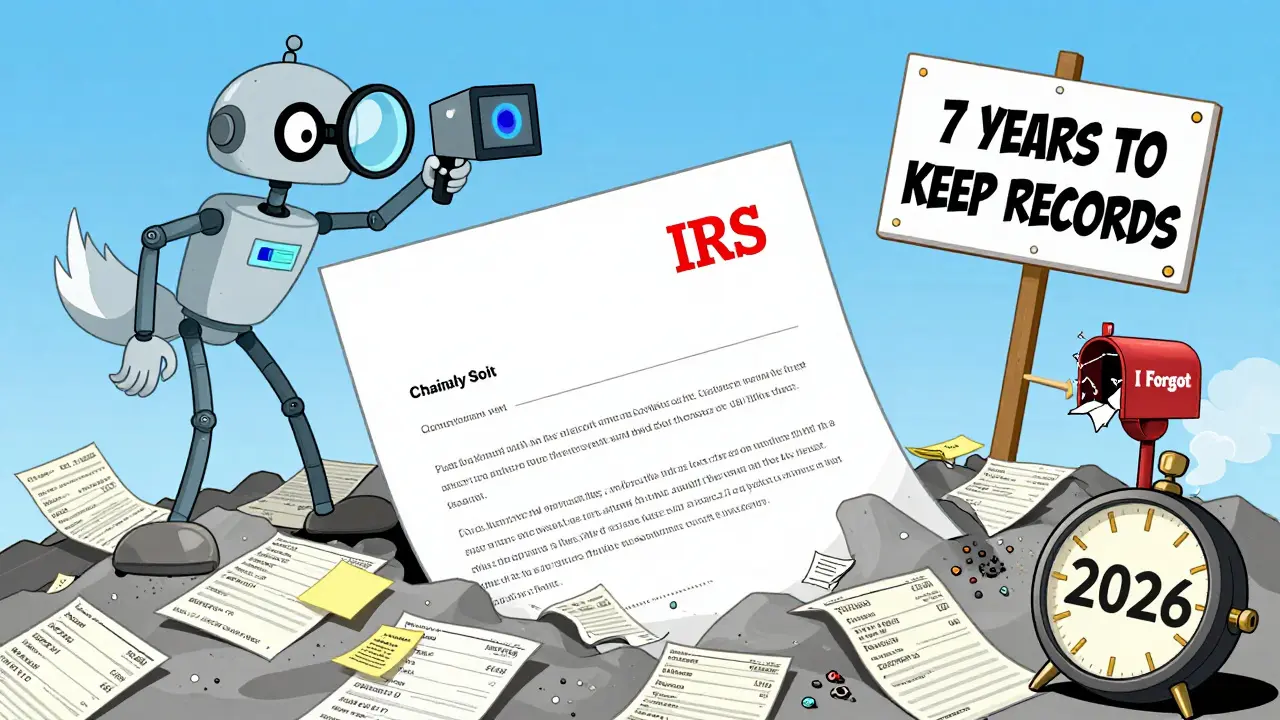
- Keep records for 7 years. The IRS can audit crypto transactions for up to seven years after filing.
- Report everything on Form 8949. Even if it’s not on a 1099-DA, list it. Use Schedule D to summarize capital gains.
Most people think they’re safe if they don’t get a 1099. They’re wrong. The IRS doesn’t need a broker to know what you did. They have the blockchain.
The Bigger Picture: What’s Next?
Is this the end of DeFi reporting? Not likely. The White House has signaled that international standards like CARF (Common Reporting Standard) may eventually require countries to report DeFi transactions. The U.S. could reverse course again. Congress might restore reporting rules. The IRS might issue new guidance. The rules are in flux.
But here’s the truth: tax obligations don’t disappear just because reporting does. The law hasn’t changed. You still owe taxes on every gain, every reward, every swap. The only thing that changed is who’s supposed to tell the IRS.
So if you’re using DeFi in 2026, treat it like a business. You’re not just trading crypto - you’re running a personal financial operation with tax consequences. And if you’re not keeping records, you’re gambling with your audit risk.
Do I need to report DeFi transactions if I didn’t get a 1099-DA?
Yes. The absence of a 1099-DA doesn’t mean the transaction isn’t taxable. The IRS requires you to report all digital asset sales, exchanges, staking rewards, and other taxable events - regardless of whether a broker reported them. Failure to report can lead to penalties, interest, or audit.
What if I used multiple wallets and DeFi platforms?
You must aggregate all your transactions across wallets and platforms. A DeFi trade on Uniswap, a staking reward on Coinbase Wallet, and a swap on MetaMask are all part of your total taxable activity. Use a crypto tax tool that connects to all your wallets to avoid missing transactions. The IRS can see activity across all public blockchains.
Can I use FIFO for DeFi transactions?
Yes, FIFO is the default method if you don’t identify specific units. But it’s not always the best. If you bought ETH at $1,500 in 2023 and again at $3,000 in 2025, and you sell 1 ETH in 2026, FIFO would force you to use the $1,500 cost basis - even if you meant to sell the newer, more expensive one. To avoid this, use specific identification with proper documentation.
Are staking rewards taxed as income or capital gains?
Staking rewards are taxed as ordinary income at the time you receive them, based on their fair market value in USD. Later, if you sell those rewards, you’ll owe capital gains tax on any increase in value since you received them. For example, if you earn 0.5 ETH worth $1,200 in staking, you report $1,200 as income. If you later sell that ETH for $1,500, you owe $300 in capital gains.
What happens if I don’t report my DeFi trades?
The IRS has tools to detect unreported crypto activity. They cross-reference blockchain data with tax returns. If you report $10,000 in gains but your wallet shows $200,000 in trades, you’re likely to get an audit. Penalties can include 20% accuracy-related penalties, 75% fraud penalties, and interest on unpaid taxes. In extreme cases, criminal charges are possible.
Do I need to report transfers between my own wallets?
No. Transferring crypto between wallets you own - even from Coinbase to MetaMask - is not a taxable event. Tax is only triggered when you sell, exchange, or dispose of the asset. But keep records of these transfers to prove you didn’t sell anything.
Can I use crypto tax software for DeFi?
Yes. Tools like Koinly, CoinTracker, and ZenLedger can import transaction data from over 10,000 wallets and DeFi protocols. They classify transactions automatically and generate IRS-ready reports. This is the easiest way to stay compliant. Manual tracking is possible but extremely error-prone.
Is there a de minimis exemption for small DeFi trades?
No. The $10,000 and $600 thresholds only apply to brokers - not to taxpayers. Even if you swapped $50 worth of tokens, you still have to report the gain or loss. The IRS doesn’t have a personal-use exemption for crypto like it does for occasional sales of personal items.
jennifer jean
February 17, 2026 AT 14:29omg i just realized i staked like $3k in ADA last year and never reported it 😭
now i’m scrambling to find my wallet history
thank u for this post, seriously. i thought crypto was tax-free if no 1099 came
brb going to download koinly
george chehwane
February 18, 2026 AT 22:34so let me get this straight - the government abolished mandatory DeFi reporting because it’s "too decentralized" - but now expects ordinary citizens to become forensic accountants for blockchain? 🤡
Next they’ll ask us to manually log every Bitcoin transaction like it’s 1998 and we’re filing a tax return on a typewriter.
Capitalism is just feudalism with more APIs.
Scott McCrossan
February 20, 2026 AT 02:42Oh wow. So the IRS is just gonna go full blockchain detective now?
They’re gonna subpoena every single wallet address on the planet?
What’s next? They’ll start tracking my Dogecoin meme purchases and send me a letter saying "you owe $23.47 in capital gains for that Shiba Inu NFT you bought with your lunch money"
Meanwhile I’m just over here trying to survive my 9-5 and now I’m supposed to be a crypto CPA too?
This isn’t tax law. This is psychological warfare.
Beth Erickson
February 21, 2026 AT 10:06if you're using defi you're already a tax evader
no one in their right mind tracks every swap
the irs is just trying to scare people into using coinbase
they don't want decentralization
they want control
and if you're not paying them their cut you're a criminal
good luck with that
Ruby Ababio-Fernandez
February 22, 2026 AT 02:04just report what you got on 1099 and hope for the best
Jeremy Fisher
February 23, 2026 AT 22:17you know what’s wild? in the 1970s, people didn’t even track their stock trades - they just filed a simple return and moved on.
now we’re expected to know the exact timestamp and USD value of every single ETH-to-USDC swap we’ve ever made since 2017?
it’s not just impractical - it’s culturally absurd.
we’ve turned finance into a bureaucratic horror story where your wallet is your audit trail and your peace of mind is collateral.
the irony? the people who built DeFi were trying to escape this exact system.
now they’re being forced to become its most diligent slaves.
Anandaraj Br
February 25, 2026 AT 21:49you people are so naive thinking the IRS will not catch you
blockchain is public record
every transaction is forever
if you made profit you are already in trouble
no one in india does this properly and still they get audited
you think america is different?
you are so behind the curve
AJITH AERO
February 26, 2026 AT 19:50so you're telling me i have to pay tax on a 50 cent staking reward from a pool i joined in 2021?
that's like taxing me for breathing air
next they'll charge me for sunlight
Angela Henderson
February 28, 2026 AT 02:46i’ve been using trust wallet for years and never thought about any of this
just figured if i didn’t cash out i was fine
but now i’m going through my whole history and holy cow - i’ve done like 87 swaps
some of them were just moving from one wallet to another but i didn’t know that wasn’t taxable
so now i’m terrified i’m gonna get hit with a huge bill
and i’m not even rich
just someone who liked buying small amounts of crypto when it was cheap
why does everything have to be so complicated
Geet Kulkarni
February 28, 2026 AT 13:56Dear fellow crypto enthusiasts,
It is with profound humility and adherence to international fiscal standards that I must underscore the imperative of full compliance with the United States Internal Revenue Code, particularly Section 6050I as pertains to digital asset transactions.
While the absence of Form 1099-DA may appear to suggest a regulatory lacuna, one must not confuse non-reporting by intermediaries with non-taxability of underlying economic events.
Each swap, staking event, and liquidity provision constitutes a discrete taxable occurrence, irrespective of jurisdictional ambiguity or technological decentralization.
I strongly urge all stakeholders to engage certified blockchain tax professionals and utilize accredited platforms such as Koinly or ZenLedger, which have been rigorously vetted for compliance with OECD guidelines.
Failure to do so constitutes not merely negligence, but a violation of fiduciary duty owed to the global financial ecosystem.
Paul David Rillorta
March 1, 2026 AT 23:23the irs is working with chainalysis to track your wallet
they already know everything
they’re just waiting for you to self-incriminate on your tax return
they’re gonna come for your house
they’re gonna take your dog
they’re gonna make you pay for that one time you swapped 0.001 eth for a meme coin
they’re not your friends
they’re the government
and they want your crypto
they always do
andy donnachie
March 3, 2026 AT 17:39Just a quick note from Ireland - we’ve got similar rules here. Even if you don’t get a form, you still report. The Irish Revenue Commission uses blockchain analysis too. I’ve been using Koinly for two years now - it’s saved me from panic during tax season. Connect all your wallets, even the forgotten ones. Trust me, the ‘I forgot I had that wallet’ story doesn’t fly with auditors. And yes, transfers between your own wallets? Totally fine. But keep a log anyway. Better safe than sorry.
Lauren Brookes
March 4, 2026 AT 00:32There’s something deeply ironic about this whole situation.
DeFi was supposed to be about freedom - no banks, no middlemen, no gatekeepers.
But now we’re stuck in this weird limbo where the system we wanted to escape is still watching us - just not through the old channels.
It’s not that the rules changed.
It’s that the burden shifted.
From institutions to individuals.
And now we’re all expected to be our own accountants, auditors, and compliance officers - all while trying to live normal lives.
Maybe the real question isn’t whether we owe taxes.
It’s whether we’re okay with a system that turns every financial choice into a legal minefield.
And if we are… then what did we even build this for?