Future of Token Vesting Models in Web3 Projects
 Jan, 8 2026
Token vesting isn’t just a technical detail in crypto projects-it’s the invisible hand that keeps markets from crashing, teams from quitting, and investors from panicking. Back in 2017, it was common to see founders sell their entire token allocation the moment it unlocked. Today, that’s a red flag. The future of token vesting is moving beyond simple time locks. It’s becoming smarter, more responsive, and deeply tied to real project outcomes.
Why Vesting Still Matters More Than Ever
In early crypto, tokens were handed out like candy at a birthday party. Everyone got a big chunk upfront, and many cashed out within weeks. That created a cycle of hype and collapse. Projects burned through cash, teams disbanded, and users lost trust. Vesting broke that cycle. By locking tokens for 12 to 36 months, projects forced stakeholders to think long-term. Founders couldn’t just flip and run. Investors had skin in the game beyond a quick flip. Even employees stayed because their compensation grew over time. Today, with over $2 trillion in asset tokenization projected by 2025, vesting is no longer optional-it’s a baseline expectation. Investors now check vesting schedules before even reading the whitepaper. If a team’s tokens unlock all at once in 12 months? That’s a warning sign.From Time-Based to Milestone-Based Vesting
The old model was simple: 25% after one year, then 1/48th monthly for the next three years. It worked. But it didn’t care if the project shipped a product, hit user targets, or met security audits. The new wave ties vesting to performance. Think of it like a startup equity plan-but for blockchain. If a team hits their Q3 roadmap, 10% of their tokens unlock. If the DEX hits 500K active users, another 5% releases. If the smart contract passes a third-party audit? Bonus unlock. Projects like Arbitrum and Polygon have already started testing this. Instead of rewarding time, they reward impact. This isn’t just fairer-it’s more efficient. Teams that deliver early get rewarded faster. Teams that lag don’t get a free pass.Cliffs Are Still Here, But They’re Smarter
The one-year cliff-where nothing unlocks until the 12-month mark-isn’t going away. But its purpose is evolving. In the past, cliffs were a blunt tool: "Stay for a year or get nothing." Now, they’re layered with conditions. Some projects use a hybrid model: 20% unlocks after 12 months, but only if the protocol’s TVL stays above $100M. Others tie the cliff to governance participation-team members must vote in at least 80% of proposals to unlock their first tranche. This turns vesting from a passive waiting game into an active participation requirement. It’s not enough to show up. You have to contribute.
Transparency Is the New Standard
A year ago, many projects hid their vesting schedules behind private documents or vague blog posts. Today, the best projects publish live vesting trackers on their websites. You can see exactly when each investor, team member, or advisor’s tokens unlock-down to the day. Why? Because opacity breeds suspicion. When tokens suddenly flood the market, prices crash. Users blame the team. The community splits. But when the schedule is public, people plan ahead. They know when selling pressure might hit. They adjust their strategies. Trust grows. Projects like Uniswap and Aave now use on-chain vesting contracts that anyone can verify. The blockchain doesn’t lie. That’s the gold standard now.DEXs Are Rewriting the Rules
Decentralized exchanges don’t just list tokens-they depend on them. Liquidity providers need tokens to stake. Governance voters need tokens to participate. If 30% of a DEX’s native token unlocks in one week, liquidity can vanish overnight as holders sell to cash out. That’s why leading DEXs are extending vesting periods. SushiSwap’s team tokens now vest over five years. Curve’s early investors have 48-month cliffs. Even new DEXs like Balancer are building in gradual unlocks that match liquidity growth curves. The goal? Align token unlocks with actual usage. If a DEX’s trading volume doubles in 18 months, only then do more tokens unlock. It’s not about time-it’s about network health.Regulation Is Shaping the Future
In 2024, the SEC started treating token vesting as a key indicator of whether a token is a security. If tokens are released to insiders with no performance conditions, regulators see it as an unregistered offering. But if vesting is tied to active service or measurable milestones, it looks more like compensation. Projects are now designing vesting models with compliance in mind. Legal teams are involved from day one. Vesting schedules are audited by third parties. On-chain records are kept for regulators. This isn’t a burden-it’s an advantage. Projects with clear, compliant vesting attract institutional capital. Hedge funds, family offices, and even pension funds are now entering crypto. And they won’t touch a project without transparent, regulated vesting.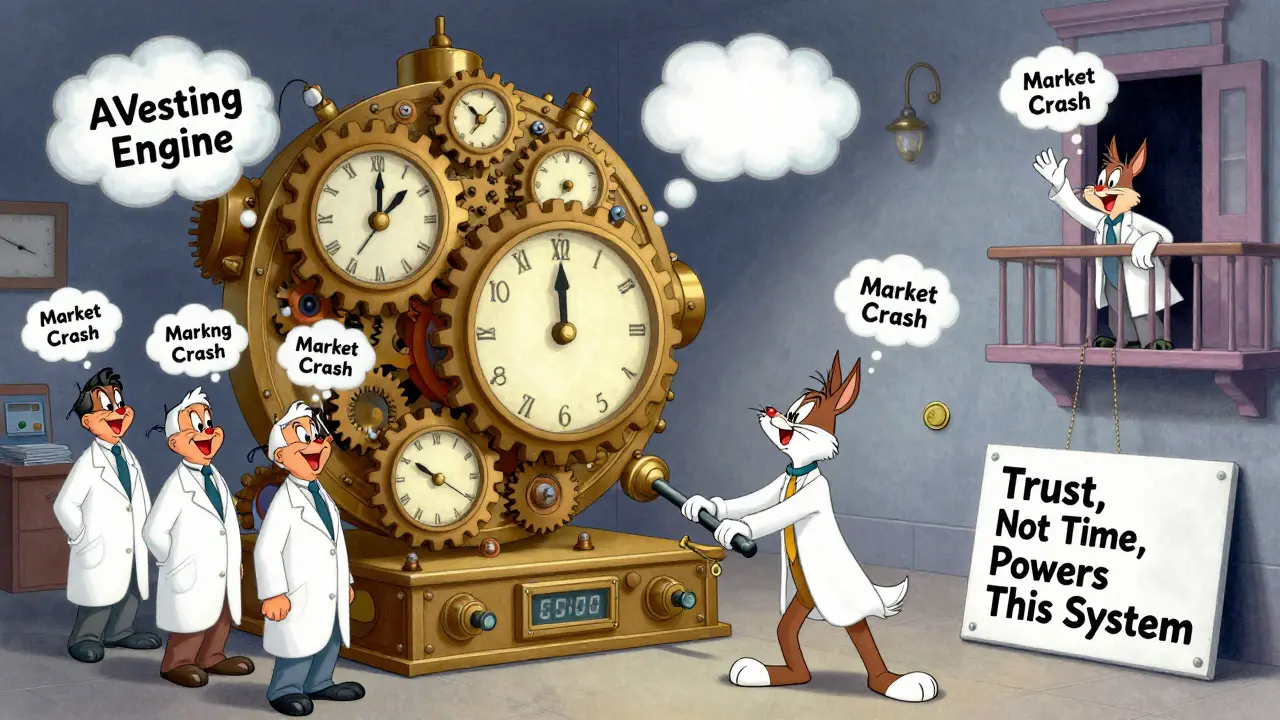
What’s Next? Dynamic, AI-Driven Vesting
The next frontier isn’t just milestone-based. It’s predictive. Imagine a vesting model that adjusts in real time based on market volatility, trading volume, or even social sentiment. If the token price drops 30% in a week, vesting pauses for 30 days to prevent panic selling. If community activity spikes, unlocks accelerate to reward engagement. Some early experiments are already happening. A few DeFi protocols are testing smart contracts that integrate with Chainlink oracles to trigger vesting based on external data. This isn’t sci-fi-it’s the logical next step in aligning incentives with real-world outcomes.What to Watch For in 2026
If you’re investing in or building a Web3 project, here’s what to look for:- Is vesting tied to milestones? If it’s just a calendar, walk away.
- Are vesting schedules on-chain and public? If not, trust is low.
- Are team tokens locked longer than investors’? That’s a good sign.
- Is there a mechanism to pause or delay unlocks during market stress? Shows maturity.
- Are there penalties for early selling? Some projects now burn tokens if sold before full vesting.
Why This Isn’t Just About Money
Token vesting isn’t a financial tool. It’s a cultural one. It shapes behavior. It tells people: "Your value here isn’t what you own today-it’s what you help build over time." The projects that win in 2026 won’t be the ones with the flashiest marketing. They’ll be the ones where the team, investors, and users all move in the same direction-slowly, steadily, and together. Vesting is the quiet engine behind every sustainable crypto project. And in 2026, the best ones won’t just lock tokens-they’ll lock in trust.What is token vesting in crypto?
Token vesting is a system that gradually releases cryptocurrency tokens to team members, investors, or advisors over time instead of giving them all at once. This prevents immediate selling, encourages long-term commitment, and protects the project from market crashes caused by sudden token dumps.
How long should token vesting last?
For team members, 3 to 5 years is now standard, with a 12- to 24-month cliff. Investors typically have 12- to 36-month vesting periods. The key is matching the vesting length to the project’s expected timeline for product maturity and market adoption. Shorter vesting (under 12 months) is a red flag for most serious investors.
What’s the difference between linear and cliff vesting?
Linear vesting releases tokens evenly over time-like 1/48th monthly for 4 years. Cliff vesting means nothing unlocks until a set date (like 12 months), then the rest releases gradually. Most projects combine both: a 12-month cliff, then monthly unlocks for the next 3 years.
Can vesting schedules be changed after launch?
Technically, yes-if the smart contract allows it. But any change requires community approval through governance votes. Projects that unilaterally alter vesting schedules lose trust fast. The most credible projects build immutable vesting into their core contracts from day one.
Why do some projects have longer vesting for team members than investors?
Because team members are the ones building the project. Investors can exit anytime. Founders and engineers need long-term incentives to keep working even when the market crashes. Longer vesting for the team signals they’re committed to the project’s future, not just a quick profit.
Do all crypto projects use vesting?
No-but the ones that don’t are usually scams or short-term speculation plays. Top-tier projects, especially those backed by institutional investors, always use vesting. If a project doesn’t disclose a vesting schedule, treat it as high-risk.
How can I check a project’s vesting schedule?
Look on the project’s official website under "Tokenomics" or "Token Distribution." Reputable projects link to on-chain trackers like Etherscan or dedicated vesting dashboards. You can also check blockchain explorers using the project’s vesting contract address. If it’s buried in a PDF or not public at all, avoid it.
What happens if someone sells their vested tokens early?
Nothing legally-they own the tokens. But in practice, early selling can trigger community backlash, loss of governance rights, or even penalties. Some newer projects use bonded vesting: if you sell before the full unlock, part of your tokens get burned as a penalty. This discourages dumping.
Are vesting models regulated?
Not directly-but regulators like the SEC and ESMA look at vesting as evidence of intent. If tokens are released to insiders with no performance conditions, it may be classified as an unregistered security offering. Projects with milestone-based, transparent vesting are less likely to face regulatory action.
How do vesting models affect token price?
Large, sudden unlocks often cause price drops as holders sell. Well-designed vesting spreads unlocks over time, reducing sell pressure. Projects that align unlocks with product milestones or user growth see less volatility because the token’s utility increases at the same time as supply enters the market.
Paul Johnson
January 8, 2026 AT 08:49Sabbra Ziro
January 8, 2026 AT 21:02It’s the difference between a sprint and a marathon, and honestly, the marathon winners are the ones who matter.
Mujibur Rahman
January 9, 2026 AT 09:20Real teams ship. Real teams earn. Real teams don’t get paid just for showing up.
Natalie Kershaw
January 10, 2026 AT 15:47Also love how DEXs are aligning unlocks with liquidity curves-so smart. This is Web3 maturity right here 🙌
Danyelle Ostrye
January 11, 2026 AT 17:05Jennah Grant
January 12, 2026 AT 02:04Some DeFi protocols are already testing this. The tech is ready. The culture just needs to catch up.
Sarbjit Nahl
January 13, 2026 AT 01:22Why should founders be locked in longer than investors? That’s not fairness, that’s hierarchy dressed in crypto lingo.
The real innovation isn’t in vesting-it’s in dismantling the founder-investor power imbalance entirely.
Becky Chenier
January 13, 2026 AT 12:05Just saying.
Dave Lite
January 14, 2026 AT 11:53When your team’s tokens unlock only after hitting user milestones? That’s not finance. That’s engineering culture.
And yes, I’m crying a little. 😅
Veronica Mead
January 15, 2026 AT 14:27It is incumbent upon project teams to structure vesting schedules with the explicit intent of aligning compensation with service rendered.
Charlotte Parker
January 17, 2026 AT 11:53They’re not aligning incentives-they’re just making sure the same people stay in charge longer.
What about decentralized ownership? What about true community governance?
Or are we just rebranding corporate equity with a crypto veneer?
Mollie Williams
January 19, 2026 AT 03:42What if the real value wasn’t in the tokens you held, but in the work you did while waiting for them?
That’s the quiet revolution here-not the smart contracts, but the shift in mindset.
We’re not investing in coins anymore. We’re investing in people’s patience.
Michael Richardson
January 19, 2026 AT 10:31Get your priorities straight.
Denise Paiva
January 19, 2026 AT 16:10But let’s not pretend it’s altruistic. It’s just the market’s way of saying: "We know you’re gonna flip. So we’re gonna make you wait."
It’s not trust. It’s fear dressed up in whitepaper fonts.
Gideon Kavali
January 20, 2026 AT 13:29That’s not innovation. That’s conformity.
When everyone does the same thing, you’re not leading-you’re following. And in crypto, following means losing.
LeeAnn Herker
January 20, 2026 AT 16:25Same people who said DeFi was "decentralized" while they held 60% of the treasury.
Transparency is just the new marketing tactic.
They want you to think you’re safe while they quietly dump on the next cycle.
Trust me. I’ve seen it before.
Andy Schichter
January 22, 2026 AT 12:56Caitlin Colwell
January 23, 2026 AT 07:51Emily Hipps
January 24, 2026 AT 16:48It turns short-term traders into long-term believers.
And honestly? That’s the only thing that can save this space.
Valencia Adell
January 25, 2026 AT 10:37Every "milestone-based vesting" model is still controlled by the core team.
Who defines the milestones? Who audits them? Who decides if the "community activity spiked"?
It’s just centralized control with fancy charts.
Dennis Mbuthia
January 25, 2026 AT 15:49Then they "unlock" it all in 24 months with a "strategic partnership".
Same old scam. New blockchain lingo.
And now they want us to trust them because they "publish on-chain"? Lol.
I’ve got a bridge in Brooklyn to sell you.
jim carry
January 26, 2026 AT 16:42Finally, people are realizing that crypto isn’t about flipping. It’s about building.
And you know what? I’m not just here for the tokens.
I’m here for the movement.
And if you’re not? You’re already too late.
Tiffani Frey
January 28, 2026 AT 03:33Who controls the oracle? What if the data is manipulated? What if the market is gamed to trigger unlocks?
Complexity without transparency is not innovation-it’s obfuscation.
Calen Adams
January 28, 2026 AT 17:04Projects that get vesting right? They survive bear markets.
Projects that treat it like a formality? They’re already dead.
Don’t just read the whitepaper. Read the vesting schedule like it’s your last chance to save your portfolio.