Iranian Energy Subsidies for Crypto Mining: How Cheap Power Fuels a National Crisis
 Dec, 20 2025
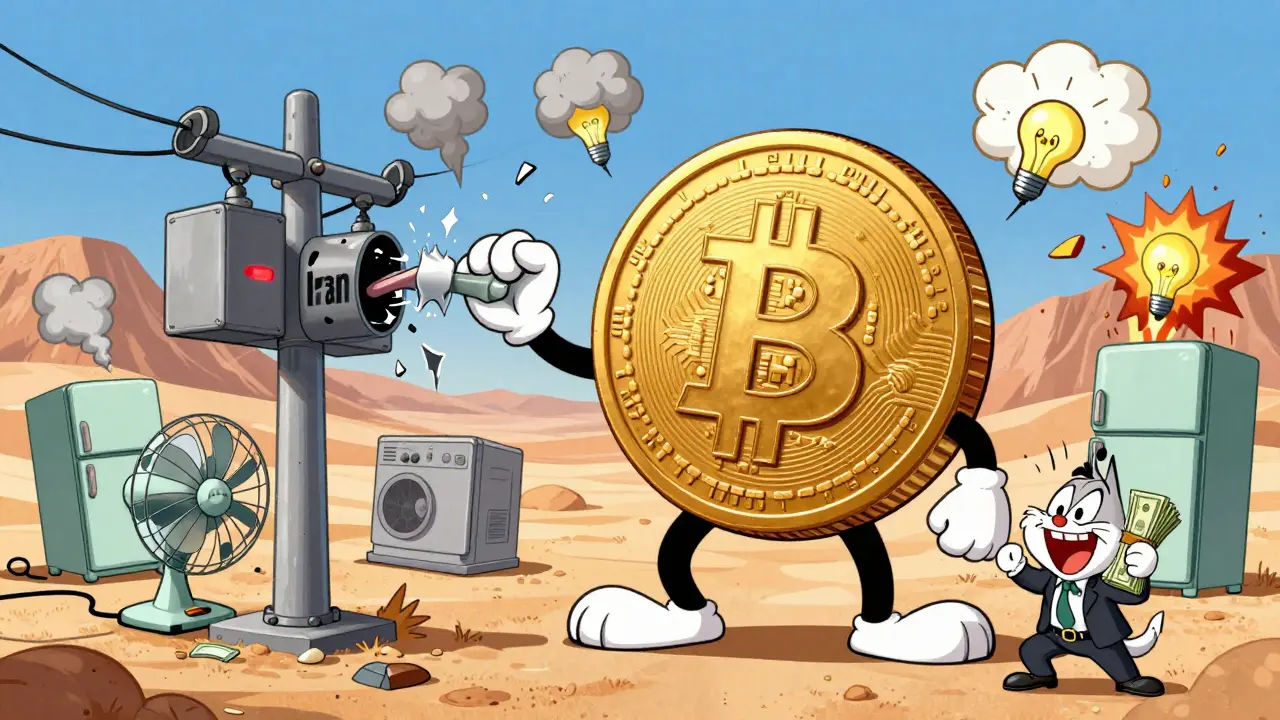
Iran gives its citizens some of the cheapest electricity in the world-so cheap, in fact, that mining Bitcoin costs less than $1,300 per coin. Meanwhile, the average household in Tehran goes without power for 10 hours a day during summer. This isn’t a glitch. It’s policy.
How Iran Turned Electricity Into a Crypto Cash Machine
In 2018, Iran legalized cryptocurrency mining. At the time, the country was reeling under U.S. sanctions. Banks couldn’t process international payments. Foreign currency was scarce. The government needed a way to earn dollars without selling oil. So they turned to Bitcoin. The plan was simple: use cheap, subsidized electricity to mine crypto, then sell the coins abroad for hard currency. The government didn’t raise electricity prices for miners. Instead, they kept household rates at $0.01-$0.02 per kilowatt-hour and gave licensed miners slightly higher-but still absurdly low-rates of $0.04-$0.07. Compare that to Italy, where Bitcoin mining costs $306,000 per coin, or the U.S., where it’s around $8,000. Iran’s subsidy creates a 235-fold cost advantage. By 2025, this system was generating an estimated $1.5 billion a year for Iran’s economy. Around 450,000 to 600,000 miners were running 3.5 to 4.2 million ASIC machines. The Central Bank of Iran (CBI) allowed licensed miners to sell their Bitcoin for trade settlements-bypassing sanctions by buying medicine, food, and machinery from countries like China and Russia. But here’s the catch: the electricity doesn’t come from surplus. It comes from the same grid that powers homes, hospitals, and schools.The Grid Is Breaking
Iran’s power infrastructure hasn’t been properly upgraded since the 1970s. Roughly 60-70% of the grid is operating below capacity. Transformers are old. Transmission lines are overloaded. And now, cryptocurrency mining is pulling nearly 2,000 megawatts of power-equal to the entire electricity demand of Tehran, a city of 9 million people. One Bitcoin miner consumes over 300 megawatt-hours of electricity. That’s enough to power 35,000 Iranian homes for a day. And there are millions of these machines running. During peak summer months, when air conditioning demand spikes by 30-40%, the grid collapses. In July 2025, a nationwide internet blackout shut down over 900,000 illegal mining rigs-and power consumption dropped by 2,400 megawatts overnight. That’s not a coincidence. It’s proof that mining is siphoning off critical capacity. The government admits it. Mohammad Allahdad, a top official at Tavanir (Iran’s power company), said mining accounts for 15-20% of the country’s electricity imbalance. Former Energy Minister Reza Ardakanian warned in 2024 that crypto mining was using up to 10% of Iran’s total generation capacity.Who’s Really Mining?
Not everyone who mines in Iran is a small-time hobbyist. According to reports from the National Council of Resistance of Iran and the Mackenzie Institute, the Islamic Revolutionary Guard Corps (IRGC) controls 55-65% of all mining operations. Some are hidden inside stadiums, warehouses, and even underground tunnels in cities like Ahvaz. These aren’t startups. They’re state-backed operations with access to subsidized power, imported hardware, and direct export channels. Meanwhile, ordinary Iranians pay full price for electricity-only to face 8-12 hours of blackouts daily. On social media, the anger is raw. One Twitter user, @IranEnergyCrisis, wrote: “21 hours of blackouts this week while the IRGC’s mining farms in Ahvaz Stadium tunnels run 24/7-this is economic terrorism against ordinary Iranians.” Reddit threads on r/Iran show 92% of comments blaming mining for outages. Telegram channels like “Iran Electricity Crisis” now post real-time blackout maps that line up perfectly with known mining locations. When Bitcoin’s price jumps, blackouts spike within 48 hours.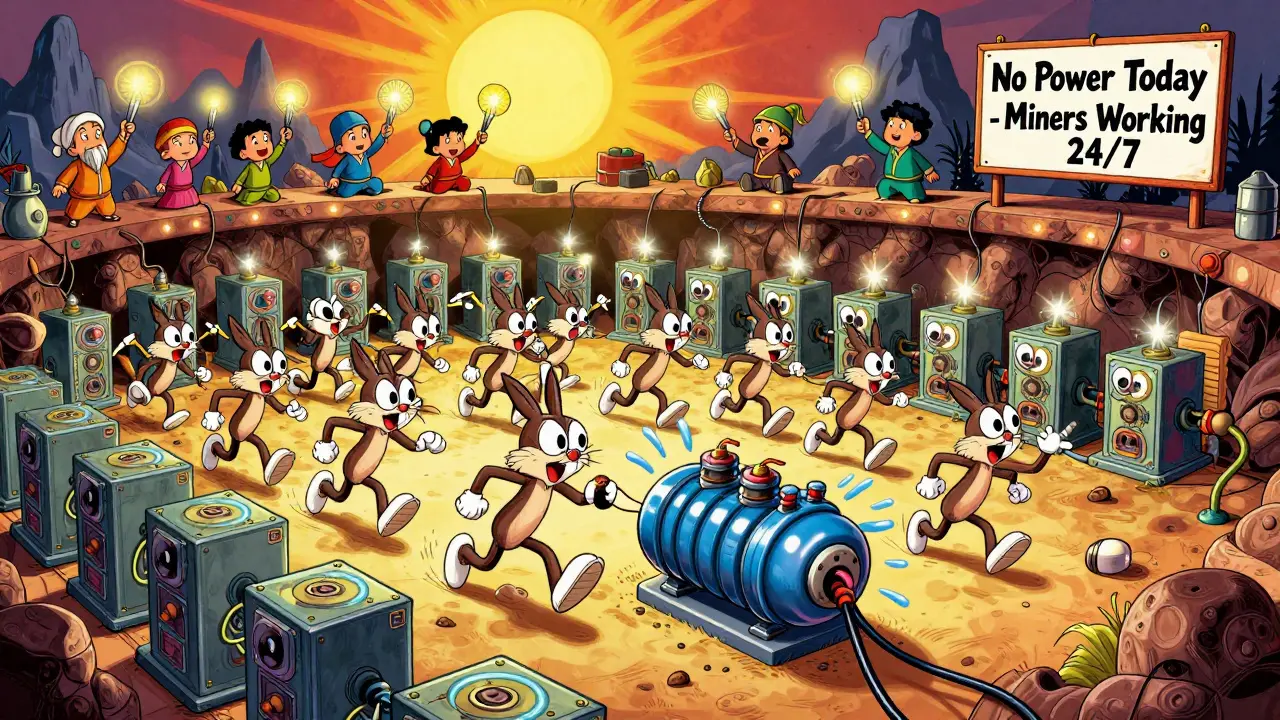
The Rules Are Unfair-and Hard to Follow
The government says it’s trying to bring order. To mine legally, you need four licenses: one from the Ministry of Industry for importing equipment, one from the power company for electricity allocation, one from the CBI to export crypto, and a smart meter installed to track usage. The process takes 3-6 months. Approval rates are below 40%. And even if you get through, you’re stuck with a 15-20% commission fee if you use a state-approved mining pool. So most miners go illegal. They plug into household outlets. They use fake IDs. They pay bribes. And they don’t pay taxes. The government estimates up to 2 gigawatts of power-equivalent to Tehran’s entire usage-is stolen daily by unlicensed miners. To fight back, Iran launched a reward program: citizens get 10% of the recovered electricity cost if they report illegal mining. In the first half of 2025, over 8,400 reports led to 2,157 shutdowns. But the scale is overwhelming. For every rig taken down, ten more pop up.Why This Can’t Last
Iran’s crypto mining model is a short-term fix with long-term consequences. The money earned helps fund imports and bypass sanctions. But the cost? Rolling blackouts. Overheated transformers. Hospitals losing power. Students studying by flashlight. The International Energy Agency predicts that without major grid upgrades, Iran’s power shortages will grow by 25-30% by 2027. The Carnegie Endowment calls this dilemma “a microcosm of Iran’s broader energy policy: short-term gains versus long-term collapse.” Some experts argue the policy is deliberate. Dr. Saeed Laylaz, former economic advisor to President Khatami, said the government created a parallel economy where the IRGC controls both the energy and the crypto output-bypassing the central bank entirely. Others, like Energy Minister Ali Akbar Mehrabian, defend it: “It brings in $800 million in foreign exchange. It offsets the cost.” But that’s only true if you ignore the human cost.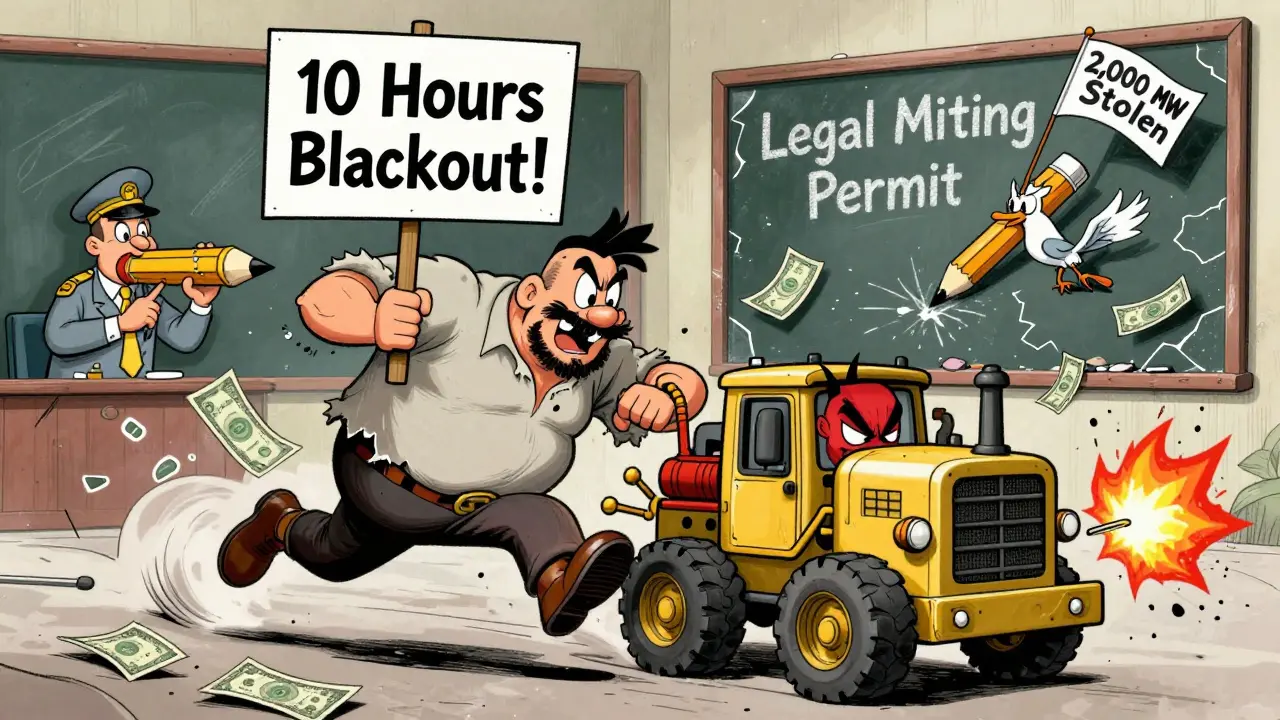
vaibhav pushilkar
December 21, 2025 AT 19:09Iran’s grid is a ticking bomb. Cheap power for mining? Sure. But when families can’t cool their homes, it’s not innovation-it’s theft.
Vyas Koduvayur
December 22, 2025 AT 01:52Let’s be real-the IRGC didn’t start mining to help the economy, they started it to bypass sanctions and fund their entire war machine. The fact that the government even allows this is proof they’ve given up on the people. You think a 15% commission on legal mining is fair? Try living without AC for 12 hours while some underground rig in Ahvaz burns through 200kWh just to turn $1 into $1.02 after electricity costs. The entire system is a pyramid scheme where the only winners are the ones with guns and access to Chinese ASIC factories. And don’t even get me started on how the CBI’s export rules are just a thin veil for money laundering. This isn’t energy policy, it’s state-sponsored kleptocracy dressed up as crypto entrepreneurship.
Lloyd Yang
December 22, 2025 AT 20:50What’s happening in Iran isn’t just an energy crisis-it’s a moral crisis wrapped in circuit boards. Imagine your kid studying for exams under a flashlight while a machine in a warehouse three blocks away is quietly turning your neighbor’s stolen electricity into a billionaire’s offshore wallet. The irony is brutal: the same government that blames the West for sanctions is now using those sanctions as an excuse to weaponize its own people’s basic needs. And yet, the miners keep running. Not because they’re evil, but because the system made them the only viable escape hatch. It’s tragic. We talk about climate change and grid resilience like abstract concepts, but here? It’s real. It’s hot. It’s dark. And the machines? They never sleep.
Sybille Wernheim
December 23, 2025 AT 02:52This is the kind of story that makes you want to scream and hug someone at the same time. The ingenuity of using crypto to bypass sanctions? Brilliant. The cost to ordinary families? Unforgivable. We need to stop seeing this as just ‘Iran’s problem’-it’s a warning shot for every country chasing quick tech wins without thinking about the people behind the power outlets. Let’s not forget: behind every ASIC rig is a child who can’t study, a hospital that can’t run an MRI, a grandmother who can’t breathe in the heat. This isn’t crypto. It’s capitalism with the soul ripped out.
Sarah Glaser
December 23, 2025 AT 16:08The structural imbalance between state-controlled resource allocation and private utility consumption represents a profound failure of distributive justice in post-sanction economic adaptation. The IRGC’s monopolization of mining infrastructure, coupled with the state’s inability to modernize transmission networks, creates a feedback loop wherein illicit extraction is both symptom and cause of institutional decay. The regulatory framework, while ostensibly designed to impose order, functions instead as a rent-seeking apparatus that incentivizes noncompliance through bureaucratic obstructionism. Consequently, the black market emerges not as a deviation from policy, but as its logical extension.
roxanne nott
December 24, 2025 AT 09:50So let me get this straight-people can’t turn on their AC but some dude in a basement is mining BTC with stolen juice? Yeah, that’s not a glitch, that’s just how Iran rolls now. Sad. But also kinda predictable. They’ve been screwing their own people since the 70s and now they’re just doing it with GPUs.
Alison Fenske
December 26, 2025 AT 00:51I keep thinking about the kids in Tehran studying by flashlight while machines hum in the dark… it’s not just about electricity, it’s about dignity. How do you explain to a 10-year-old that their power went out because some guy in a warehouse is trying to get rich off a number no one can touch? This isn’t progress. It’s a slow-motion collapse and we’re all just watching it stream live on our phones while scrolling past it like it’s just another meme
Dusty Rogers
December 27, 2025 AT 08:28The fact that Iran’s government is still pretending this is sustainable is beyond ridiculous. They’re burning through their future to buy a few more months of imports. And the worst part? The people who suffer the most are the ones who had no say in any of it. This isn’t capitalism. It’s feudalism with Bitcoin.
Kevin Karpiak
December 27, 2025 AT 08:58Why are we even surprised? Iran’s always been a kleptocracy. They don’t care about their people. They care about power. And if mining Bitcoin keeps the regime alive, then good. Let them roast. The world should’ve cut them off decades ago.
Helen Pieracacos
December 27, 2025 AT 13:16So the IRGC runs mining farms in stadiums… and the government rewards citizens for ratting them out? That’s not a policy. That’s a reality show where the prize is a few hundred bucks and the villain is literally your neighbor’s WiFi router.
Dustin Bright
December 28, 2025 AT 19:06the fact that people are risking jail to mine btc just to survive… that’s the real tragedy here 🤯 the system broke them and now they’re breaking the grid just to eat. i’m not defending it, but… man. this is what collapse looks like.
Melissa Black
December 29, 2025 AT 02:36The energy arbitrage model deployed by Iran represents a non-linear optimization problem wherein the marginal utility of foreign exchange revenue exceeds the marginal social cost of grid degradation. The IRGC’s vertical integration of mining infrastructure enables rent extraction at scale, effectively privatizing public infrastructure while externalizing the costs of transmission failure. This is not a policy failure-it is a deliberate institutional strategy to circumvent systemic economic constraints through asymmetric resource allocation.
chris yusunas
December 29, 2025 AT 19:57Man, this reminds me of Nigeria’s diesel smuggling days-same energy theft, same silence from the top. The machines don’t care who suffers. They just mine. And the people? They just endure. But hey, at least the crypto’s moving, right? 😅
Naman Modi
December 30, 2025 AT 12:50Wait so the government lets the IRGC mine but cracks down on regular guys? That’s not hypocrisy, that’s just capitalism with a gun. 🤷♂️
Mmathapelo Ndlovu
December 31, 2025 AT 04:59It breaks my heart to think about how many lives are being traded for a few more Bitcoin. But I also wonder… if we didn’t have this obsession with digital gold, would this even be happening? Maybe we’re all complicit. 🌍💔
Ashley Lewis
January 1, 2026 AT 20:52The notion that cryptocurrency mining constitutes legitimate economic activity in a nation with a collapsing infrastructure is not only economically illiterate but morally indefensible. This is not innovation-it is predation masquerading as policy.
Craig Fraser
January 3, 2026 AT 07:42Iran’s entire energy policy is a farce. They blame sanctions, but they’ve had 40 years to fix their grid. Now they’re using crypto as a Band-Aid on a severed artery. Pathetic.
Zavier McGuire
January 5, 2026 AT 03:21so the poor get blackouts and the IRGC gets rich? yeah that tracks. they’ve been doing this since the revolution. just now the machines are louder
Grace Simmons
January 5, 2026 AT 15:22Let us not forget that the Islamic Republic has consistently prioritized military and ideological objectives over the welfare of its citizens. This is not an anomaly-it is the logical outcome of a regime that views its people as expendable.
Collin Crawford
January 6, 2026 AT 02:46It is a well-documented fact that Iran’s energy subsidies are among the most distortionary in the world. The decision to permit cryptocurrency mining under such conditions constitutes a gross violation of economic efficiency principles and a clear indication of systemic governance failure. The Central Bank’s involvement further confirms the state’s role as an active participant in illicit capital flows.