Mining Crypto in China: Law and Restrictions in 2026
 Jan, 29 2026
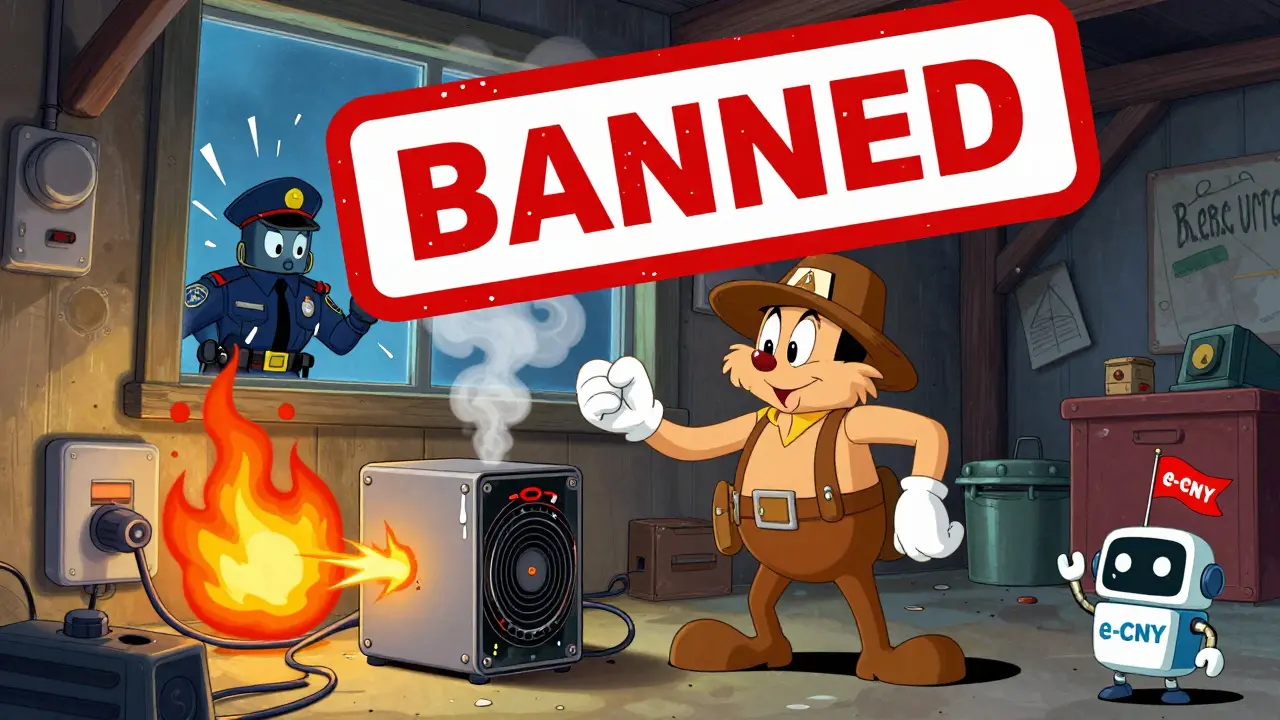
As of 2026, mining cryptocurrency in China is not just discouraged-it’s a criminal act. If you’re caught running even a single rig in your garage, you could face fines, asset seizures, or arrest. This isn’t speculation. It’s the law. And it’s been this way since the government’s comprehensive ban on all cryptocurrency activities took effect on May 31, 2025.
How China Went from Top Miner to Total Ban
Just a decade ago, China controlled over 70% of the world’s Bitcoin mining power. Factories filled with thousands of machines hummed in Inner Mongolia, Sichuan, and Xinjiang, powered by cheap hydropower and coal. But the government didn’t see miners as innovators-they saw them as threats. By 2021, China had already shut down large-scale mining farms and banned cryptocurrency exchanges. Then came the final blow: in 2025, ownership, trading, and mining were all declared illegal. No exceptions. Not even for personal use.Before 2021, regulators targeted big operations. After 2021, they started going after individuals. By 2024, police in Sichuan arrested over 120 people for owning mining rigs. In 2025, the State Administration of Foreign Exchange froze bank accounts linked to crypto purchases-even if the money was used to buy a single ASIC miner.
Why Did China Ban Crypto Mining?
There are four clear reasons behind the crackdown.Energy use. Bitcoin mining consumes more electricity than entire countries like Argentina or the Netherlands. China’s goal is carbon neutrality by 2060. Crypto mining, especially in coal-heavy regions, directly conflicted with that. In 2024 alone, authorities shut down 47 mining farms for exceeding energy quotas.
Financial control. Cryptocurrencies operate outside the banking system. That means the government can’t track money flows, control capital flight, or enforce sanctions. When Chinese citizens started moving billions out of the country using crypto, regulators saw a crisis. The People’s Bank of China responded by making any crypto transaction-buying, selling, or mining-a violation of financial law.
Illicit activity. Crypto has been used in money laundering, ransomware payments, and underground markets. In 2023, Chinese authorities traced over $2.3 billion in illegal transfers through crypto wallets. That number only grew after the 2021 ban pushed more activity underground.
The digital yuan. This is the real endgame. China has spent over $10 billion developing the e-CNY, its central bank digital currency. The government doesn’t want competition. No decentralized coins. No private blockchains. Just one state-controlled digital money system. Every mining rig in the country is seen as a threat to that vision.
How the Ban Is Enforced
The ban isn’t just on paper. It’s enforced with real-time surveillance.Electricity providers now flag unusual power spikes. A household using 50,000 kWh/month in a rural area? That’s a red flag. Authorities cross-check that data with bank records and internet traffic logs. If your router shows connections to mining pools like F2Pool or AntPool, you’re flagged.
Banks are required to block any transaction linked to crypto. Even if you send $100 to a wallet to buy a miner, your account gets frozen. In 2025, over 8,000 bank accounts were frozen for suspected crypto activity.
The Cyberspace Administration scans public forums, Telegram groups, and even private cloud storage for mining software downloads. If you’ve installed CGMiner or Awesome Miner on your PC, that’s enough for an investigation.
Ministry of Industry inspectors also visit electronics retailers. Selling ASIC miners without a license is now a felony. In 2025, 14 shops in Shenzhen were raided for selling mining hardware.

What Happens If You Get Caught?
The penalties are harsh and rising.For first-time offenders, you might get a fine of up to 100,000 RMB (around $14,000 USD) and confiscation of equipment. Repeat offenders face prison time. In 2024, a man in Henan received a 14-month sentence for running a 10-rig setup in his basement. His wife, who helped pay the electricity bill, was also fined.
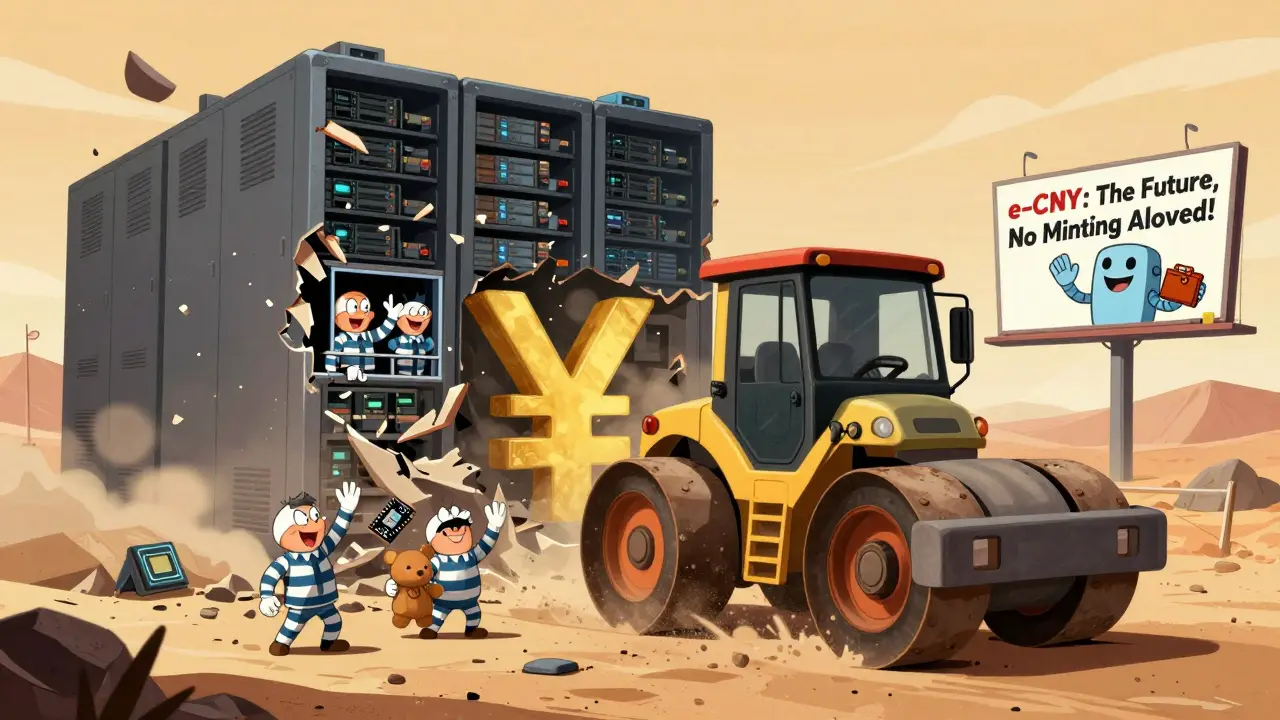
Businesses are hit harder. In 2025, a data center in Inner Mongolia was shut down after being linked to crypto mining. The owner was sentenced to five years and fined 5 million RMB. The facility was demolished.
There’s no legal gray area anymore. Even if you mined crypto before 2021, holding it now is illegal. The government doesn’t recognize crypto as property. Courts won’t protect your coins. If you’re caught with $10,000 worth of Bitcoin, it’s treated like contraband.
Is Any Mining Still Happening in China?
Yes-but it’s risky, small, and fading.Studies from Tsinghua University in late 2025 estimate that underground mining still accounts for about 3% of global Bitcoin hash rate. That’s down from over 40% in 2020. These operations are hidden in warehouses, basements, and even abandoned factories. They run on stolen power or off-grid solar. Some use modified consumer electronics to avoid detection.
But it’s getting harder. Power companies now use AI to detect anomalies. One miner in Guangdong was caught because his solar panel output didn’t match his household usage. The system flagged the mismatch. He was arrested two weeks later.
Even if you avoid detection, the cost of electricity has risen. The government increased rates for high-consumption users by 40% in 2024. Mining rigs now cost more to run than they earn. Profitability is gone.
What This Means for the World
China’s ban didn’t just affect Chinese citizens-it changed the entire crypto world.After the 2021 mining crackdown, miners flooded into the U.S., Canada, Kazakhstan, and Russia. The U.S. became the new mining leader, with Texas alone now hosting more hash power than all of China did in 2020. Mining hardware companies like Bitmain and MicroBT shifted production overseas.
Bitcoin’s network became more secure, not less. With mining spread across more countries, the network is less vulnerable to one government’s actions. But it also became more expensive. Electricity prices in the U.S. rose as demand grew.
China’s ban also accelerated the development of energy-efficient mining tech. New ASIC chips now use 30% less power than those made in 2021. That’s partly because miners had to adapt-or die.
What’s Next for China?
There’s no sign the ban will loosen. The digital yuan is now in use by over 600 million people. The government is testing it for taxes, welfare, and cross-border trade. Crypto is seen as a relic of the past.Future enforcement will focus on AI-driven detection. New tools can now identify mining patterns from just three days of electricity data. Drones with thermal cameras are being used to spot heat signatures from hidden farms.
And the penalties? They’re getting worse. In early 2026, a new draft law proposed life sentences for large-scale crypto mining operations involving over 1,000 rigs. While not yet passed, it signals the government’s intent: total eradication.
Bottom Line
Mining crypto in China today isn’t a gray area. It’s black and white: illegal, dangerous, and financially pointless. The government has spent years building systems to detect, punish, and eliminate it. The infrastructure is in place. The laws are clear. The will is absolute.If you’re thinking about mining in China, don’t. The risks far outweigh any possible reward. And if you’re holding crypto there? You’re holding something the state doesn’t recognize-and won’t protect.
The era of crypto mining in China is over. Not because the tech failed. But because the state decided it couldn’t tolerate competition.
Is it legal to mine Bitcoin in China in 2026?
No. As of May 31, 2025, all cryptocurrency mining, trading, and ownership are illegal in China. This includes personal mining setups, large farms, and even holding crypto in wallets. Violations are criminal offenses and can lead to fines, asset seizure, or imprisonment.
What happens if you get caught mining crypto in China?
If caught, your mining equipment will be seized, your bank accounts frozen, and you may face fines up to 100,000 RMB ($14,000 USD). Repeat offenders or those running large operations can be sentenced to prison. In 2024, over 120 individuals were arrested for personal mining. In 2025, a data center owner received a five-year sentence.
Can you still buy or hold Bitcoin in China?
No. The 2025 ban explicitly prohibits ownership of any cryptocurrency. Courts no longer recognize crypto as legal property. Holding Bitcoin, Ethereum, or any other digital asset is treated as a violation of financial regulations. Authorities can seize your wallet, even if you didn’t mine it yourself.
How does China detect crypto mining?
China uses a three-layer detection system: electricity monitoring (unusual power spikes), financial tracking (bank transactions to crypto exchanges), and digital surveillance (tracking downloads of mining software and connections to mining pools). AI tools now flag suspicious patterns within days. Drones and thermal imaging are also used to locate hidden mining operations.
Why did China ban crypto mining but promote the digital yuan?
The digital yuan (e-CNY) is a state-controlled digital currency. The government wants full oversight of money flow, tax collection, and financial policy. Cryptocurrencies are decentralized, anonymous, and outside state control. China sees them as a threat to its monetary sovereignty. The ban isn’t about technology-it’s about control. The digital yuan is the future. Bitcoin is not.
Are there any underground crypto mining operations still active in China?
Yes, but they’re small, risky, and declining. Estimates suggest underground mining accounts for only 3% of global Bitcoin hash rate, down from over 40% in 2020. These operations use stolen power, hidden locations, and modified hardware. However, detection tools have improved dramatically. In 2025, over 80% of underground operations were shut down within six months of discovery.
Devyn Ranere-Carleton
January 29, 2026 AT 12:30Kevin Thomas
January 29, 2026 AT 14:27Robert Mills
January 30, 2026 AT 03:44Ramona Langthaler
January 30, 2026 AT 20:39Sunil Srivastva
January 31, 2026 AT 12:58Rachel Stone
January 31, 2026 AT 14:12Gurpreet Singh
February 2, 2026 AT 01:58Will Pimblett
February 2, 2026 AT 22:06Christopher Michael
February 4, 2026 AT 10:52Elle M
February 6, 2026 AT 10:38Brianne Hurley
February 7, 2026 AT 05:20christal Rodriguez
February 9, 2026 AT 03:37Tressie Trezza
February 10, 2026 AT 07:13Gustavo Gonzalez
February 11, 2026 AT 01:05Gavin Francis
February 11, 2026 AT 15:29Dahlia Nurcahya
February 11, 2026 AT 18:26Dylan Morrison
February 13, 2026 AT 15:49Lori Quarles
February 13, 2026 AT 18:10Jeremy Dayde
February 14, 2026 AT 06:06josh gander
February 15, 2026 AT 19:31Akhil Mathew
February 16, 2026 AT 08:37Elizabeth Jones
February 16, 2026 AT 23:58Edward Drawde
February 18, 2026 AT 15:39