Payment Services Act Crypto Provisions: Global Requirements & Restrictions Explained
 Jun, 23 2026
The days of operating a cryptocurrency business in the wild west are over. If you run an exchange, a wallet provider, or any service touching digital assets, you are likely staring down a wall of new legal requirements. The landscape has shifted dramatically since 2024. With major jurisdictions like Singapore, Japan, and the European Union tightening their screws, the term "compliance" is no longer just a buzzword-it’s your license to operate.
Right now, as we move through mid-2026, the global regulatory framework for crypto payments is fragmented but increasingly strict. You aren't just dealing with one set of rules; you are navigating a complex web of laws that treat crypto differently depending on where your users sit. Some places view it as a commodity, others as a security, and many as a payment instrument subject to traditional banking laws. Getting this wrong doesn't just mean fines; it means shutting down.
Understanding the Core Regulatory Shift
Historically, regulators tried to shoehorn crypto into existing frameworks designed for stocks or banks. That approach created confusion and enforcement-by-letter rather than clear guidance. The current trend, reflected in acts like the US CLARITY Act and Europe's MiCA, is to create specific categories for digital assets. This isn't about stifling innovation; it's about defining who is responsible when things go wrong.
The central theme across all these new provisions is consumer protection and anti-money laundering (AML). Regulators want to ensure that if you lose money on a hack, or if a platform turns out to be a scam, there is a clear line of accountability. They also want to stop criminals from using anonymous transfers to launder funds. This means every crypto service provider (CASP) must now act more like a bank than a tech startup.
Why are crypto regulations changing so fast?
Regulators are reacting to market volatility, high-profile collapses, and the need to integrate crypto into the formal financial system. The shift from "enforcement by letter" to clear legislative frameworks aims to protect consumers while providing legal certainty for businesses.
Singapore’s FSMA: The Strict Deadline Model
If you have operations in Asia, Singapore’s framework is non-negotiable. The Monetary Authority of Singapore (MAS) updated its Financial Services and Markets Act (FSMA) to bring digital token services under a rigorous licensing regime. The clock stopped ticking on June 30, 2025. There were no grace periods. Any platform offering digital token services without a proper license had to cease operations immediately.
What does this mean for you? First, marketing restrictions are severe. MAS prohibits misleading advertising and requires clear risk disclosures. You cannot target inexperienced retail investors with high-risk products. Second, credit card purchases of cryptocurrencies are banned. This cuts off a major on-ramp for impulsive trading, forcing platforms to rely on bank transfers which are easier to track for AML purposes.
The Travel Rule is another critical component. When processing transfers above certain thresholds, you must share customer information with the receiving platform. This applies regardless of the blockchain technology used. It’s not enough to say "blockchain is anonymous." You must collect and transmit data on both the sender and receiver. Failure to comply here can result in immediate revocation of your license.
- Licensing: Mandatory Digital Token Service Provider (DTSP) license required.
- Marketing: No targeting of retail investors with high-risk tokens; no credit card buys.
- Travel Rule: Strict adherence to sharing originator/beneficiary data for cross-platform transfers.
- Enforcement: Zero tolerance post-June 2025 deadline.
European Union: PSD2 and MiCA Integration
In Europe, the situation is nuanced due to the interplay between the Payment Services Directive 2 (PSD2) and the Markets in Crypto-Assets (MiCA) regulation. As of March 2, 2026, National Competent Authorities (NCAs) are expected to require PSD2 authorization for entities transferring crypto assets as payment services. This is a crucial distinction. If you are moving crypto to facilitate a payment, you fall under PSD2 rules, not just MiCA.
The European Banking Authority (EBA) issued a "No Action" letter to clarify this overlap. During the transition period, NCAs should streamline authorization processes, using information from your CASP application under MiCA to speed up PSD2 licensing. However, once licensed, you face strict operational requirements. Strong Customer Authentication (SCA) is mandatory for accessing custodial wallets that qualify as payment accounts. Think of this like two-factor authentication for every transaction initiation.
Importantly, some activities are excluded. The "exchange of crypto-assets for funds" and "exchange of crypto-assets for other crypto-assets" are defined under MiCA and do not count as payment services under PSD2. So, pure exchanges might only need MiCA authorization, but if you offer stablecoin transfers for payments, you need PSD2 approval too. You must also report payment fraud and maintain cumulative own-funds requirements to ensure you can cover losses.
| Feature | MiCA (Crypto Assets) | PSD2 (Payment Services) |
|---|---|---|
| Scope | Issuance and trading of crypto assets | Transfer of value as payment services |
| Key Requirement | CASP License, Whitepaper disclosure | Strong Customer Authentication (SCA), Fraud reporting |
| Exclusions | N/A | Pure asset-to-asset exchanges |
| Authorization Timeline | Ongoing per member state | Critical date: March 2, 2026 |
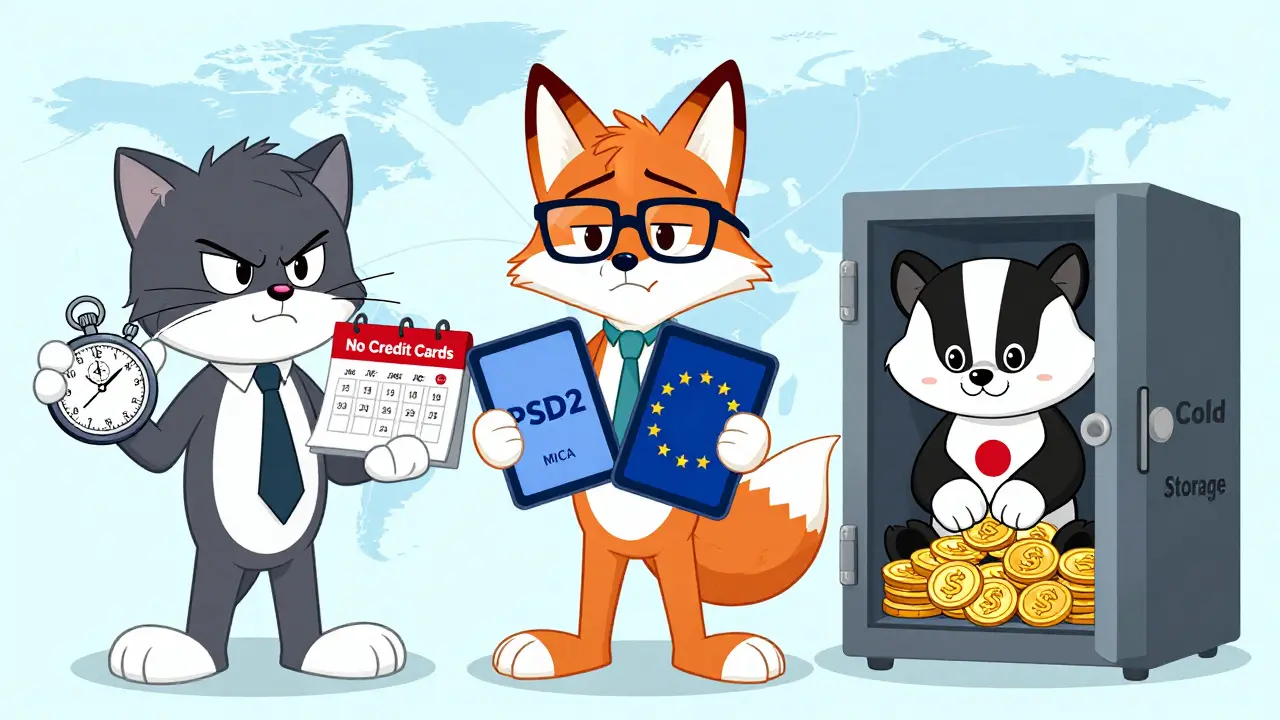
Japan’s Payment Services Act: Cold Storage Mandates
Japan has been a pioneer in crypto regulation since 2009, evolving its Payment Services Act to address emerging risks. The 2019 Amendment was a game-changer, renaming "virtual currency" to "crypto assets" and introducing stricter safety measures. The most notable requirement? Cold wallet storage. By law, exchange providers must store user assets in offline cold storage. This isn't a best practice suggestion; it's a legal mandate to prevent theft from hot wallets.
The 2025 Amendments, approved by the Cabinet in March 2025, further refine these rules. While specific implementation details are still rolling out, the direction is clear: greater transparency and technological adaptation. Japan also introduced a three-tier licensing system (Type 1, 2, and 3) based on transaction volumes and services offered. This allows smaller players to operate with lighter burdens while holding large exchanges to higher standards.
Advertising and solicitation are tightly regulated. You cannot make false claims about profits or stability. Additionally, Initial Coin Offerings (ICOs) that grant rights to profit distribution fall under the Financial Instruments and Exchange Act (FIEA), meaning they are treated as securities. This dual-regulation approach ensures that investment-like tokens get the scrutiny they deserve, while utility tokens remain under the Payment Services Act.
- Cold Storage: Mandatory offline storage for user assets.
- Tiered Licensing: Three types of licenses based on scale and service type.
- Advance Reporting: Changes in handled assets must be reported before implementation, not after.
- ICO Regulation: Profit-sharing tokens are securities under FIEA.
United States: The CLARITY Act and Jurisdictional Clarity
The US approach has long been criticized for "regulation by enforcement," where agencies like the SEC and CFTC fought over jurisdiction. The CLARITY Act (Clarifying Law Around Intent of Congress To Regulate Your) Act aims to fix this by categorizing crypto assets into three buckets: digital commodities, investment contract assets, and permitted payment stablecoins.
This classification determines who regulates what. Digital commodities fall under the Commodity Futures Trading Commission (CFTC), while investment contracts remain with the Securities and Exchange Commission (SEC). Permitted payment stablecoins have their own specific rules. This clarity allows broker-dealers and alternative trading systems (ATSs) to handle digital commodities without fear of sudden SEC intervention, provided they follow CFTC rules.
The Act also modernizes recordkeeping, allowing blockchain technology for books and records. This is a huge win for efficiency, as traditional paper trails don't fit decentralized ledgers. Furthermore, the SEC is directed to coordinate with the CFTC to harmonize oversight, reducing the risk of conflicting regulations. For DeFi projects, the Act provides some exemptions, recognizing that fully decentralized protocols may not have a central intermediary to regulate.

Cross-Jurisdictional Compliance Challenges
Operating globally means juggling these different rulebooks. Singapore demands immediate compliance with no exceptions. Europe offers a streamlined transition but insists on strong customer authentication. Japan mandates cold storage and tiered licensing. The US provides clarity but splits authority between two agencies.
The biggest challenge is technical implementation. Your systems must support Travel Rule data sharing for Singapore, SCA for Europe, and cold storage integration for Japan. This requires significant investment in infrastructure. You can't use a one-size-fits-all solution. You need geofencing capabilities to apply local rules to local users. For example, a user in London sees different product offerings and verification steps than a user in Tokyo.
Consumer protection standards also vary. Singapore bans credit card buys. Europe focuses on fraud reporting. The US emphasizes investor education. Your marketing team must navigate these differences carefully. A campaign that works in New York might get you fined in Singapore. Legal review of all communications is essential.
Next Steps for Crypto Service Providers
If you haven't already, audit your current operations against these frameworks. Identify which jurisdictions you serve and map out the specific requirements for each. Prioritize licensing applications, especially for regions with hard deadlines like Singapore. Invest in technology that supports modular compliance, allowing you to toggle features based on user location.
Engage with legal experts who specialize in fintech and crypto regulation. These laws are complex and constantly evolving. Staying informed is part of your job. Join industry associations to advocate for reasonable regulations and share best practices with peers. Compliance is expensive, but it’s the price of admission to the legitimate financial system. Ignoring it is not an option anymore.
What happens if I miss the Singapore FSMA deadline?
You must cease all digital token services immediately. MAS stated there are no extensions or grace periods. Operating without a license can lead to severe penalties, including criminal charges and permanent bans from the industry.
Do I need PSD2 authorization if I only trade crypto?
If you only exchange crypto for crypto or crypto for fiat, you generally fall under MiCA, not PSD2. However, if you offer payment services using stablecoins or transfer crypto as a means of payment, you likely need PSD2 authorization starting March 2, 2026.
How does the CLARITY Act affect DeFi?
The CLARITY Act directs the SEC to consider exemptions for certain decentralized finance activities, recognizing that fully decentralized protocols lack a central intermediary. However, projects with centralized elements may still face regulation.
Is cold storage mandatory in Japan?
Yes. Since the 2019 Amendment, Japanese exchange providers are legally required to store user crypto assets in offline cold wallets to protect against hacking and theft.
Can I use credit cards to buy crypto in Singapore?
No. MAS regulations prohibit credit card purchases of cryptocurrencies to prevent excessive debt among retail investors. Only bank transfers and other traceable methods are allowed.